LLMs
86 stories filed under LLMs on Beyond Market Intelligence. The newest of them: “Small open models match top AI on Swedish medical exams”, “Six frontier LLMs show measurable left-leaning bias across eight fairness benchmarks”, and “How AI masters new math problems reveals its true reasoning potential”. A 4-billion-parameter model just hit 87% on Swedish medical licensing questions, matching what o3 scored months ago. Six frontier models walked into a bias benchmark, and the results defy the usual left-right script. Acme AI is the next-generation, AI-powered spreadsheet platform built to replace Excel and redefine how analysts, data scientists, and enterprise teams work… The list below is every LLMs story on Beyond Market Intelligence, newest first.
Small open models match top AI on Swedish medical exams
A 4-billion-parameter model just hit 87% on Swedish medical licensing questions, matching what o3 scored months ago. That's worth pausing over. The gap between open-weight models and frontier systems is closing faster than most expected. Qwen3.5-4B, with reasoning enabled and no post-training, nearly matches a model that was state of the art in 2025. The early exit trick from the S-GRPO paper is a smart fix for those looping reasoning traces, and it works.
Six frontier LLMs show measurable left-leaning bias across eight fairness benchmarks
Six frontier models walked into a bias benchmark, and the results defy the usual left-right script. In a solo evaluation spanning roughly 20,600 examples across eight datasets, GPT-5.4, three Claude variants, two Gemini models, and Grok 4.3 were tested on political, gender, and racial bias. The standout finding: Grok self-identifies as right-leaning, yet behaves left-leaning when classifying content or answering policy questions. Refusal rates on race-related questions also varied sharply, with GPT-5.4 declining 20.3% of the time.

How AI masters new math problems reveals its true reasoning potential
The IMO 2026 benchmark results reveal a clear hierarchy: frontier models like sol and fable handle the math olympiad with near-perfect scores, while others, including sonnet and opus, lag without a harness. We tested AutoFyn, our multi-agent system, and it consistently boosted performance, though it couldn't close the gap to the top tier. Hallucinations persist, even in verifiable domains, as seen with sonnet's false solution on P3. For those exploring practical AI applications, our guide on distributed training offers a grounded starting point.

Move from Model Logic to Context Engineering for Faster Root Cause Analysis
The debate over root cause analysis is shifting. Engineers increasingly argue that modern LLMs can reason through the problem effectively, provided the context is prepared correctly. The real challenge, they say, lies in the pipelines that correlate telemetry. A Coroot experiment across eleven models offers early evidence for this claim. It is a pragmatic reframing of where the work actually happens. For those exploring how AI understands complex systems, this pairs well with our earlier piece on questioning AI's limitations.

How AI Memory Can Learn What Truly Matters to You
Most AI memory systems assume recency equals relevance. That assumption fails when what matters most is what you actually use. A usage-reinforced decay engine built on the Ebbinghaus forgetting curve walks through a smarter approach. It's a practical rethinking of how LLMs should prioritize memory, one that prioritizes salience over novelty. For those already exploring how AI structures knowledge, it pairs naturally with our guide on distributed training. This is a thoughtful, human-centered fix for a real limitation.
How Expedia's AI Observability Platform Helps Engineers Investigate Faster
When a production incident hits, every minute of investigation matters. Expedia Group's STAR platform cuts through the noise by pairing service telemetry with large language models, giving engineers a structured path to root cause analysis. Built on FastAPI and Datadog, it keeps humans firmly in control while accelerating response times. That balance matters. For more on how AI assists in complex technical work, our related piece, "Unlock LLM Training: A Practical Guide to Distributed Algorithms," offers a deeper look at the underlying mechanics.
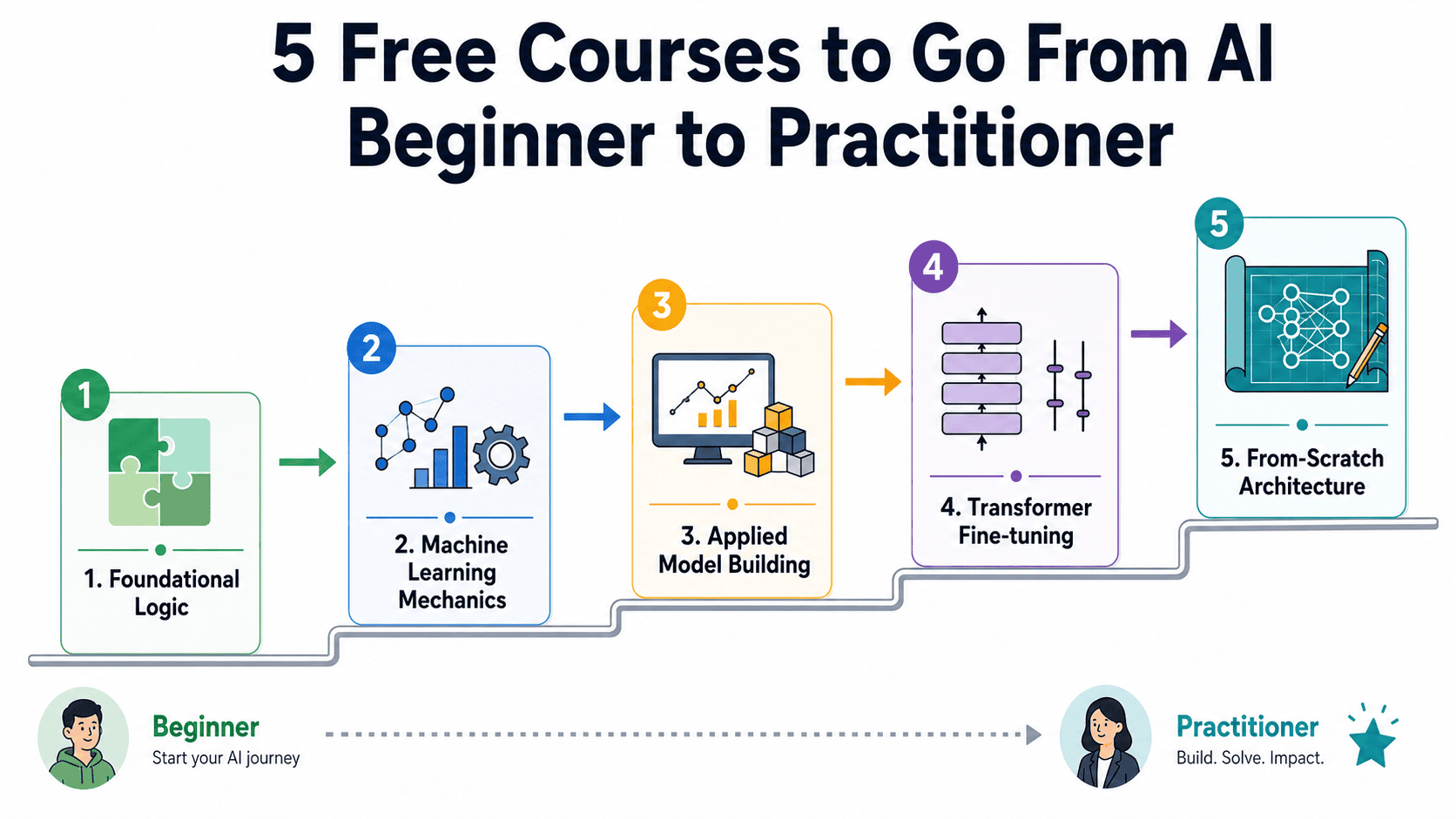
From AI fundamentals to LLMs: a free five-course roadmap
A five-course roadmap won't just hand you theory; it walks you from classical algorithms to training LLMs from scratch. That's the kind of practical progression that turns curiosity into real capability. If you've been hesitant about where to start, this is your entry point. And once you grasp the mechanics, you might find our piece on questioning AI clones a useful counterweight to the technical rush. Explore the courses, build the skills, and let the work speak for itself.
Beyond language: How JEPA aims to close the gap between answering and doing
LeCun's point lands well: an LLM can describe the physical world without truly modeling it. That gap between explaining and doing is the real challenge. His push for JEPA as a path forward is compelling, but it raises a fair question. Are we chasing an architectural fix, or just hoping for a magic bullet that isn't in our toolbox yet? It's a worthwhile tension to explore. For more on how AI handles understanding, check out "Verify Your AI's Understanding: A Simple Check for Tax Season."

From Python SDK to production harness: Scaling agents with model-driven architecture
Strands Agents has grown from a Python SDK into a full agent harness running in production, and that journey is worth examining closely. Thomas Betts sits down with Clare Liguori, the technical lead, to unpack what scaling agents actually teaches you. Her shift toward a model-driven architecture is a pragmatic response to real-world complexity, not theoretical posturing. As LLMs improve, the questions shift from "can we" to "how reliably." For deeper distributed systems context, our guide to distributed algorithms pairs well with this episode.

Give your AI agents a single source of truth for business data
Pinecone's Nexus Engine is now generally available, and it's a practical answer to a messy problem: enterprise data that sits scattered and unstructured. Nexus compiles that business context into a queryable layer, so AI agents stop guessing and start working from curated knowledge. Teams ingest once, then reuse that context across agents, cutting token costs while boosting accuracy. That's a meaningful step toward tools that actually understand the work. For more on where this tech leads, our guide to distributed training offers useful context.

Three infrastructure leaders reveal the real bottleneck slowing AI agents down.
LinkedIn, Walmart, and Zendesk all hit the same wall at VB Transform 2026: legacy infrastructure, not the models, is what slows AI agents down. Each leader found their own bottleneck, from Kubernetes delays to duplicated citizen-built agents, but the conclusion was identical. Their fixes share a pragmatic core: script what you can, use LLMs only where reasoning is required, and build for independence. The real engineering isn't in the model; it's in the harness around it.

Scale Your AI Agents with Postgres's Native Multi-Modal Power
Postgres has quietly become the backbone for production AI, and Gwen Shapira's session makes a compelling case for why that matters. She shows how teams are moving beyond toy demos, using Postgres's JSONB parsing and high-recall HNSW indexing to ground LLMs in both deterministic and semantic context. The 4x speedup from vector quantization is a practical win, but the real insight is managing agentic memory without losing reliability. For those exploring distributed training challenges, our guide on distributed algorithms pairs well with this foundation.

Continuous Evaluation Keeps Your RAG Systems Reliable and User-Ready
A production RAG system isn't a set-and-forget deployment. It's a living thing, and like any living thing, it drifts. That's why this practical guide focuses on building an evaluation workflow that catches retrieval failures, hallucinations, and performance drift before they ever reach your users. It's about moving from hoping your system works to knowing it does. For those ready to go deeper into the underlying mechanics, our guide on distributed training offers a solid foundation. But start here, where trust is built continuously.

Stop parsing JSON manually and let AI handle structured data output
If you're tired of wrestling with JSON schemas and manual parsing, this guide is for you. It demonstrates a cleaner path: using Pydantic with OpenAI to get structured outputs directly from LLMs. The approach removes the fragile, time-consuming busywork, letting you trust the model's response instead of second-guessing every field. It's a practical shift toward more reliable data handling. For those ready to move beyond basic prompting, this is a solid next step.