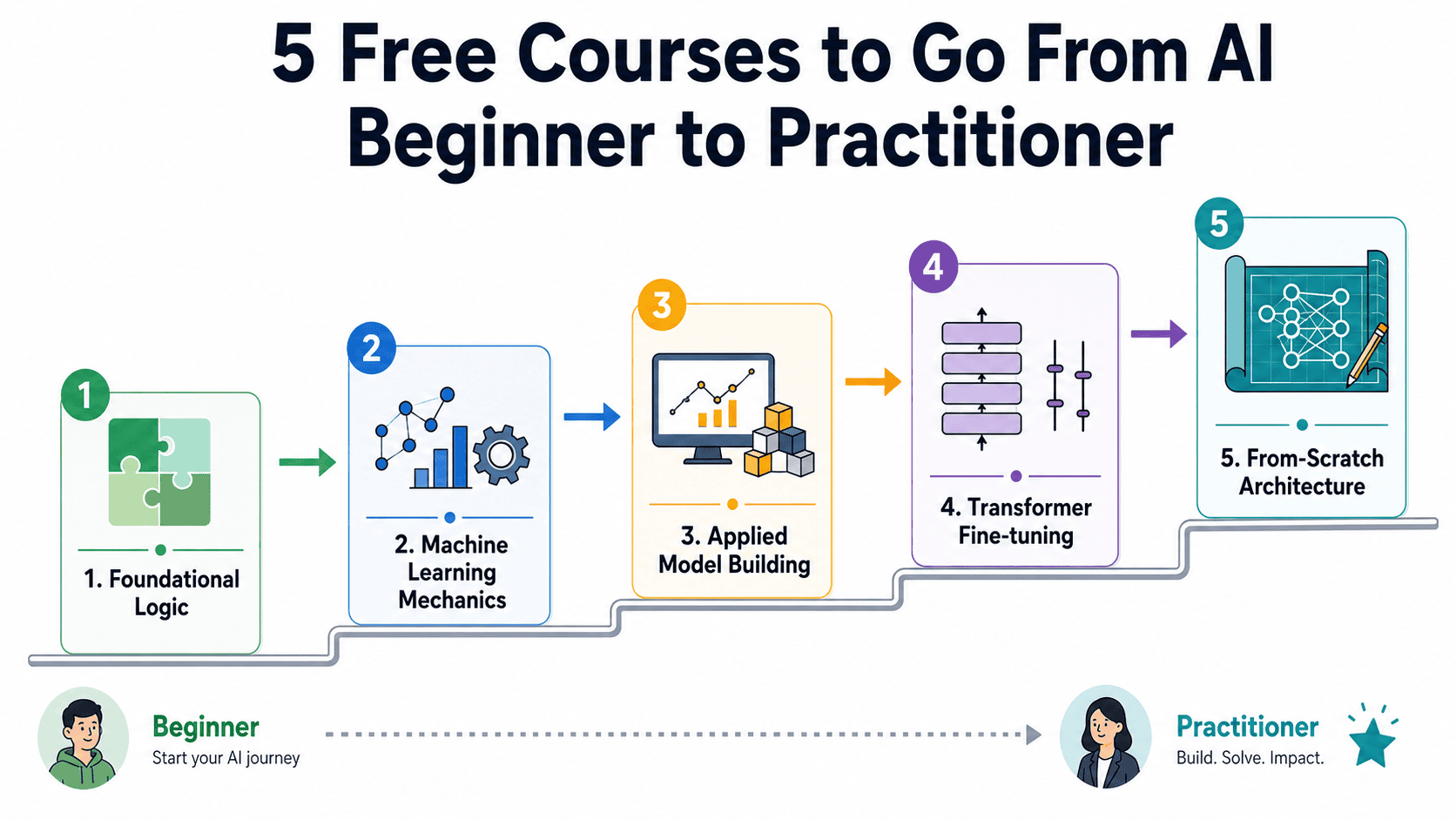
The promise of going from AI beginner to practitioner in five free courses is an ambitious one, and it's the kind of roadmap that deserves a hard look. For anyone who has felt the quiet panic of watching the industry move faster than their own skill set, this curated path from classical algorithms to training large language models from scratch is a pragmatic answer to a very real problem. It doesn't ask you to buy a degree or wait for a corporate training budget. It simply says: start here, and keep moving. That's a message we can get behind, because the barrier to entry has never been about intelligence, but about access to a structured on-ramp.
We've written before about the emotional weight of this technology, whether it's the strange experience of Talking to My AI Clone Taught Me to Question the Tech or the practical necessity of understanding Unlock LLM Training: A Practical Guide to Distributed Algorithms. Those pieces touched on the same underlying truth: this field is not about memorizing terms, it's about building the mental models to know what's happening under the hood. A free course list that moves from foundational algorithms to the mechanics of LLMs is effectively asking you to do the same thing, but in a structured, sequential way. It's not a shortcut; it's a scaffold. And for our readers who are tired of tutorials that skip the hard parts, that distinction matters.
Our honest take is that most people don't need more information, they need more discipline. The courses are free, but the real cost is your attention and your willingness to struggle through the parts that don't immediately produce a flashy demo. The roadmap forces you to confront the fundamentals, which is exactly where most self-taught practitioners have gaps. If you've ever nodded along to a video about transformer architecture only to freeze when asked to explain the attention mechanism, you already know the feeling. This path is the antidote to that, because it assumes you are serious enough to start from the beginning, even when you're eager to get to the good stuff. That's a mature way to approach learning, and it's one we respect.
The specific takeaway here is that you don't need to wait for a perfect moment or a paid certification to begin. Pick a starting point, commit to finishing the sequence, and let the work itself teach you where your understanding is thin. We'd tell any reader who asks us that they want to break into AI: stop looking for a single magic resource and start treating this roadmap as a contract with yourself. The real test isn't finishing the courses, it's what you build after you finish. Watch to see if the next wave of practitioners emerges from those who took the free path and then pushed beyond it, because that's where the actual transformation happens.