quantization
14 stories filed under quantization on Beyond Market Intelligence. The newest of them: “From naive GEMM to FlashAttention: a free code-first GPU kernel series”, “Two Metrics That Fix What Every Quantization Guide Misses”, and “Build the Engines Behind Fast LLMs With These Hands-On Projects”. Most GPU kernel tutorials treat optimization as a black art. Ten quantization guides, and not one threshold-dependent metric between them. Acme AI is the next-generation, AI-powered spreadsheet platform built to replace Excel and redefine how analysts, data scientists, and enterprise teams work… The list below is every quantization story on Beyond Market Intelligence, newest first.
From naive GEMM to FlashAttention: a free code-first GPU kernel series
Most GPU kernel tutorials treat optimization as a black art. This series opens it up. The insight that performance is a data-movement problem first, compute second, reframes everything. Building FlashAttention from scratch, where tiling avoids writing the full attention matrix to memory, is a perfect worked example. The 44-session roadmap covers GEMM through Hopper architecture, with live profiling at every step. If you write production kernels, this is the kind of resource worth contributing feedback to.
Two Metrics That Fix What Every Quantization Guide Misses
Ten quantization guides, and not one threshold-dependent metric between them. That's a telling gap, because without those numbers, quantization remains a black box, optimizing for theoretical efficiency while ignoring what shapes real-world accuracy. Two metrics close the blind spot, and once you see them, the old guides feel incomplete. For readers already questioning hidden assumptions in AI workflows, our earlier piece on whether you still own AI-written code explores a parallel tension worth your time.
Build the Engines Behind Fast LLMs With These Hands-On Projects
Latency defines the LLM experience, and the fastest way to understand it is to build it yourself. These hands-on projects move past theory, putting you behind the engine to see exactly where speed is won and lost. It is direct, practical work that transforms abstract performance concepts into tangible skill. If you are also curious about rethinking core learning methods, our exploration of physics-inspired approaches without backpropagation pairs naturally with this builder's mindset.
Running AI detection fully client-side with a fraction of the original size
Two open-source AI detectors, stripped of unnecessary bulk and running entirely in your browser. Rita Bratamaiti compressed a 500 MB text model to 97 MB and a ViT image detector to 26 MB, then got both working client-side with ONNX Runtime Web. No uploads, no servers. A text check takes about 60 milliseconds on a laptop. It is a practical, transparent approach to AI detection, and one that respects your privacy.
Precision scoring models that skip text generation for faster decisions
Precision scoring models that skip text generation are making faster decisions possible, and the latest v2.1 updates to the 27B and 9B Jebadiah models show real progress. Treating a decision as a closed-set scoring problem eliminates parsing and sampling entirely. The results speak clearly: the 27B jumped to 57.03 on the Decision Index, with strong gains in knowledge, language, and retrieval. The tool-use regression on When2Call is worth investigating, though.
Smaller model, sharper reasoning: 44M parameters trained from scratch on CPU
Three weeks ago, SHADOW-250M proved a 60 MB model could retrieve records from disk. Now, SHADOW-50M pushes the same idea further: 44M parameters, 19.8 MB, and roughly 1,900 tokens per second on a laptop CPU. It reasons over what it retrieves, runs arithmetic through a fixed circuit, and answers from memory without re-reading source text. It loses to larger models on standard benchmarks, and the author says so plainly.
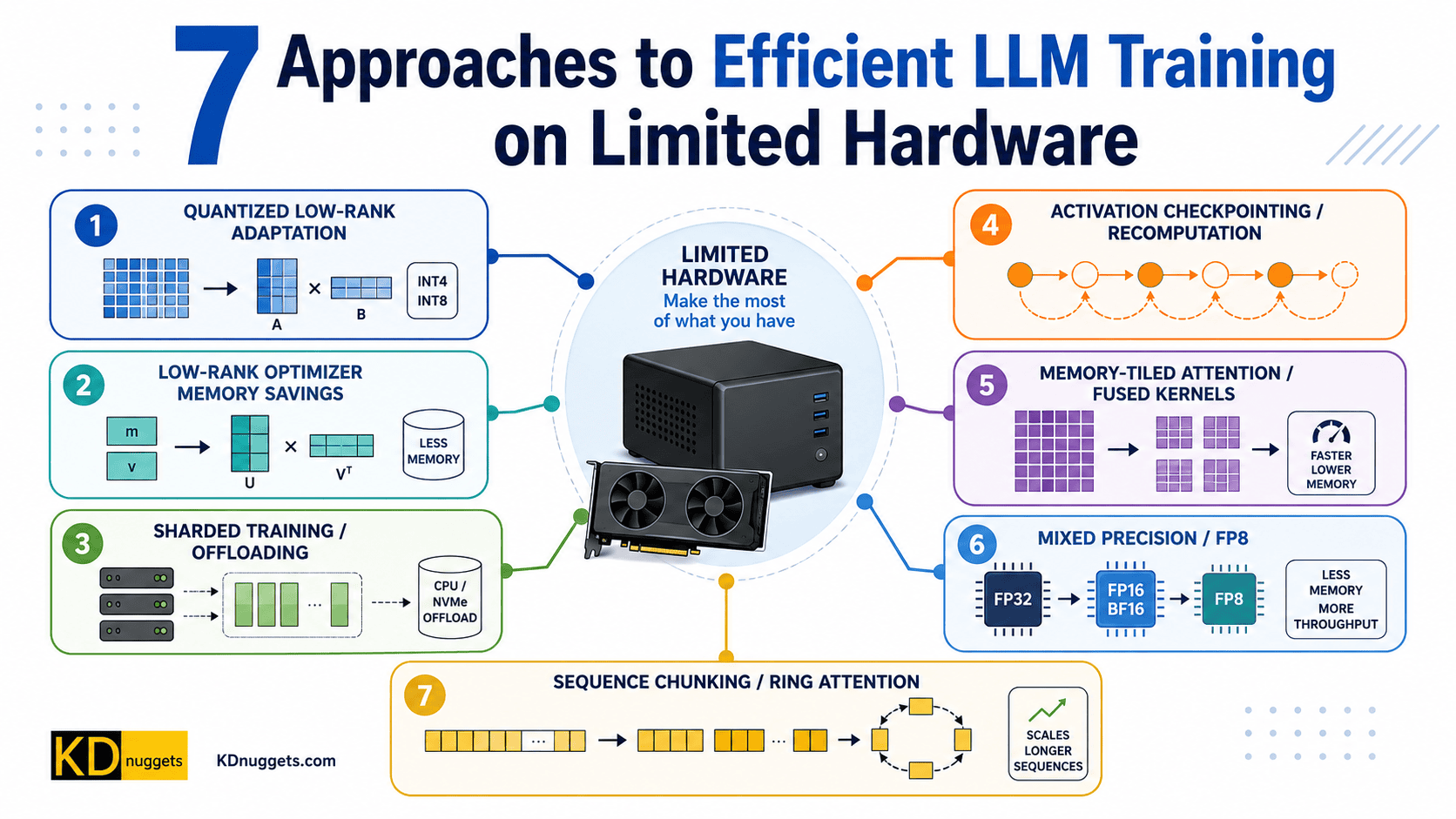
Seven Techniques to Train LLMs on Consumer Hardware
Training a large language model used to mean renting a server farm or settling for someone else's API. This guide challenges that assumption with seven practical engineering techniques for consumer GPUs, proving that memory limits are a constraint to design around, not a wall. It's a grounded, hands-on read for builders who want the control of training their own models.
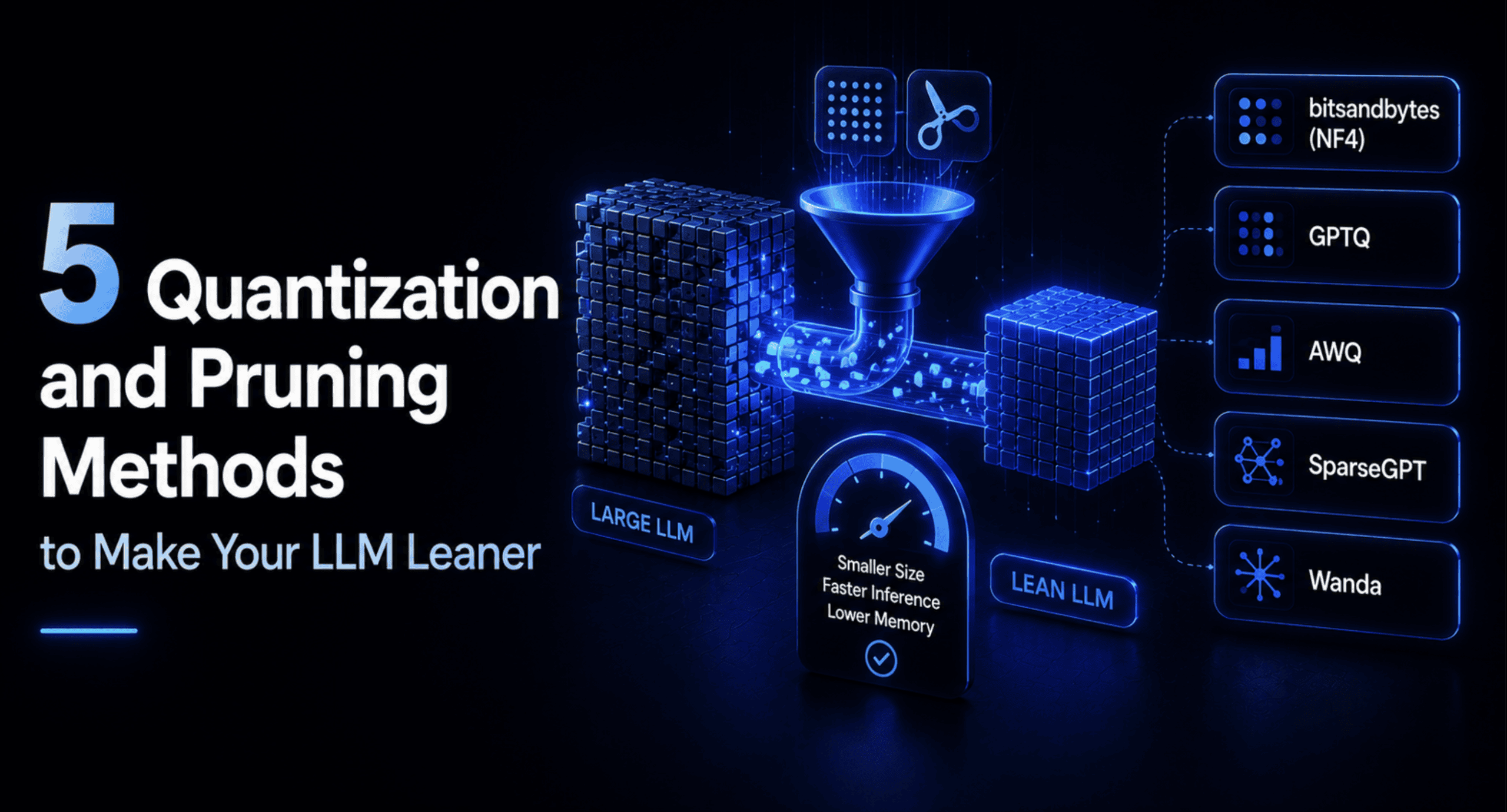
Five Production Methods to Make Your LLM Leaner and Faster
Every parameter in your model costs money, and too many of them mean your inference bill climbs with every prompt. Quantization and pruning are how you cut that weight without gutting performance, and skipping them leaves you paying for latency you do not need. Quantization and pruning cut model weight without gutting performance, and five production methods demonstrate how. If you are still unpacking how distributed systems shape model training, our guide to distributed algorithms pairs well with this one.
Compact AI runs 400 tokens per second on a laptop CPU with 60 MB
A 250M parameter model that runs at 400 tokens per second on a laptop CPU, no GPU required, is a practical statement about efficiency. The 60 MB deployment, achieved through sub-2-bit quantization, and the 1-bit disk cache for long context are the technical details that matter here. The developer trained it on 30B tokens and built a vocabulary from fixed 512-bit codes, which is an unusual choice that shows in the WordSim-353 scores.
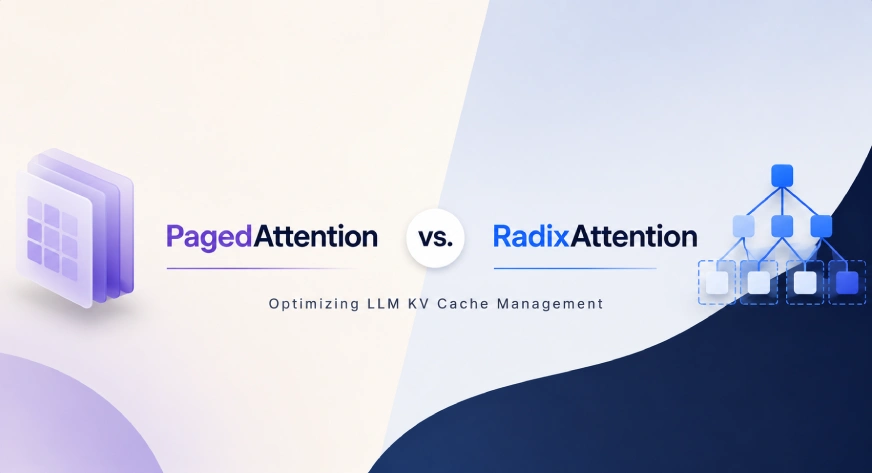
Unlocking LLM Performance Through Smarter Memory Management
KV cache memory can quietly decide whether an LLM deployment thrives or stalls. PagedAttention tackles fragmentation with smarter allocation, while RadixAttention targets prefix reuse. Both cut the GPU strain that limits concurrency and throughput. What stands out is how practical these optimizations feel. Production latency improves without demanding new hardware. For readers exploring how context shapes model behavior, our piece on agentic context learning pairs well with this discussion. It is a useful next step for understanding what makes modern LLMs efficient beyond raw architecture.

Generating 32x32 images from a microcontroller with 264KB of RAM
Training an image diffusion model on a microcontroller with 264KB of RAM is a bold experiment, and the results are honest about the tradeoffs. The Shrike lite's FPGA added parallel INT8 MAC engines, but the memory wall from I/O operations made it slower than the MCU alone, at 220 seconds per image versus 70. That contrast is a useful lesson in hardware bottlenecks. Many outputs were noisy, yet some images landed.

Qwen3.8-27B brings powerful local AI agents to your own machine
The 27-billion-parameter model from Alibaba landed quietly on Hugging Face, but developers heard it loud and clear. Qwen3.8-27B isn't just another compact local model; it brings coding agents, image understanding, and a 262,144-token context window to hardware you might already own. Third-party tests now match it with cloud-only systems from months ago. That gap is closing faster than expected, and for enterprises watching data privacy and cost, the appeal is obvious. It's worth exploring how this changes what "local" really means.
One shared encoder, seven heads: training a unified security classifier
Masked losses are the quiet workhorse behind multi-task models, and this team's self-test for zero gradients on absent tasks is a genuinely smart safeguard. It caught two subtle bugs, which is exactly why you write those checks. The unified encoder's routing head lags at 0.916, and the semantic overlap there feels like a data problem, not a modeling one. We'd point curious readers to our related piece on deduplication stages, since both tackle messy real-world data pragmatically.
Ternary decomposition frees LLM compression from fixed-size limits
Fixed-size ternary matrices were the wall. ExTernD walks around it. The approach decomposes a weight matrix into two ternary matrices with a diagonal scaling matrix between them, and because that inner rank can grow, accuracy stops being a ceiling. It is a direct answer to a limitation most PTQ work treats as a given. The trade-off is a modest VRAM increase over current quantization methods. For the accuracy retained, that cost is easy to justify. This is practical progress, not a promise.