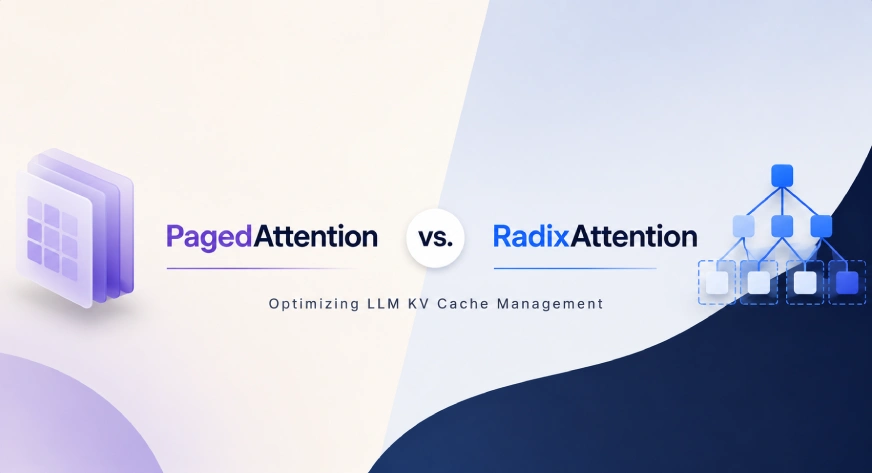
Behind most production LLM slowdowns, the real bottleneck is rarely the model itself. It is the key-value cache eating GPU memory as context windows stretch. The comparison between PagedAttention and RadixAttention is worth sitting with, because it reframes how we should think about performance: not as a hardware problem, but as a memory management problem. PagedAttention tackles fragmentation by treating cache blocks like virtual memory pages, improving allocation efficiency. RadixAttention takes a different route, reusing shared prefixes across requests so identical context is not recomputed or stored twice. Together, they point to a future where speed comes from smarter caching, not bigger chips.
This matters more than the latest quantization trick or a faster attention kernel, because those optimizations hit a ceiling when the cache itself is the constraint. For teams building agentic workflows or long-document tools, the practical takeaway is direct: your latency and throughput are decided by how well you manage what the model has already seen. We have written before about how AI agents learn by editing context, not model weights, and that idea lands harder when you realize the cache is the context. If you are reusing long system prompts or shared instruction sets, RadixAttention gives you a structural advantage. If your workload is more varied, PagedAttention's memory efficiency buys you higher concurrency. These are not competing philosophies so much as complementary tools for different usage patterns.
What we appreciate about this framing is that it moves the conversation away from model capability and toward operational design. Most practitioners do not need to choose between the two; they need to recognize which bottleneck applies to them. If you are constantly hitting out-of-memory errors under load, PagedAttention style allocation is your lever. If you are seeing redundant compute on repeated prompts, prefix reuse is your win. That is a more honest and useful way to evaluate infrastructure than chasing benchmark scores. It also connects to a broader theme we have explored in how LLMs navigate token space, where structure, not just scale, determines what is efficient. Cache management is just another layer of that structure.
If a reader asked us what to do with this information today, we would say this: audit your workload for repetition and memory fragmentation before you buy more GPUs. The gains from these techniques are not theoretical, but they are also not automatic. You have to match the strategy to your traffic patterns. The open question to watch is whether future systems will blend both approaches, combining page-level allocation with semantic prefix reuse, or whether one will dominate for general use. That is the detail we will be tracking, because it will tell us whether we are heading toward a unified standard or a fragmented toolbox.