scikit-learn
scikit-learn on Beyond Market Intelligence: a running collection of 6 stories we have gathered and hand-picked because they are worth your time. Every post here touches on scikit-learn in some way — the news, the analysis, the deep dives, and the occasional surprise find. Acme AI is the next-generation, AI-powered spreadsheet platform built to replace Excel and redefine how analysts, data scientists, and enterprise teams work with data. New stories are added to this page as we find them, so check back if you want to keep up with what is happening around scikit-learn, or subscribe to the RSS feed to get them as soon as they are published. Browse the collection below, or head back to the homepage to see everything Beyond Market Intelligence is covering right now.
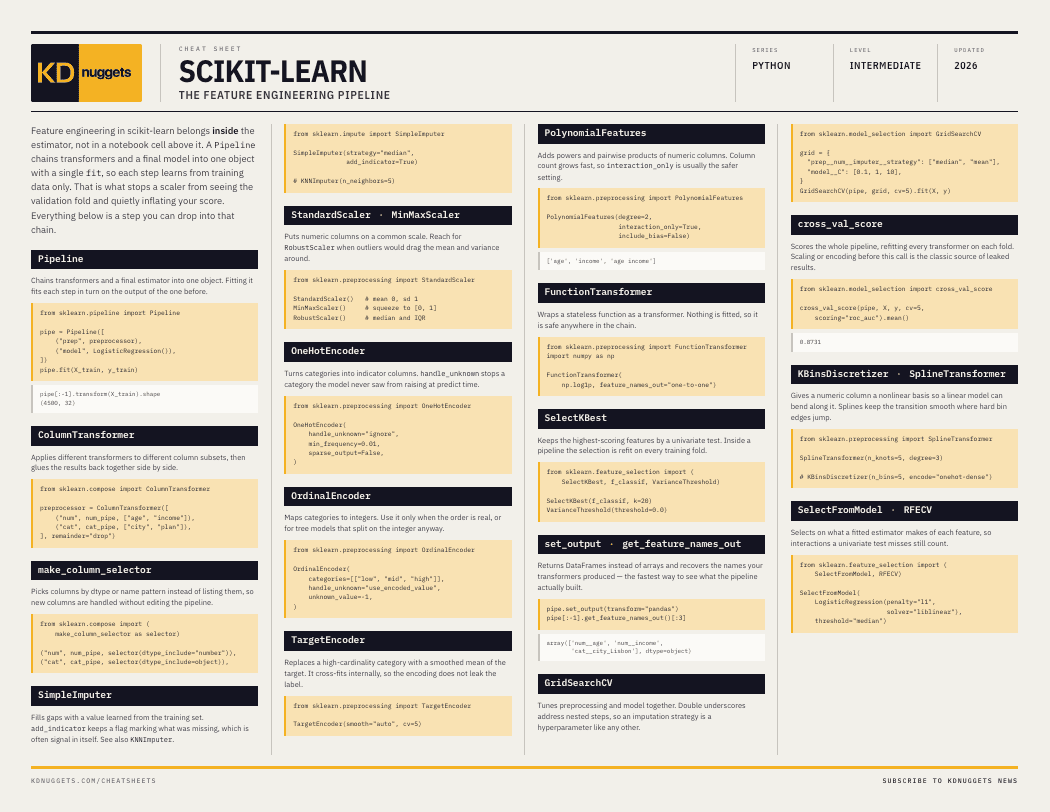
Feature Engineering in Scikit-Learn: A KDnuggets Cheat Sheet
Mastering feature engineering is critical for maximizing model performance, and Scikit-Learn provides powerful tools to streamline this process. This KDnuggets cheat sheet clarifies a key concept: when feature engineering resides within a Pipeline, transformations are fitted solely on training data, ensuring accurate scoring. Understand how this approach optimizes your models and unlocks their full potential. For a deeper dive into building robust AI solutions, explore our article, "Build an AI Data Analyst That Thinks Like a Senior Analyst," and discover a six-stage pipeline for verification.
py-evoFE: Automated Evolutionary Feature Engineering for Tabular ML in Python (Genetic Algorithms + Scikit-Learn + Polars) [P]
Announcing py-evoFE (v0.3.0), an open-source Python library designed to automate and optimize feature engineering for tabular machine learning. Leveraging genetic algorithms alongside Scikit-Learn and Polars, py-evoFE intelligently discovers and combines feature transformations, addressing a critical bottleneck in model development. Unlike brute-force methods that generate excessive, noisy features, py-evoFE employs evolutionary selection to produce compact, high-impact recipes.
Catching bugs in scikit-learn [D]
Scikit-learn users, be aware: version 1.9 includes a fix for a subtle bug in the BayesianRidge uncertainty calculation. Keen observers can now explore this firsthand through a fascinating bug-hunting exercise. The provided notebook [https://github.com/aadya940/scikit-verify/blob/master/examples/sklearn_bug_hunting.ipynb] challenges you to identify the formula change between versions 1.8 and 1.9 before revealing the solution. For those seeking to maximize their coding agent efficiency, consider "How to Effectively Solve 100+ Tasks with Claude Code" for deeper insights.
Build an End-to-End Data Science Project with Grok Build and Grok 4.6
Ready to build a production-ready data science project from start to finish? With Grok Build and Grok 4.6, you can streamline your workflow, encompassing everything from Exploratory Data Analysis (EDA) and scikit-learn model training to FastAPI API creation, rigorous testing, and seamless cloud deployment. This comprehensive approach empowers you to transform raw data into impactful, scalable solutions. For a deeper dive into related techniques, explore our recent article on "Implementing Watermarking for Language Models."
fru - Fast Random Forest Implementation [P]
Introducing Fru, a newly published, high-performance Random Forest implementation built in Rust. Featuring Python and R bindings, Fru delivers significant speed advantages over established libraries. Benchmarks show Fru outperforming scikit-learn by factors in Python and exceeding the ranger package in R, sometimes by several times—enhanced by a novel permutation importance implementation. Its layered design enables seamless integration with data tools like pandas and polars.

The Python Ecosystem That Changed AI Development
The rise of modern AI is inextricably linked to the Python ecosystem. This open-source environment fostered unprecedented accessibility, democratizing state-of-the-art techniques previously confined to research labs. Explore how Python's libraries – from NumPy and Pandas to TensorFlow and PyTorch – empowered a generation of developers and transformed AI development. Discover the collaborative spirit and rapid innovation that defined this shift, fundamentally reshaping the landscape of data science and machine learning. For a deeper dive into related challenges, see “Dili raises $21.