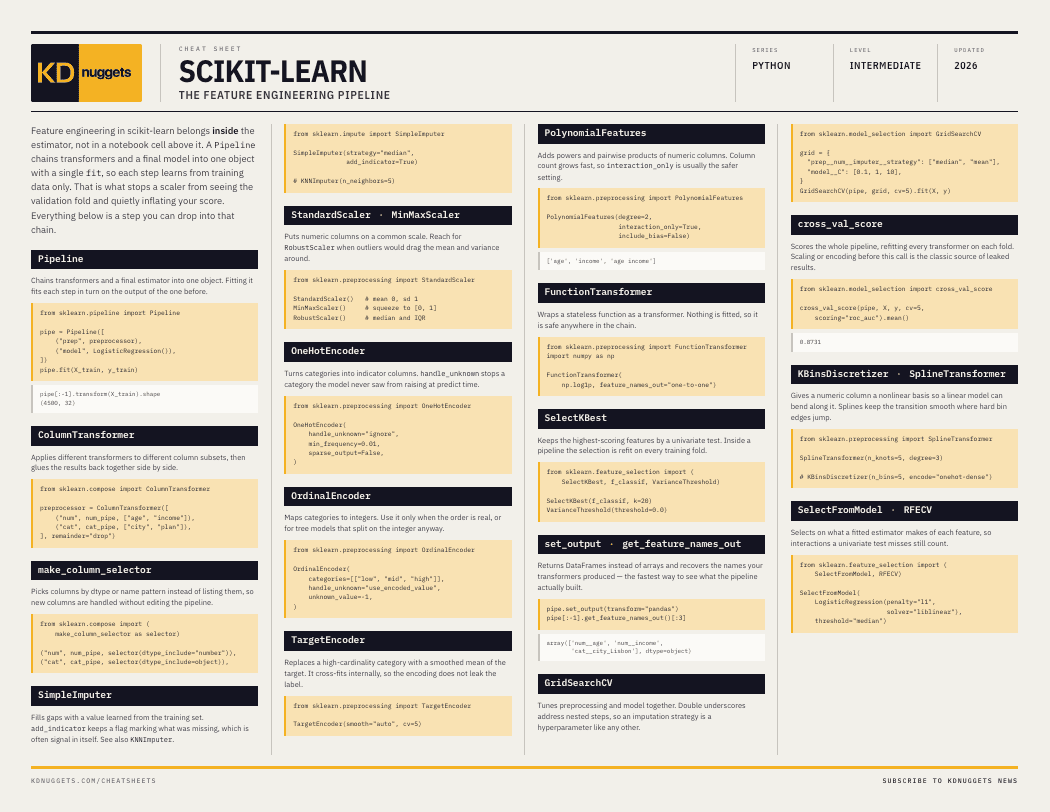
Most cheat sheets hand you the pieces and call it a day. This one does something more useful: it shows you why the pieces belong together. The core insight is deceptively simple. Once feature engineering lives inside a `Pipeline`, each step is fitted on training data only, and the model is scored what it actually earned. No leakage, no inflated validation scores, no surprises when real-world data shows up. That is the difference between a notebook experiment and a system you can trust. And it is the reason this cheat sheet deserves your attention, not just your bookmark.
We have seen this pattern before in other disciplines. Distributed training and inference both involve having a fundamental understanding of how distributed systems work, as our Unlock LLM Training: A Practical Guide to Distributed Algorithms makes clear. Just as a distributed system falls apart without careful coordination between workers, a machine learning pipeline falls apart when feature engineering lives outside the training loop. The same logic applies at a smaller scale in Exploring Paragraph Structure: How LLMs Navigate Token Space, where structure determines what the model can learn. Here, the structure is the pipeline itself. Get that structure right, and every subsequent step, from scaling to model selection, earns its keep. Get it wrong, and you are optimizing a model that never had a fair shot.
Our honest take is this: most data scientists already know the theory. They know that fitting a scaler on the full dataset before splitting is a sin. But knowing and internalizing are different things. The value of this cheat sheet is that it makes the correct behavior the path of least resistance. When feature engineering is embedded in a `Pipeline`, you are not just avoiding a common mistake. You are designing for reproducibility and clarity. You are forcing every transformation to be part of a single, auditable sequence. For anyone who has ever inherited a messy notebook with fifteen cells of ad-hoc transformations, this is the difference between a house of cards and a foundation.
If a reader came to us asking whether this approach is worth the overhead, we would say this: the overhead is an illusion. Yes, you spend a few extra minutes structuring your code. But you save hours of debugging later, and you gain the ability to test your model on new data without second-guessing your preprocessing steps. The takeaway is simple: a pipeline is not a convenience, it is a discipline. And discipline is what separates a model that works in theory from one that works in production. The next time you reach for a scaler or an imputer, ask yourself where it lives. If the answer is "outside the pipeline," you have already lost the point.