workflow automation
270 stories filed under workflow automation on Beyond Market Intelligence. The newest of them: “Why enterprise AI agents stall at deployment, not capability”, “Manage AI spending with the same confidence you secure your passwords.”, and “Agent-as-a-Router brings dynamic intelligence to enterprise AI model selection.”. At VB Transform 2026, Bryan Silverthorn from Amazon made a pointed case: enterprise AI agents aren't failing because they're not smart enough. Token spend is becoming the next enterprise budget crisis, and 1Password is moving to put IT and finance teams back in control. Acme AI is the next-generation, AI-powered spreadsheet platform built to replace Excel and redefine how analysts, data scientists, and enterprise teams work… The list below is every workflow automation story on Beyond Market Intelligence, newest first.

Why enterprise AI agents stall at deployment, not capability
At VB Transform 2026, Bryan Silverthorn from Amazon made a pointed case: enterprise AI agents aren't failing because they're not smart enough. They're failing because they're not reliable enough. With 85% of companies piloting agents but only 5% shipping them, the gap is a measurement problem, not a model problem. His "intern" framework is a refreshingly human lens on managing autonomous systems. It's practical advice for escaping pilot purgatory. For more on scaling these workflows, see our piece on orchestrating AI agents with Google's AX.

Manage AI spending with the same confidence you secure your passwords.
Token spend is becoming the next enterprise budget crisis, and 1Password is moving to put IT and finance teams back in control. Its new AI Spend and Consumption Management capability, embedded in SaaS Manager, delivers a unified, real-time view of consumption across Anthropic, Cursor, and OpenAI. This isn't about cutting costs blindly; it's about building the visibility needed to direct AI investment toward what actually drives business value.

Agent-as-a-Router brings dynamic intelligence to enterprise AI model selection.
Static routing has a blind spot: it never sees whether a model actually succeeded. ACRouter fixes that by letting the router learn on the job. Its C-A-F loop tracks execution outcomes, turning each failure into a smarter decision. The result is a 2.6x cost saving over Opus-only setups, with no accuracy sacrifice. This is a practical step toward self-optimizing AI infrastructure. For teams tired of hard-coded rules, it's worth exploring how this approach fits your stack.

Your AI coding assistant might be handing attackers your source code
Forget typosquatting; a new software supply chain threat, termed "slopsquatting," is emerging due to AI coding tools. Enabled by large language model (LLM) hallucinations, this attack allows cybercriminals to inject malicious code directly into development workflows. Attackers register fake, plausible package names—often mimicking legitimate libraries—which AI coding assistants then recommend, bypassing traditional security protections. Organizations relying on open-source AI tools face significantly increased risk; as highlighted in recent reporting, CISA had to build its incident playbook during a recent security event.
When Trust in Testing Fails, Agent Autonomy Outpaces Verification
Enterprise AI adoption faces a critical evaluation gap: agents are gaining autonomy faster than companies can reliably verify their performance. A recent VB Pulse survey revealed that half of enterprises deploying AI agents have experienced customer-facing failures despite passing internal evaluations. While 66% are accelerating automation, only 5% fully trust current automated testing methods. This mismatch highlights a need to prioritize repeatability and rigorous regression testing, as demonstrated in our related article, "57% of enterprises have watched AI agents be confidently wrong."
Enterprise AI runs at half capacity as controls lag behind deployment
Wall Street's AI buildout debate has been answered: a VentureBeat Research survey of 573 technical leaders reveals that 86% of enterprises run their GPUs at half capacity or less – a clear sign of current infrastructure utilization. This highlights a critical gap: enterprises are deploying AI agents ahead of robust control measures, with many relying on single-prompt chatbots rather than true multi-step agents.

ChatGPT Work turns your AI assistant into an autonomous task manager
OpenAI introduces ChatGPT Work, a cloud-based AI agent poised to transform how professionals leverage AI. Embedded within the flagship chatbot, this new platform moves beyond simple Q&A, autonomously managing tasks across email, Slack, and calendars using the advanced GPT-5.6 model. ChatGPT Work streamlines workflows by generating documents, spreadsheets, and even websites, demonstrating OpenAI's commitment to democratizing agentic AI capabilities – a strategy highlighted by their recent confidential SEC filing.

Slack's AI agents adapt to UI changes for more resilient testing.
Slack engineering is introducing Agent Driven End-to-End Testing, a progressive approach to UI test automation leveraging AI agents. This innovative method executes workflows based on intent, dynamically adapting to evolving UI and system changes—reducing test fragility in distributed environments. Complementing existing unit, integration, and E2E testing, agentic testing prioritizes resilience and efficiency. Discover how Slack is transforming its testing strategy and learn more about similar advancements, such as Cloudflare's recent introduction of temporary accounts for autonomous worker deployment.

Your enterprise AI strategy needs more than one interface
Enterprise AI adoption isn't about a single interface—it's about adapting AI to diverse business needs. Presented by Oracle NetSuite, this exploration reveals why assuming a universal conversational system underestimates how organizations leverage new technologies. From finance teams prioritizing accuracy to analytics groups seeking flexible data exploration, different departments require tailored solutions. NetSuite’s AI Connector Service and Model Context Protocol empower businesses to connect data securely to existing workflows, ensuring AI enhances, rather than disrupts, established operations.

From Code to Confidence: Why Enterprise AI Needs More Than Generation
The promise of AI code generation is undeniable, yet a stark reality persists: most organizations fail to translate prototyping success into enterprise-grade execution. SAP's Michael Ameling observes that 81% strategize for AI, yet only a fraction achieve operational deployment, revealing a critical gap beyond code quality. Successfully integrating AI-generated logic into complex, legacy systems demands foundational data readiness, robust governance, and a shift in developer roles—a challenge amplified by AI’s very power. Discover how to bridge this gap and unlock true enterprise value.

Adaptive Multi-Agent Systems Unlock Smarter, Scalable Software Workflows
Unlock the next level of software development automation with "The Multi-Agent Approach." Itamar Friedman reveals how architects and engineering leaders can surpass current AI productivity limitations by leveraging adaptive multi-agent systems. This presentation explores moving beyond basic autocomplete to resilient workflows through autonomous testing, intelligent code review, and robust arbitration—all while maintaining governance over agent communication. Discover how to build a scalable, context-driven SDLC. For deeper insights into dynamic configuration delivery, explore Airbnb's architecture behind Sitar-agent.

When AI attacks in seconds, resilience must begin before the breach.
The cybersecurity landscape is rapidly evolving, and enterprises face a critical new challenge: AI-driven attacks that can compromise systems in mere seconds. Traditional security measures are struggling to keep pace, demanding a shift towards cyber resilience—continuously identifying clean recovery states and automating restoration. As Dev Rishi, GM of AI at Rubrik, notes, recovery must now happen at machine speed. Explore how AI-native resilience, anchored by small, efficient models, is redefining enterprise security and preparing organizations for the inevitable.

Trunk Tools cuts document review by 50 days with specialized AI architecture
Construction data presents a unique challenge: most general-purpose AI models struggle with the industry’s jargon-dense, abbreviation-heavy documents. Trunk Tools addresses this by building a specialized, three-layer architecture—perception, semantics, and agents—to transform data chaos into agent-ready workflows. This purpose-built stack has dramatically reduced document review cycles from months to days and prevents costly field errors.

Why smart enterprises diversified their AI strategy before Fable 5 vanished
The recent, weeks-long outage of Anthropic’s Claude Fable 5 underscores a critical shift in enterprise AI strategy. New VentureBeat Pulse Research reveals that two-thirds of organizations have already implemented a hedging posture, blending closed frontier models with open-weight alternatives or moving workflows entirely off closed APIs. This proactive stance highlights growing concerns about vendor dependency and the need for greater control. Enterprises are actively prioritizing resilience and flexibility, recognizing that reliance on a single model carries significant risk—a lesson reinforced by the unexpected disruption.
Integrate, Don't Accumulate: Smarter Tools Fit Your Workflow
Users aren't seeking another tool; they need seamless integrations that respect established workflows. The proliferation of disparate applications creates friction, hindering productivity. Our latest piece explores this critical shift, advocating for a design approach centered around integrating valuable features directly into existing mental models. Discover how this focus unlocks greater efficiency and reduces cognitive load. For further context on the evolving AI landscape, see our article on "Nvidia competitor Etched hits $5B valuation," demonstrating the growing demand for specialized AI solutions.
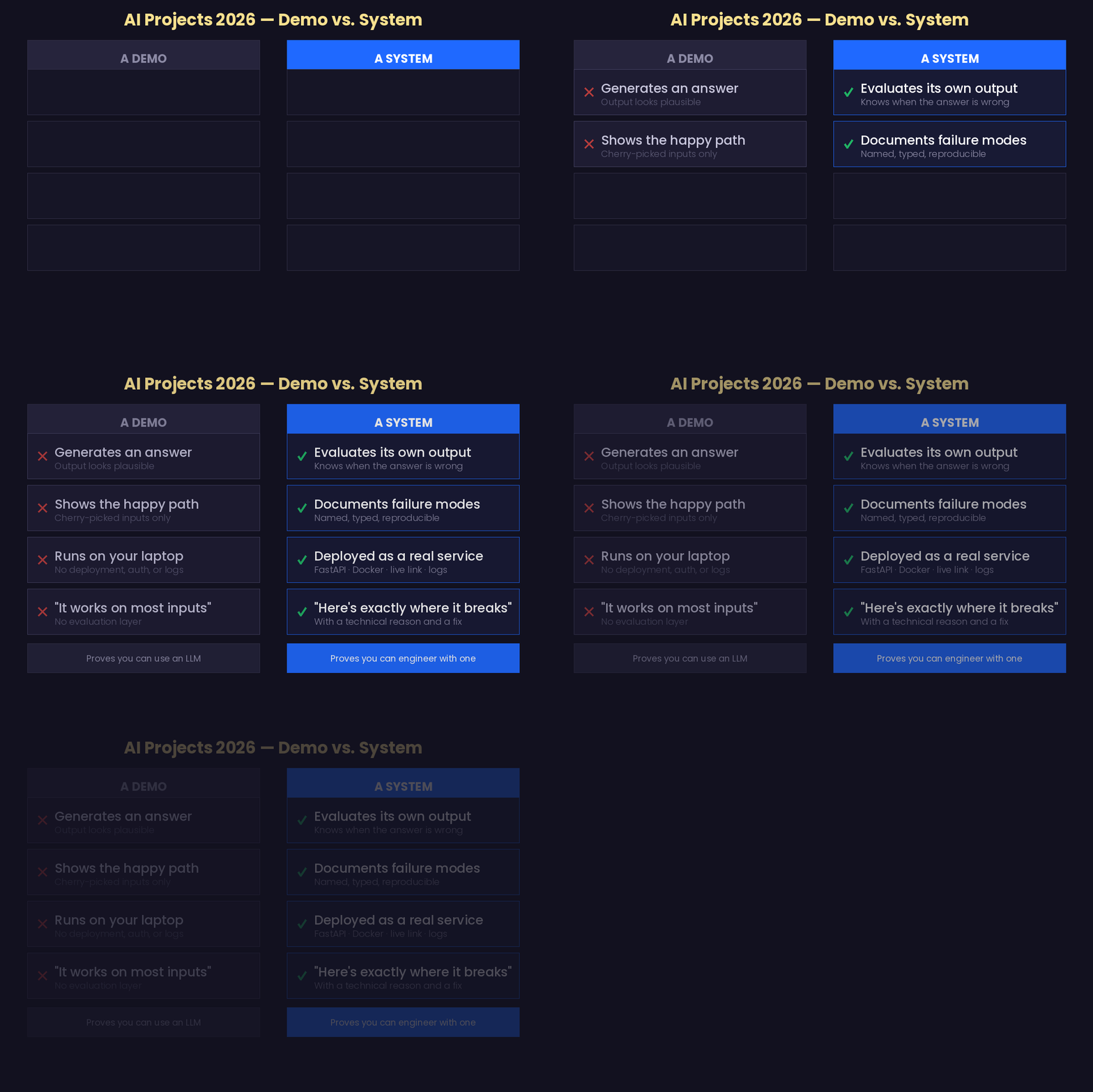
Build AI projects that prove you know where your system fails
Navigating the landscape of AI projects for 2026 requires a focused approach. The most compelling projects aren't about sheer complexity; they're about demonstrating a clear understanding of system limitations and articulating those failures confidently to potential employers. Forget wading through 50 ideas – this post delivers the top 10 AI projects poised to impress. Discover how to build demonstrable skills and showcase your expertise. For deeper insights into user interface design within AI, explore "Matching AI Modality To User Intent."

How Morgan Stanley sped up reconciliation by keeping humans closer to the process
Morgan Stanley dramatically accelerated a critical reconciliation process—profit and loss (P&L) reconciliation—by deploying an internal AI agentic system called FIXR. Counterintuitively, the firm achieved a 50% reduction in processing time by prioritizing human oversight and iteratively incorporating controller decisions into automated rules. This "co-worker" approach, rather than a fully autonomous model, unlocks complex organizational workflows and exemplifies a shift toward process-first AI implementation, as highlighted by Morgan Stanley’s Managing Director, Todd Johnson.

Anthropic's new Claude Sonnet 5 brings flagship power at a mid-tier price
Anthropic has launched Claude Sonnet 5, a new AI model delivering near-flagship performance at a significantly reduced cost, aiming to broaden access to powerful agentic capabilities. Priced at introductory rates of $2 and $10 per million tokens, Sonnet 5 substantially outperforms its predecessor and even rivals Anthropic’s Opus model in several key benchmarks. This strategic move precedes the company’s highly anticipated IPO, designed to demonstrate broad developer adoption and compelling cost-performance.

Google delivers faster, cost-effective image generation for enterprise teams
Google today introduces Nano Banana 2 Lite (NB2 Lite), designated Gemini 3.1 Flash-Lite Image, a significant advancement in AI image generation designed for enterprise efficiency. This model delivers images in a remarkably fast 4 seconds at a competitive $0.034 per 1,000 images. Optimized for high-throughput workflows, NB2 Lite outperforms its predecessor while offering cost savings compared to other Gemini models. Explore its capabilities now via Google AI Studio, the Gemini API, and GEAP—a practical solution for rapid prototyping and automated asset generation.
Accessibility as a core operational capability, not a final checklist
Teams are generating user interfaces at unprecedented speeds, yet ensuring usability, security, and maintainability remains critical. Accessibility shouldn't be a post-development audit; it’s an operational capability woven into every stage. This means proactively integrating accessibility considerations into workflows, empowering teams to build inclusive products from the outset. Discover how shifting this perspective transforms development, fostering efficiency and ultimately delivering superior user experiences. For deeper insights into isolated execution environments, explore our article on "AWS Launches Lambda MicroVMs."

Meituan unveils LongCat-2.0, the open-source coding model built on Chinese chips
Meituan has unveiled LongCat-2.0, a 1.6-trillion-parameter Mixture-of-Experts (MoE) agentic coding model now openly available on GitHub, Hugging Face, and its platform. This near-frontier model, previously powering the anonymous "Owl Alpha" which topped OpenRouter charts, disrupts enterprise AI dominance with a permissive MIT license and a unique 1-million-token context window. Notably, LongCat-2.0 was trained entirely on Chinese-manufactured chips, signaling a potential shift in AI infrastructure. Explore its competitive pricing structure and discover how it’s reshaping autonomous software engineering, as detailed in related

Explore how DeepSeek's DSpark framework accelerates AI inference by 85 percent.
DeepSeek has open-sourced DSpark, a new framework poised to significantly accelerate large language model (LLM) inference by up to 85%. This MIT-licensed system optimizes speed by employing a "scout" that anticipates likely text paths, allowing the LLM to quickly verify and proceed. The release, including technical papers and codebases, aims to address a key challenge in AI deployment – efficiently serving large models for real-time user experiences.

When AI meets reality, enterprise security must evolve beyond old assumptions.
Prompt injection poses a critical and escalating threat to enterprise AI deployments. Over the past two years, as businesses integrate large language models (LLMs) across operations, malicious actors have exploited fundamental design flaws, targeting agents, RAG pipelines, and model routers. Ranked as LLM01 by OWASP, prompt injection is demonstrably effective, evidenced by real-world incidents like data exfiltration from Slack and zero-click exploits against Microsoft 365 Copilot. Organizations must treat LLMs as untrusted components to mitigate this pervasive risk.

AWS FinOps Agent automates cost anomaly detection and owner notification
Amazon’s public preview of the AWS FinOps Agent marks a significant step toward streamlined cost analysis and optimization. This managed service automates key FinOps workflows, enabling rapid investigation of cost anomalies and correlating spending changes with AWS activity. The agent intelligently routes findings to resource owners via integrations with tools like Slack and Jira, empowering teams to take proactive action. Discover how this innovative solution can transform your cloud cost management—a topic explored further in our recent article, "Swift 6.4 Brings New Language Features."