5 Real-World Applications of Agentic AI in Enterprise Automation
Our take
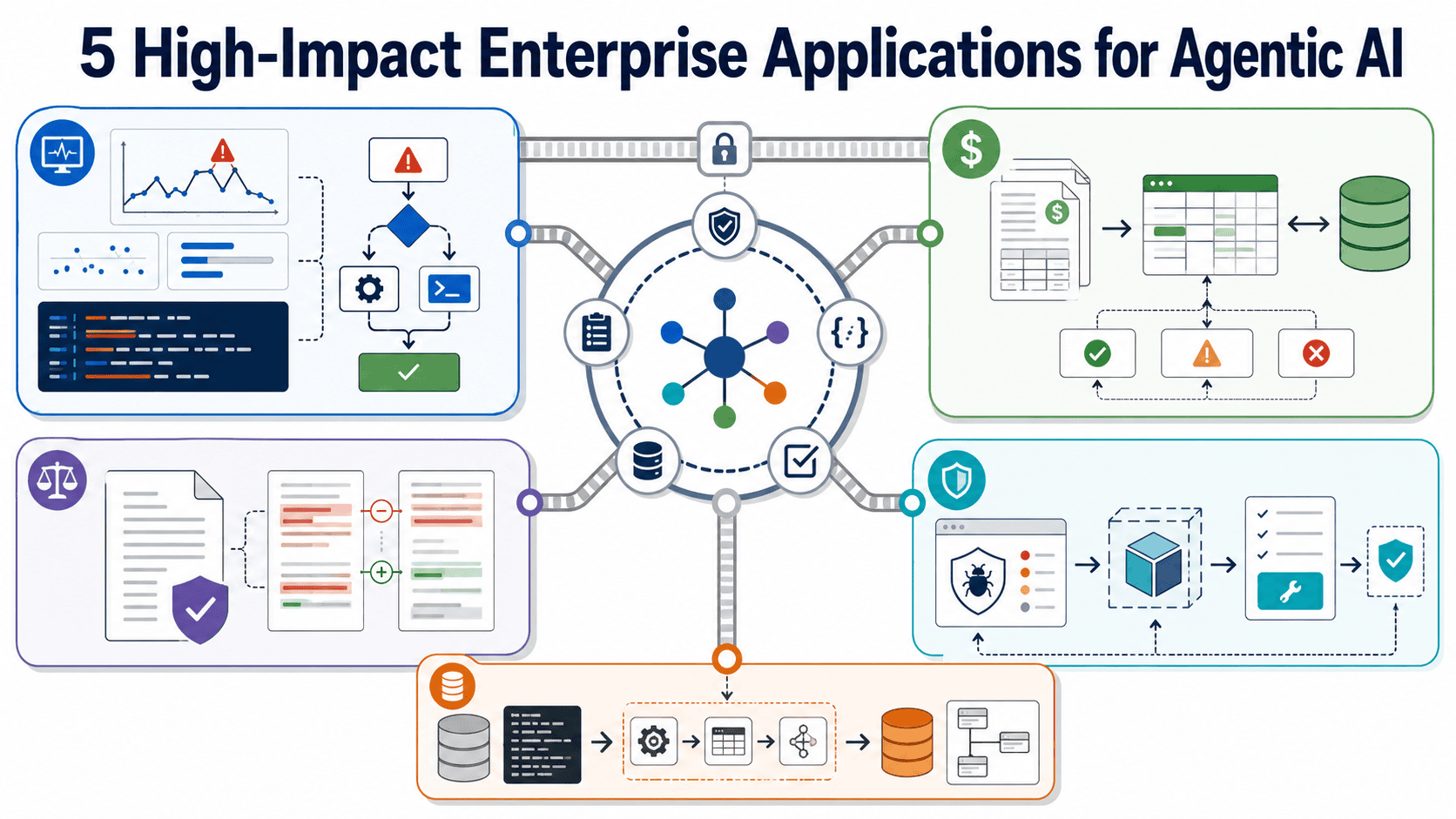
The emergence of agentic AI within enterprise automation is rapidly moving beyond theoretical discussions and into tangible, practical applications. The recent article highlighting its use across SRE, finance, legal, migration, and security is a compelling indicator of this shift. While the concept of AI agents—autonomous entities capable of perceiving, reasoning, and acting—has been around for a while, the integration of deterministic safety constraints marks a crucial step towards enterprise adoption. It's no longer about simply automating tasks; it’s about automating them reliably and predictably, a critical requirement for organizations dealing with sensitive data and complex workflows. This aligns with broader trends we’re seeing, as evidenced by HashiCorp’s positioning of HCP Terraform [HCP Terraform Positions Itself as the Control Plane for AI-Driven Infrastructure] as a governance layer for AI-driven infrastructure, emphasizing the need for control and oversight as AI’s role expands. The ability to define these safety constraints allows businesses to mitigate risks and ensure that AI agents operate within acceptable boundaries, addressing a key barrier to wider implementation.
The selection of SRE, finance, legal, migration, and security as initial deployment areas is particularly insightful. These departments often grapple with repetitive, rule-based tasks, making them ideal candidates for agentic AI. Consider the legal sector, for example, where AI agents can automate document review and compliance checks, freeing up legal professionals to focus on higher-level strategic work. Similarly, in finance, agents can handle tasks like invoice processing and reconciliation, improving accuracy and efficiency. The challenge, as highlighted in a recent piece [AI is redefining the workforce — and most planning models aren’t ready], lies in ensuring that organizational structures and planning models adapt to this evolving landscape. Businesses must proactively address the potential impact on the workforce and invest in reskilling initiatives to prepare employees for roles that complement, rather than compete with, AI agents. The promise of Anthropic’s Claude Fable 5.1 and Mythos 5.1 [Anthropic's Claude Fable 5.1 and Mythos 5.1 arrive with a 75% cost reduction for Fable cache reads] further underscores the accelerating pace of innovation in foundational AI models, which will undoubtedly fuel the development of more sophisticated and capable agents.
The emphasis on deterministic safety constraints is what truly differentiates this development. Previous iterations of AI automation often lacked transparency and predictability, making them unsuitable for critical business processes. Deterministic constraints provide a mechanism to define and enforce rules, ensuring that AI agents behave as expected and minimizing the risk of unintended consequences. This isn’t about stifling innovation; it’s about channeling it responsibly. The move towards agentic AI also necessitates a rethinking of traditional data management practices. These agents need access to data to function effectively, but that access must be carefully controlled and monitored. This will likely drive increased adoption of data governance tools and frameworks, further enhancing the security and reliability of AI-powered automation. The ability to specify these constraints also allows for iterative refinement – as agents encounter unexpected situations, the constraints can be adjusted to improve their performance and ensure continued safety.
Ultimately, the successful deployment of agentic AI in enterprise automation hinges on a shift in mindset. It's no longer enough to simply automate tasks; organizations must embrace a more holistic approach that considers the broader implications of AI on their workforce, data governance, and overall business strategy. The focus on deterministic safety constraints represents a significant step in the right direction, but ongoing monitoring and adaptation will be essential to realizing the full potential of this transformative technology. What will be the key metrics used to measure the long-term impact of agentic AI on enterprise productivity and innovation, and how will organizations balance the benefits of automation with the need to maintain human oversight and control?
Read on the original site
Open the publisher's page for the full experience