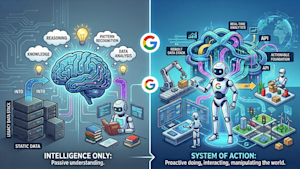
The premise behind Google's Agentic Data Cloud is the right one, and it's arriving not a moment too soon. For years, the data stack has been a place where humans go to look things up, dashboards, reports, the occasional deep-dive query. That worked when the bottleneck was human attention. But the moment you hand the keys to an AI agent, the rules change. Agents don't schedule a meeting to review the numbers; they act on them. And they do it at all hours, across every system you own. Your data architecture either supports that or it becomes the reason the agent fails.
What stands out here isn't the flash of a new product name, it's the quiet admission that the old way of preparing data for humans doesn't scale to machines. Google's Knowledge Catalog is the most honest acknowledgment of this yet. It automates the semantic heavy lifting that data stewards used to do by hand, which means your catalog can finally cover everything, not just the 20 percent someone had time to label. That matters because an agent that misreads a column is worse than one that can't find it. If you're still relying on manual curation to keep your data trustworthy, you're not behind on a feature, you're behind on a prerequisite.
The cross-cloud piece is equally practical, though for a different reason. Letting BigQuery query Iceberg tables on S3 without egress fees isn't a technical novelty; it's a cost structure decision. If your agents are going to run thousands of queries a day, the difference between a private network and a metered API call is the difference between a viable workload and a budget line item that spirals. Google is betting that openness, federating with Databricks, Snowflake, and the open Iceberg standard, is what enterprises will demand once they realize their agents need access to everything, not just what lives in one cloud. That's not charity; that's pragmatism.
The Data Agent Kit, meanwhile, points to the real shift in how data work gets done. Describing an outcome instead of writing a pipeline is a different muscle for most teams, and it will take getting used to. But the direction is clear: the value is moving from writing code to reviewing what the agent produced and steering it when it goes off course. That's a better use of a senior engineer's time, and it's the only way you'll keep up with the volume of requests an agent-driven business generates. The vendors arguing over semantics are missing the point, everyone agrees context matters. The question is whether your team is ready to stop maintaining the plumbing and start defining the outcomes. If you're not planning for that transition now, you're not just behind on a tool; you're behind on the job itself.