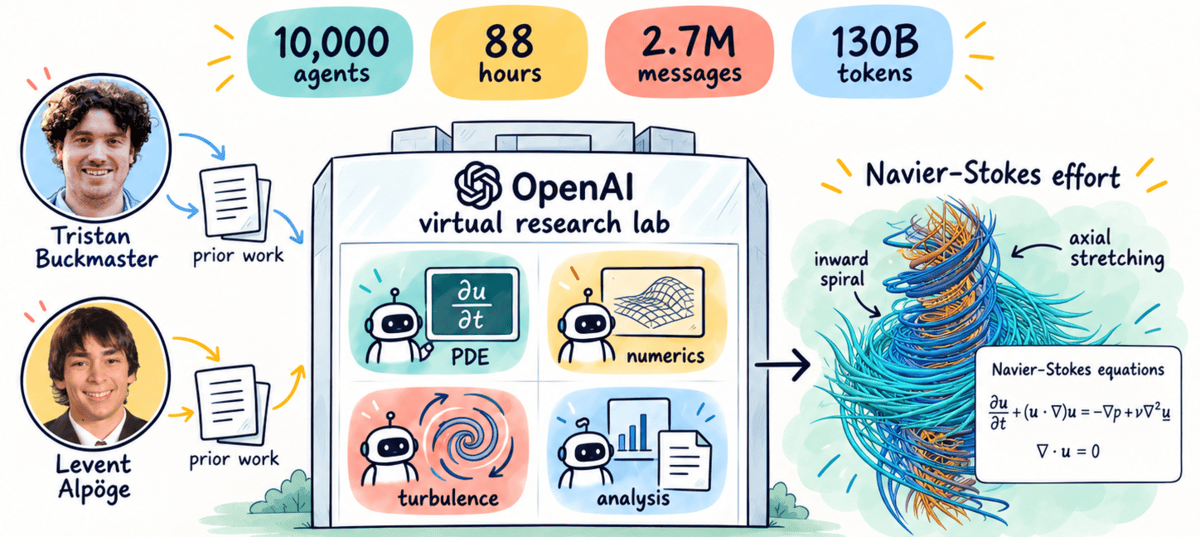
OpenAI's agents solved a complex math problem in 88 hours, but the real story isn't the speed. It's the question of what we call a discovery, and who gets the credit. The agents reached a proposed solution, yet the human research that laid the groundwork, and the controversy that followed, suggest that AI is narrowing a mathematical gap without closing it. For anyone working with data, this is a practical signal: tools are getting faster, but they still depend on human context to mean anything. This matters because the same dynamic is playing out in spreadsheets and data workflows every day. As OpenAI charts final private raise before its 2027 public debut, the pressure to demonstrate that speed equals value grows, but the math problem shows that speed alone doesn't settle the harder question of interpretation.
The agents didn't work from scratch. They built on years of human research, theoretical framing, and even disagreement about what constitutes a valid proof. That's not a failure of AI; it's a reminder that discovery is a human process with a human endpoint. When we talk about AI transforming spreadsheet work, we should be honest about where the transformation actually happens. It's not in the raw calculation. It's in the ability to surface patterns, suggest alternatives, and let the user decide what matters. The controversy around this solution, whether it counts as a genuine discovery, mirrors the skepticism many spreadsheet users feel when AI suggests a formula or flags an anomaly. The tool is helpful, but the judgment still belongs to the person. This is why we focus on accessible, human-centered tools: because the goal is not to replace thinking, but to remove the friction that slows it down.
The timing of this story is telling. As OpenAI Skips Nvidia's Safety Pledge: Yet Partners Privately, the industry is navigating a tension between public commitments and private cooperation. That same tension shows up in the math problem: the public narrative celebrates the 88-hour solve, but the private reality involves messy human collaboration and unresolved debate. For our readers, the takeaway is straightforward: AI can accelerate the grunt work, but it cannot define the outcome. If you are evaluating a new spreadsheet tool, ask not just how fast it processes data, but how well it helps you frame the right question. The agents found a solution; the humans are still deciding if it's the right one.
The concrete detail to watch is how OpenAI handles the attribution question in future releases. If the company leans into the 88-hour headline without acknowledging the human scaffolding, it risks overselling the tool and underdelivering on trust. If it frames the agents as collaborators rather than discoverers, it sets a standard that every AI-native tool should follow. That distinction will determine whether these tools empower users or simply generate noise.