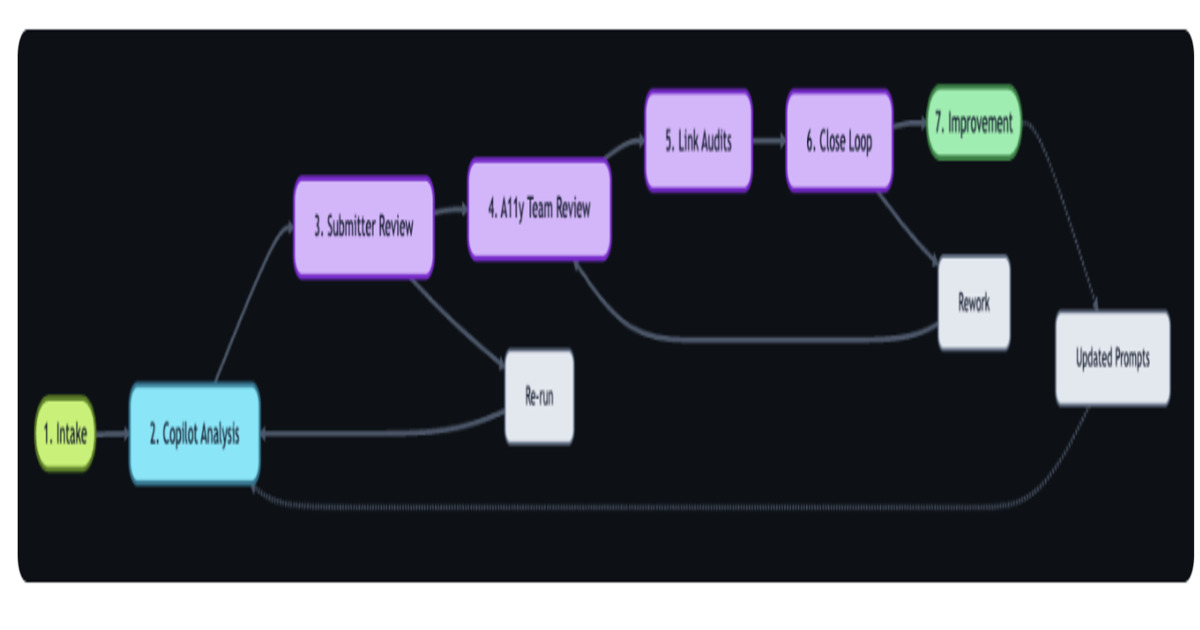
Accessibility feedback has always been a bottleneck disguised as a good intention. Teams want to fix what users report, but the sheer volume of incoming issues, duplicate tickets, and vague descriptions turns good intentions into a backlog that never shrinks. GitHub's new continuous AI-powered workflow, built on GitHub Actions, Copilot, and Models APIs, directly addresses that logjam by automating the triage stage without removing the human from the loop. That is the right call, because the goal is not to replace judgment but to free it up for the work that actually matters: fixing the problem.
What this means for your team is practical, not theoretical. The system centralizes accessibility reports into a single stream, so nothing gets lost in email threads or scattered issue trackers. It then analyzes each report against WCAG compliance standards, which means the AI does the initial heavy lifting of categorizing, prioritizing, and flagging what needs attention. Your team no longer spends hours parsing whether a screenshot of a broken contrast ratio is a new issue or a duplicate. Instead, they get a clear, ordered queue with the context already attached. The human validation step remains, which is essential. AI can identify patterns and suggest severity, but it cannot yet understand the lived experience of a user who cannot tab through a form. That nuance stays with your people, where it belongs.
The result is faster resolution, but the deeper win is cross-functional collaboration. When accessibility feedback is triaged consistently and transparently, designers, developers, and product managers start from the same baseline. The AI workflow becomes a shared language, not a source of friction. Teams stop arguing about whether something is a blocker and start discussing how to fix it. That shift in conversation is what moves accessibility from a compliance checkbox to an integrated part of the development cycle. It is not about making your team work harder; it is about removing the repetitive, low-value work that currently eats their day.
The concrete takeaway is this: if your organization is still treating accessibility feedback as a manual, reactive chore, you are not just falling behind on inclusion, you are wasting skilled effort on tasks an AI can handle accurately and consistently. GitHub's approach is not a magic bullet, but it is a sensible, grounded use of AI that respects both the technology and the people using it. Start by evaluating how much of your current triage work is pattern recognition and sorting. If that number is high, this workflow is worth a serious look, not as a replacement for your team's expertise, but as the support system that lets that expertise show up where it matters most.