For engineers evaluating browser agents, the choice has never been clean: pay for a closed API you cannot inspect, or adopt an open-weight framework that is essentially an empty shell. Ai2's MolmoWeb is the first release that actually fills that shell with a trained, inspectable model, and that makes it a genuinely different option. It is not a marketing distinction. It is a practical one for any team that needs to know what their agent is doing under the hood.
What matters here is not just that the model weights are open. It is that the training data and pipeline are open too. That 30,000 human task trajectories across more than 1,100 websites, the 590,000 subtask demonstrations, the 2.2 million screenshot question-answer pairs, those are not numbers to impress investors. They are the raw material that lets you audit, reproduce, and fine-tune the agent on your own internal workflows. If your team is responsible for deploying a browser agent in a regulated environment or on proprietary web applications, that transparency is the difference between trusting a vendor and verifying a system. MolmoWeb gives you the latter.
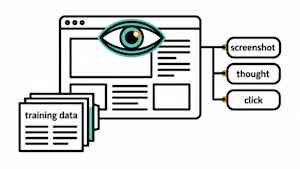
The technical choices also matter for how you actually use it. MolmoWeb operates entirely from screenshots, not from HTML or accessibility trees. That makes it browser-agnostic, it runs against Chrome, Safari, or a hosted service without rewriting the agent layer. It also means the model learns to see the page the way a human does, which is harder to achieve but more generalizable across different site architectures. The limitations are real: text reading errors, unreliable drag-and-drop, degraded performance on ambiguous instructions, and no support for logins or financial transactions. But those are documented constraints, not hidden failures. For teams evaluating this against a closed API, the tradeoff is clear: you give up some polish at the edges in exchange for full visibility and the ability to adapt the model to your own domain.
For enterprise teams, the decision is not just about which model scores higher on a benchmark. It is about whether you can own the pipeline end to end. MolmoWeb lets you inspect the training data, reproduce the results, and fine-tune on your own task trajectories without sending every screenshot to a third-party API. That is the kind of control that makes open-weight models viable for production, not just for experiments. Ai2 has shown that open does not have to mean unfinished.