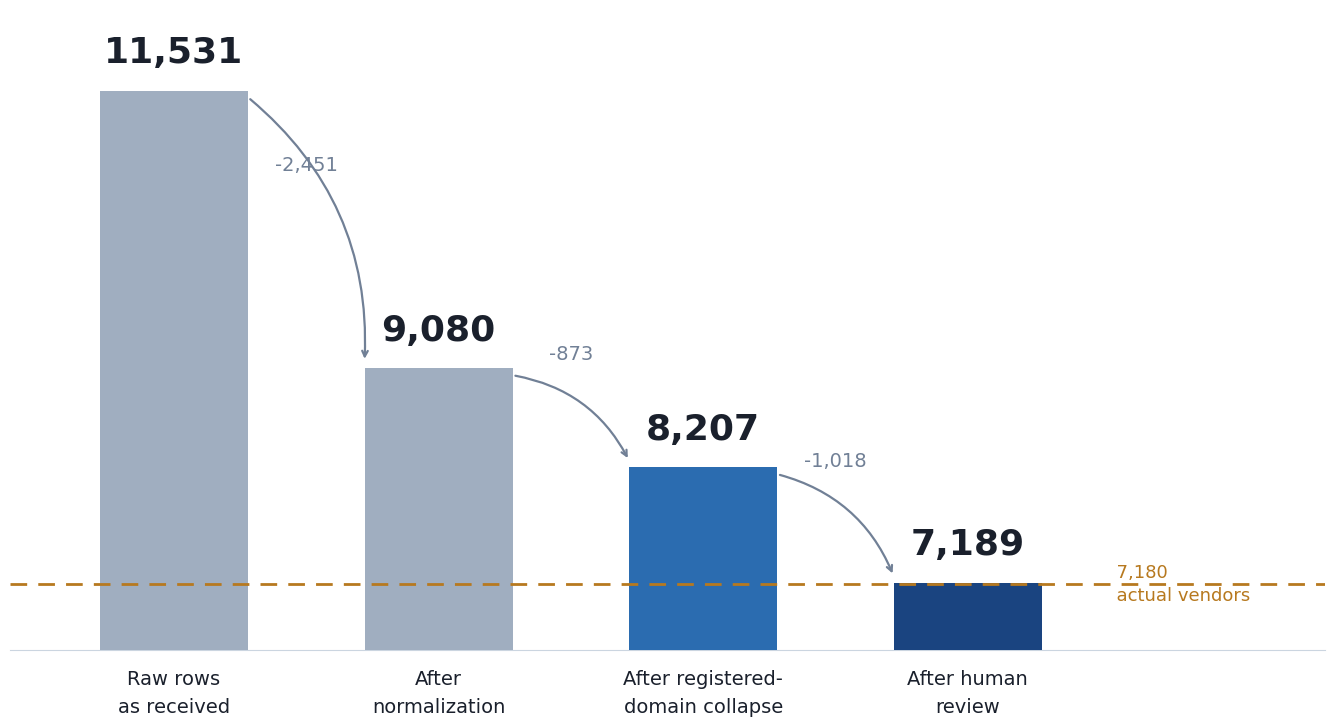
Any spreadsheet user who has stared at a 10,000-row supplier list knows the feeling: your eyes glaze over, and you start to wonder if "Acme Corp" and "Acme Corporation" are the same vendor or two different companies that happen to share a name. The recent piece on deterministic deduplication tackles this exact problem, and it does so by asking a deceptively simple question: what does a similarity score of 91 actually mean? For most of us, that number is a black box. It feels scientific, but it doesn't tell you whether you can safely merge two rows, or whether you are about to combine a legitimate supplier with a separate entity that just happens to share a few characters.
Our take is that the author is onto something important by shifting the conversation away from fuzzy matching and toward deterministic stages. Instead of relying on a single score that tries to capture everything, the approach breaks the problem into discrete, rule-based steps. This is a more honest way to work with data. It acknowledges that "similarity" is not a single number but a collection of specific, testable conditions. For readers who have struggled with Power Query help spitting data from a column into multiple new column, this feels like a natural evolution. You are not just cleaning data; you are building a decision tree that you can explain to a colleague, or even to a non-technical stakeholder, without resorting to hand-waving about algorithmic complexity.
The practical value here is significant. When you use a deterministic approach, you are not hoping for the best. You are defining what "match" means for your specific dataset. That is a form of Protecting Formula Columns While Copy-Pasting Rows in a philosophical sense: you are protecting the integrity of your data by making sure that the logic is transparent and repeatable. It is not about being smarter than the algorithm; it is about being more deliberate. We would tell a reader who is drowning in messy vendor lists to stop chasing the perfect similarity threshold and start writing rules that answer the questions you actually care about. For example, does the address match? Does the tax ID match? If yes, merge. If not, leave it alone.
The specific takeaway to quote is this: a similarity score is a starting point for investigation, not a verdict. The real work begins when you ask why that score is 91 and not 100. That is where the deterministic stages earn their keep. As for what to watch next, keep an eye on how this philosophy extends beyond deduplication. The same logic that helps you decide whether two rows are the same vendor could easily apply to Trying to conditional format based on an index, where the goal is to create rules that respond to specific conditions rather than broad patterns. The future of data work is not in better guesses; it is in clearer definitions. And that is a shift we can all get behind.