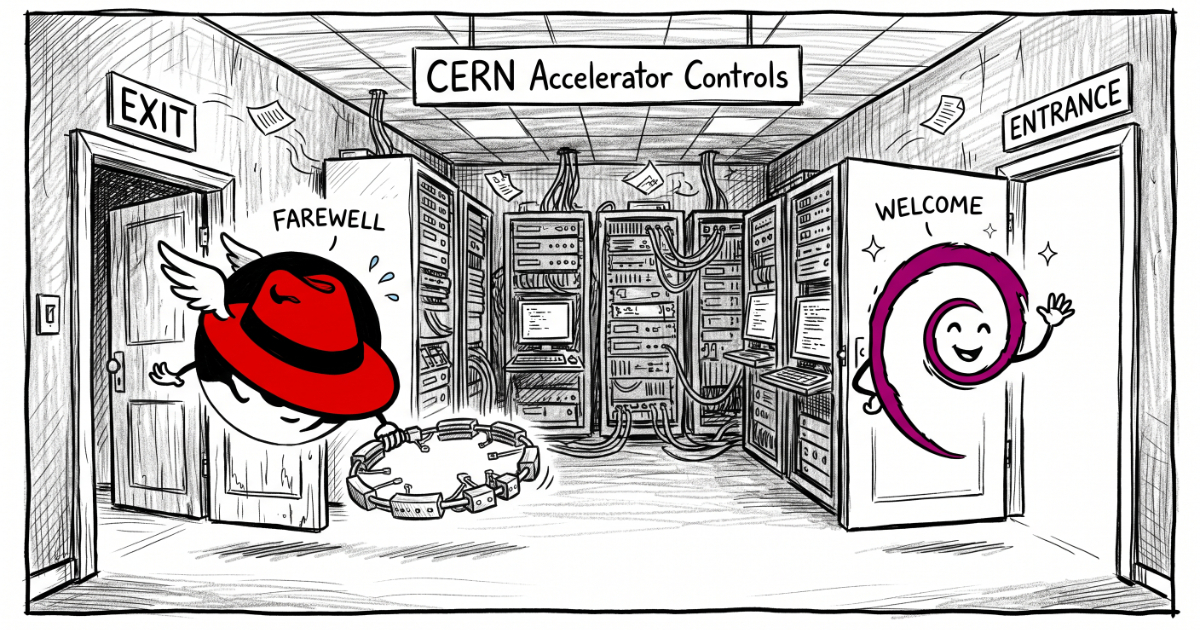
CERN's decision to move its accelerator control systems from Red Hat to Debian is not a rejection of enterprise Linux. It is a precise, pragmatic answer to a constraint that will feel familiar to anyone who has ever kept aging hardware alive: when the vendor's roadmap stops accommodating your reality, you find a path that does. The engineers cited Red Hat's tightening compiler mandates as the trigger, and the target is specific, 2,200 specialized control machines, with completion expected in late 2026. That is not a temper tantrum. That is a carefully scoped migration with a deadline and a clear reason.
What makes this story worth pausing on is the discipline of the scope. CERN is not ripping out Red Hat everywhere. Its other systems stay on Red Hat and AlmaLinux. The migration is confined to the control infrastructure where legacy hardware has to keep working, often for decades, long after the mainstream software ecosystem has moved on. This is the quiet, unglamorous side of technology decisions that rarely makes headlines, but it carries real weight. It also mirrors a theme we have been tracking in adjacent spaces: the gap between what tools promise and what they actually demand of the people using them. For example, Bridging Retrieval and Action: A New Approach to AI Tasks explores how connecting separate capabilities explicitly can unlock performance that neither delivers alone, and CERN's move is a similar kind of integration, matching the distribution to the machine's actual needs rather than the vendor's preferred narrative. And in a different corner of the ecosystem, Monitor Cypress Tests with Grafana: Persistent Observability for Your Data shows how practical tooling choices can remove friction from daily workflows, a principle that applies just as much to an operating system as to a test suite.
Our take is straightforward: this is what mature engineering looks like. It is not a statement about Debian being superior to Red Hat in some abstract sense. It is a statement about control, about ensuring that the software layer does not become the reason a piece of scientific infrastructure becomes harder to maintain. For readers who manage systems with long lifespans, the lesson is direct. Your vendor's roadmap is a suggestion, not a law. When a compiler mandate or a licensing change threatens your ability to keep running what you have, you have options. CERN chose Debian because it offers the flexibility to keep legacy hardware functional without constant rework. That is not a niche concern. It is the core of operational sustainability.
The open question we would leave with you is simple. If a research organization with world-class engineering talent and a famously complex environment decides that the cost of following a vendor's direction is too high, what does that say about the direction of enterprise Linux more broadly? The migration will be worth watching not because it will change the world, but because it will reveal how smoothly a large, risk-averse institution can pivot when the pressure is real. If CERN can do it, others can. The question is whether they will wait for their own compiler mandate, or start exploring now. We would suggest the latter, because the next constraint is already on the horizon.