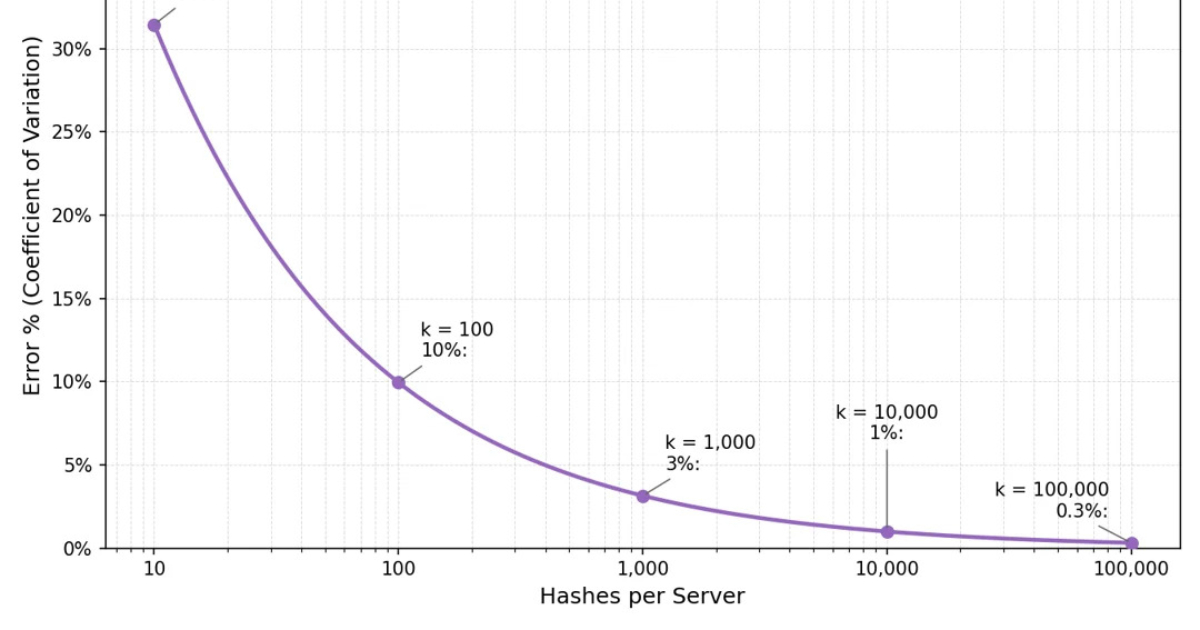
Cloudflare's recent optimization of its internal load-balancing service is a masterclass in practical engineering: by refining the Rust implementation of consistent hashing in pingora-ketama, the company eliminated more than 100 TB of memory waste. That number alone is staggering, but what matters more is how they achieved it, through statistical analysis of hash distribution and collision rates, not brute-force hardware upgrades. This is the kind of work that deserves attention, because it reveals a deeper truth about modern infrastructure: the biggest wins often come from questioning assumptions baked into code we've long taken for granted.
The technical story is straightforward. Cloudflare reduced the number of hashes per backend by roughly 90% by compacting hash-ring entries and using data-driven insights to trim redundancy. The result is a load balancer that uses a fraction of the memory it once did, freeing up resources for other tasks. This echoes a theme we've seen in other recent work, such as how Zod Compiles Schemas in Process, Slashing Memory Use by 9x, both cases show that careful rethinking of data structures can yield dramatic improvements without adding complexity. Similarly, our coverage of Profile production bottlenecks on demand with interactive flamegraphs highlighted how Cloudflare gives developers the tools to identify these exact inefficiencies at runtime. Together, these stories point to a broader shift: optimization is no longer about throwing more memory at a problem, but about measuring what you actually need.
For anyone running distributed systems, the practical takeaway is immediate and specific. Consistent hashing is everywhere, in caching layers, database sharding, and load balancing, and most implementations default to generating far more hash points than necessary. Cloudflare's work shows that by analyzing the statistical properties of your hash function, you can cut that number by an order of magnitude while preserving distribution quality. The 100 TB savings came from one service; apply similar scrutiny across your stack, and the cumulative effect could be transformative. This is not theoretical. The code is open source in pingora-ketama. You can inspect it, test it, and adopt it.
What makes this story stand out is its humility. Cloudflare didn't invent a new hashing algorithm or announce a breakthrough in distributed systems theory. They looked at an existing, well-understood technique and asked a simple question: do we really need this many hashes? The answer was no, and the result was a 100 TB memory recovery. That is the kind of engineering that moves the industry forward, not through grand claims, but through careful measurement and the courage to delete what isn't needed. The open question now is how many other services are carrying similar waste, waiting for someone to ask the same question.