DeepSeek DSpark: The Speculative Decoding Trick Behind 400% Faster LLM
Our take
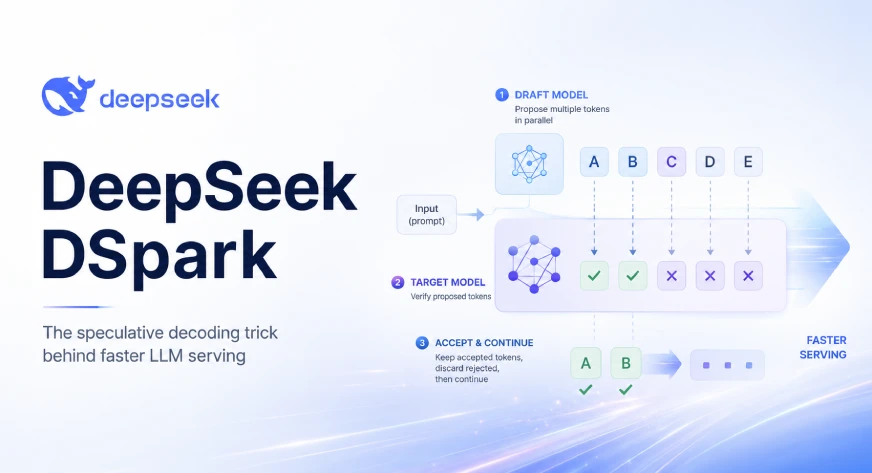
The recent unveiling of DeepSeek’s DSpark module and its remarkable impact on DeepSeek-V4’s inference speed is a significant development for anyone working with large language models (LLMs). While speculative decoding isn't entirely new, DSpark’s ability to simultaneously address weak draft quality and inference waste—two persistent challenges in the field—is what truly sets it apart. The reported 60-85% boost in per-user generation speed, without any discernible degradation in model quality, is a compelling testament to its effectiveness. This isn't just about faster generation; it's about a more efficient and cost-effective deployment of LLMs, allowing businesses to handle greater workloads and provide more responsive user experiences. Consider the architectural challenges addressed by Airbnb in their recently shared Sitar-agent dynamic configuration sidecar for Kubernetes services Airbnb Shares Architecture Behind Sitar-Agent Dynamic Configuration Sidecar for Kubernetes Services; DSpark's efficiency gains contribute directly to the kind of optimized resource utilization that these infrastructure-level solutions aim to enable.
The core innovation of DSpark lies in its approach to speculative decoding, a technique where the model generates multiple candidate outputs in parallel and then selects the best one. Traditionally, this has been hampered by the quality of the initial "draft" outputs and the subsequent waste of resources on candidates that are ultimately rejected. DSpark appears to refine this process, leading to a higher likelihood of generating viable candidates from the outset. This is particularly noteworthy given the ongoing discussion around cost asymmetry in AI agent decision-making, as highlighted in "The Threshold Is a Price, Not a Percentage" The Threshold Is a Price, Not a Percentage. By minimizing wasted computation, DSpark aligns well with the principle of optimizing for cost-effectiveness rather than relying on arbitrary confidence thresholds. The ability to significantly improve performance without retraining the underlying model is also a crucial advantage, allowing for rapid deployment and adaptation to evolving workloads. Furthermore, the success of WeWard in incentivizing user engagement through app locking Venus Williams-backed WeWard can now lock your apps until you hit your steps demonstrates the power of subtle yet impactful performance enhancements in user-facing applications—a lesson that clearly applies to LLMs as well.
The implications of DSpark extend beyond simply accelerating LLM inference. It represents a move towards a more pragmatic and efficient approach to AI deployment, prioritizing real-world performance and cost-effectiveness over purely theoretical advancements. This focus on practical utility is increasingly important as businesses grapple with the challenges of scaling LLMs and integrating them into production systems. The ability to achieve substantial speedups without compromising quality suggests a broader trend towards optimization techniques that can unlock the full potential of existing models. It also underscores the importance of specialized modules like DSpark, which can be integrated into existing LLM architectures to deliver targeted performance gains—a more modular and adaptable approach than constantly chasing larger and more complex models. The ease of integration and the demonstrable performance improvements are particularly appealing for organizations seeking to maximize their return on investment in AI.
Looking ahead, it will be fascinating to see how DSpark’s approach to speculative decoding influences future LLM architectures and training methodologies. Will we see a rise in specialized modules designed to address specific bottlenecks in the inference pipeline? More importantly, will this focus on efficiency inspire a shift in the AI research landscape, moving away from a relentless pursuit of ever-larger models and towards a deeper understanding of how to optimize the performance of existing ones? It seems clear that the conversation around LLM performance is evolving, and DSpark’s contribution is a pivotal moment in that evolution—a testament to the power of clever engineering in unlocking the true potential of AI.
DeepSeek’s new DSpark module brings speculative decoding to DeepSeek-V4. It might look like a niche inference tweak, but in production it boosted per-user generation speed by 60 to 85 percent with no drop in model quality. What sets DSpark apart is that it tackles two longstanding problems at once, weak draft quality and the waste […]
The post DeepSeek DSpark: The Speculative Decoding Trick Behind 400% Faster LLM appeared first on Analytics Vidhya.
Read on the original site
Open the publisher's page for the full experience