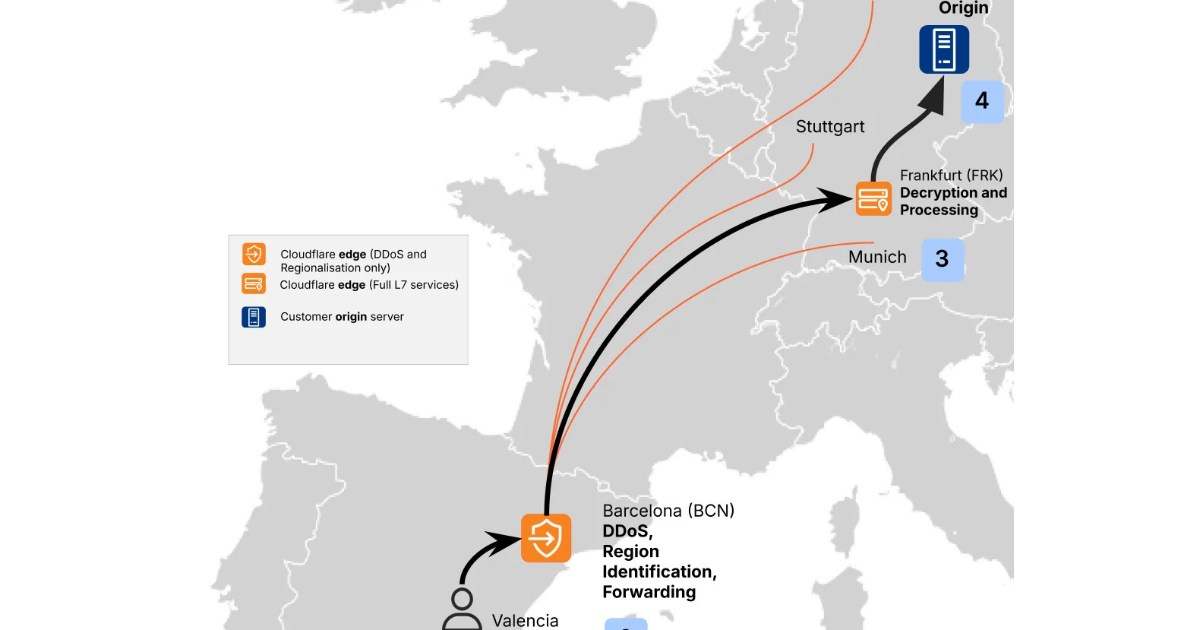
Cloudflare's Custom Regions is a genuinely useful step forward, but let's be clear about what it actually does. It gives customers precise control over where their data is processed at the application layer, selecting specific groups of data centers by country or region for TLS termination and processing. That matters for compliance, and it matters for anyone who has ever had to explain to a regulator where their data went.
The practical value here is straightforward. Many organizations have been forced into a binary choice: use a global CDN and hope data sovereignty requirements are met, or restrict themselves to a handful of regional providers and sacrifice performance. Custom Regions splits that knot. You can keep TLS termination and processing inside Germany, for example, while still benefiting from Cloudflare's broader network for caching and delivery. That is not a revolution, it is a pragmatic tool for a world where data boundaries are increasingly defined by law, not by engineering convenience.
We should note what this does not do. Cloudflare is not offering data residency in the sense of storage or full compute. This is about where TLS terminates and where application-layer processing occurs. If your compliance obligations require that data never leaves a specific country at rest, you still need a different solution. But for the common case of ensuring that user requests are not processed in jurisdictions you want to avoid, Custom Regions is a clean, configurable answer.
For the reader evaluating this, the takeaway is simple. If your compliance team has been asking where traffic is handled and you have been giving vague answers, this gives you a concrete answer. If you run a global application and need to serve users in the EU without routing through the US, you can now define that boundary explicitly. That is the kind of control that makes a spreadsheet user's life easier, not because the technology is flashy, but because it removes a variable you should not have to worry about.