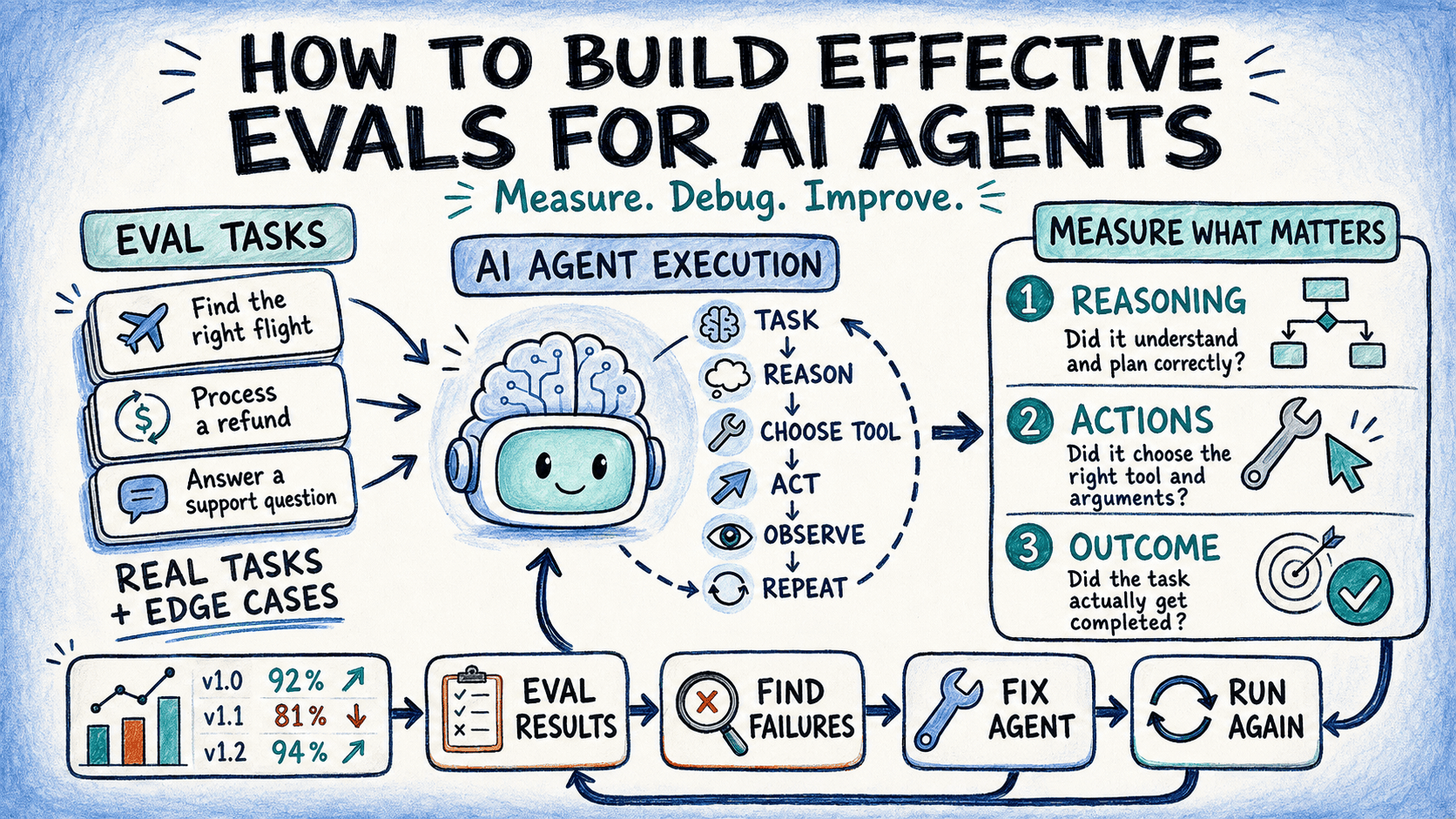
The most honest thing we can say about building evals for AI agents is that most teams start too late, and when they finally start, they aim for perfection on day one. Designing clear tasks and choosing the right graders is sound guidance, but it misses the deeper truth: evals are not a finish line, they are a habit. You do not build an eval harness once and call it done. You build a small, ugly version of it, run it against real failures, and then iterate. The teams that get this right are not the ones with the most sophisticated metrics. They are the ones who treat evals as a living practice, not a deliverable.
Our take is simple: stop trying to evaluate everything. Designing clear tasks is correct, but clarity is not the same as specificity. A clear task is one where the agent's success or failure is observable and unambiguous. If you cannot write a single sentence describing what a good outcome looks like, your eval is not ready. We would tell a reader who asks us directly: pick three real user workflows, write a handful of examples for each, and grade them with a simple rubric. Do not reach for an LLM judge yet. Do not build a complex harness. Just get a baseline. That baseline will teach you more about your agent than any theoretical framework ever will.
The harder question is grading. Choosing the right graders is where most implementations go off the rails. A grader that is too lenient gives you false confidence. A grader that is too strict makes you blind to progress. The pragmatic middle ground is to start with deterministic checks, like verifying that a specific tool was called or a specific field was filled, and only then layer on model-based grading for subjective quality. We have seen too many teams spend weeks building a perfect evaluation set, only to discover that their agent changed behavior in a way their evals never captured. That is not a failure of effort. It is a failure of feedback loops. Your evals should be noisy enough to catch regressions, but simple enough to update in an afternoon.
What we would tell a reader who is still on the fence is this: the real value of evals is not in the numbers. It is in the conversation they force you to have about what your agent is actually supposed to do. Tracking changes over time is not just about monitoring. It is about building a culture where every new feature comes with a question: how will we know if this is working? The teams that adopt that mindset are the ones who will ship agents that feel reliable, not magical. The rest will keep chasing the next prompt trick. The specific detail to watch is your regression rate: if you are not seeing your pass rate dip and recover on a weekly basis, you are not testing often enough. That is the metric that tells you whether your evals are actually doing their job.