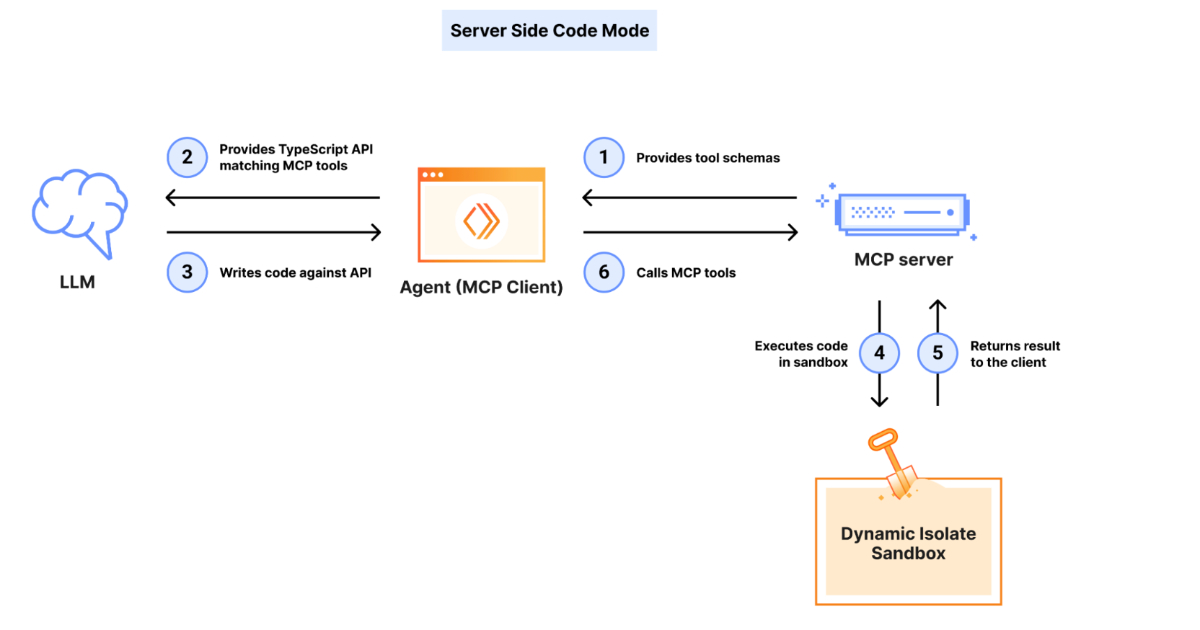
Cloudflare's new MCP server, powered by Code Mode, is the most practical step yet toward making AI agents genuinely useful in complex data environments. By slashing the token footprint across 2,500+ endpoints, Cloudflare has addressed the single biggest bottleneck holding back multi-API orchestration: context limits. This is not about flashy demos or abstract capability. It is about letting agents do more with less, which is exactly what enterprises need when they are trying to scale AI beyond a single, narrow use case.
For you, the person wrestling with unwieldy spreadsheets and sprawling data pipelines, this matters in a very concrete way. The promise of AI agents has always been that they could handle the tedious, multi-step work of pulling data from one system, transforming it in another, and pushing results somewhere else. But that promise collapsed under the weight of token consumption. Every API call, every response, every piece of context ate into a finite budget, forcing you to choose between a narrow set of actions and a shallow understanding of your data. Cloudflare's approach flips that trade-off. By offloading the heavy lifting to code execution, the agent keeps its reasoning overhead low and its operational reach wide. You are no longer asking the model to memorize every endpoint; you are letting it write the code to call them on demand.
What is particularly refreshing here is the emphasis on security and execution. Cloudflare is not just promising a smaller footprint; it is delivering a controlled, code-centric environment where agents can act with guardrails. That is the kind of pragmatic innovation that moves the needle. It acknowledges that the real challenge is not making an agent smart enough to understand an API, but making it reliable enough to use dozens of them without burning through your budget or your patience. For users who have been burned by overhyped demos that fall apart in production, this is a signal that the industry is finally prioritizing efficiency and safety over raw capability.
The takeaway is straightforward: the future of AI agents is not about bigger models or more parameters. It is about smarter execution, smaller footprints, and tighter security. Cloudflare has shown that you can give agents access to a vast ecosystem of APIs without demanding a king's ransom in tokens. If you have been waiting for a reason to trust AI orchestration with your most complex workflows, this is a concrete, measurable reason to start. The question is no longer whether agents can handle the scale. It is whether you are ready to let them.