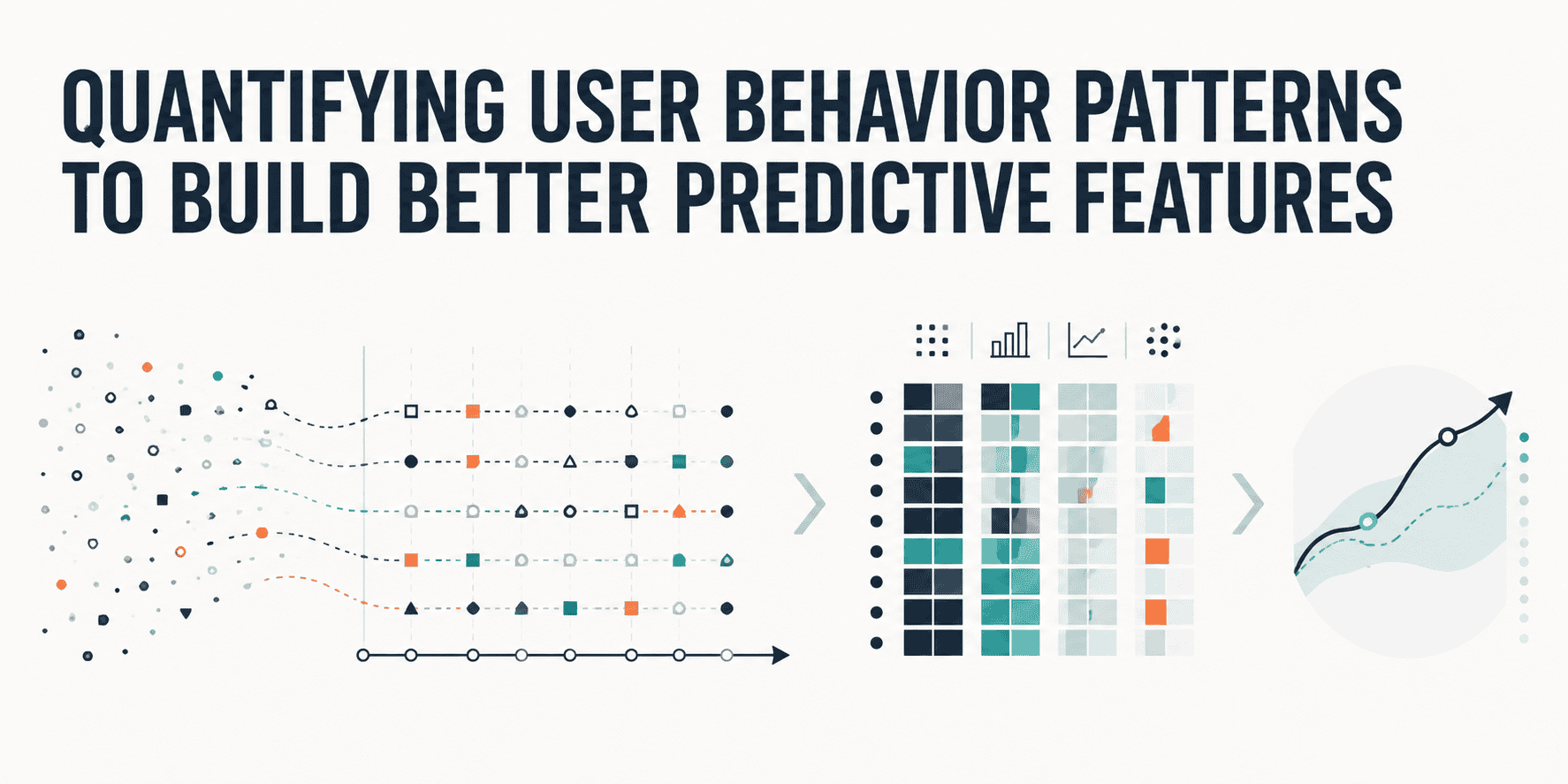
The opening premise, one we've circled for years, is that a 35-year-old male in Seattle clicked 12 times last month, and that number, on its own, is noise. It tells you nothing about whether he was frustrated, curious, or on the verge of abandoning the task entirely. The piece correctly identifies that behavior without context is just motion. For anyone who has ever stared at an analytics dashboard and felt the urge to apologize to their own product team, this is the validation you didn't know you needed. But the deeper point is more useful than a simple critique of shallow metrics. It's a call to stop building predictive features on top of lazy proxies and start asking what those clicks actually mean in sequence.
This is where the conversation gets practical. This stance aligns with the work we've explored in Exploring Real-World Computer Vision: Deployments, Edge Models, and Current Challenges, where raw sensor data only becomes useful when you understand the environment it's pulled from. A model that sees a cat in a living room is not the same as one that sees a cat in a warehouse aisle at 3 a.m. Similarly, a click on a "pricing" page means nothing if the user just came from a 40-minute session comparing you to a competitor. The intent is buried in the path, not the point. And when we look at Explore the Forrester Function: Beyond Mathematics, a Tool for Machine Learning, we see the same principle applied to optimization: a function's value is meaningless without knowing the bounds and the starting point. Your users are the same. Their behavior is a function of context, and if you're not tracking the context, you're just guessing at the derivative.
So what should you do with this insight? Stop asking "how many clicks" and start asking "what's the sequence before the action that matters." The piece hints at this, but we'll be direct: build features that model intent as a narrative, not a scorecard. That means logging the order of actions, the time between them, and the semantic role each interaction plays. It means treating a power user's 12 clicks as a sign of mastery, not engagement, and a new user's 12 clicks as a sign of confusion, not interest. The same number, opposite conclusions. That's the kind of nuance that separates a predictive feature from a pattern-matching trick. And if you're worried about privacy, which you should be, ICLR Submissions Exposed: Addressing Data Privacy Concerns in AI Research reminds us that collecting more granular behavioral data comes with real responsibility. The fix isn't to collect less; it's to be more deliberate about what you infer and how you protect it.
The takeaway you can quote: "A click is a fact, but intent is an argument." Build your features to make that argument, not just report the fact. The open question we're watching is whether teams will have the patience to redesign their logging infrastructure before they chase another shiny metric. Because the next time someone tells you a user "clicked 12 times," you should be the one asking, "Show me the story behind those clicks." If they can't, they're not building predictive features. They're building a horoscope for spreadsheets.