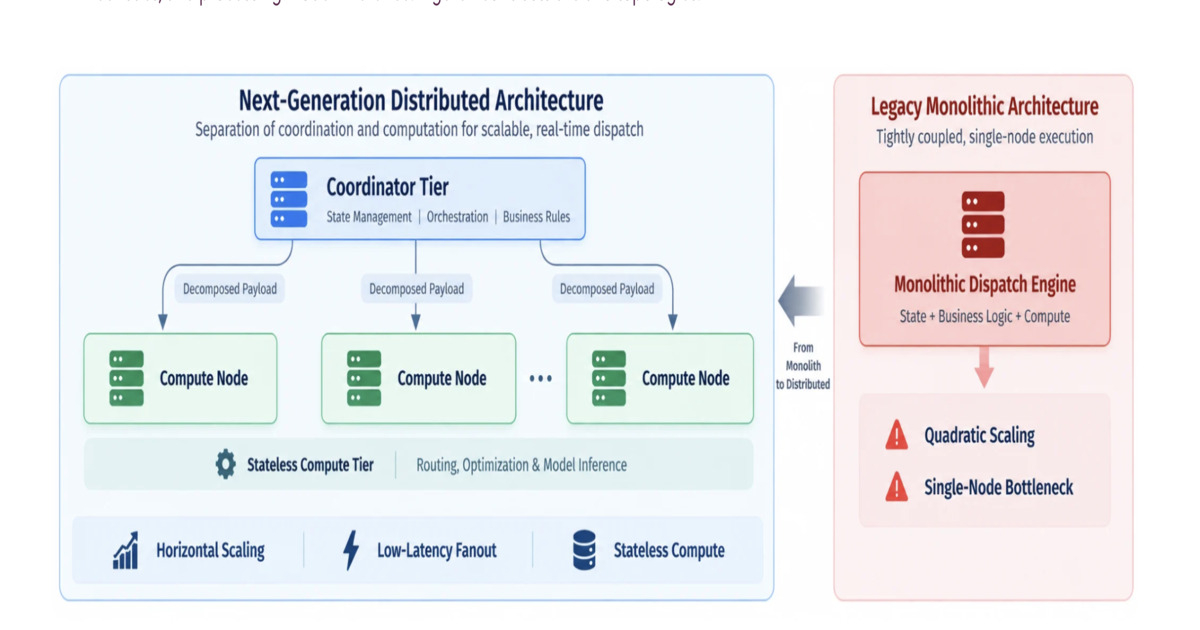
DoorDash's decision to dismantle its monolithic dispatch engine and rebuild it as a distributed system that separates coordination from computation is exactly the kind of architectural bet that most companies talk about but few execute. The results, 10x throughput and more than 99.99% peak availability, are impressive, but the real story here is about design philosophy. DoorDash chose to treat dispatch not as a single optimization problem to solve, but as a dynamic, real-time negotiation between agents. That shift matters for anyone who relies on complex decision-making at scale.
This redesign mirrors a pattern we've seen elsewhere, most notably in LinkedIn's New Analytics System Unlocks Clarity Across Any iOS UI Structure, where the team decoupled logical UI structure from native rendering to achieve clarity. Both projects reject the idea that a single, tightly coupled engine can handle growing complexity. DoorDash's approach goes further by embedding hybrid machine learning inference and multi-agent reinforcement learning directly into the dispatch flow. That means the system doesn't just process orders faster, it learns to make better assignments over time, adapting to traffic patterns, driver availability, and restaurant readiness without human intervention.
The practical takeaway is straightforward: if your system processes millions of decisions per second, a monolithic optimizer is a bottleneck, not a solution. DoorDash proved that splitting coordination (the "who goes where" logic) from computation (the "how to get there" math) unlocks both speed and resilience. The 99.99% uptime figure is no accident, distributed architectures isolate failures, so a slow computation node doesn't stall the entire dispatch pipeline. For businesses still running on legacy scheduling logic, this is a clear signal to reevaluate. Amazon secured Decart’s AI optimization team in a $7.5 billion deal for similar reasons: optimization at scale is a competitive advantage worth investing in heavily.
Yet the most interesting detail is what DoorDash didn't do. They didn't simply throw more servers at the old monolith. They rethought the fundamental architecture, embracing multi-agent reinforcement learning as a core component rather than a bolt-on. That's a bet on adaptability over raw horsepower. The question it raises for every operations-heavy organization is not whether to modernize, but how deeply to rewire the logic itself. Tesco’s decade-long shift from legacy systems to a unified cloud-edge platform shows that transformation takes time, but DoorDash's results suggest the payoff can come faster when you prioritize architectural separation and learning over incremental patching. Watch for other logistics and delivery companies to follow suit, not because they have a choice, but because the cost of not doing so is now measurable in throughput and uptime.