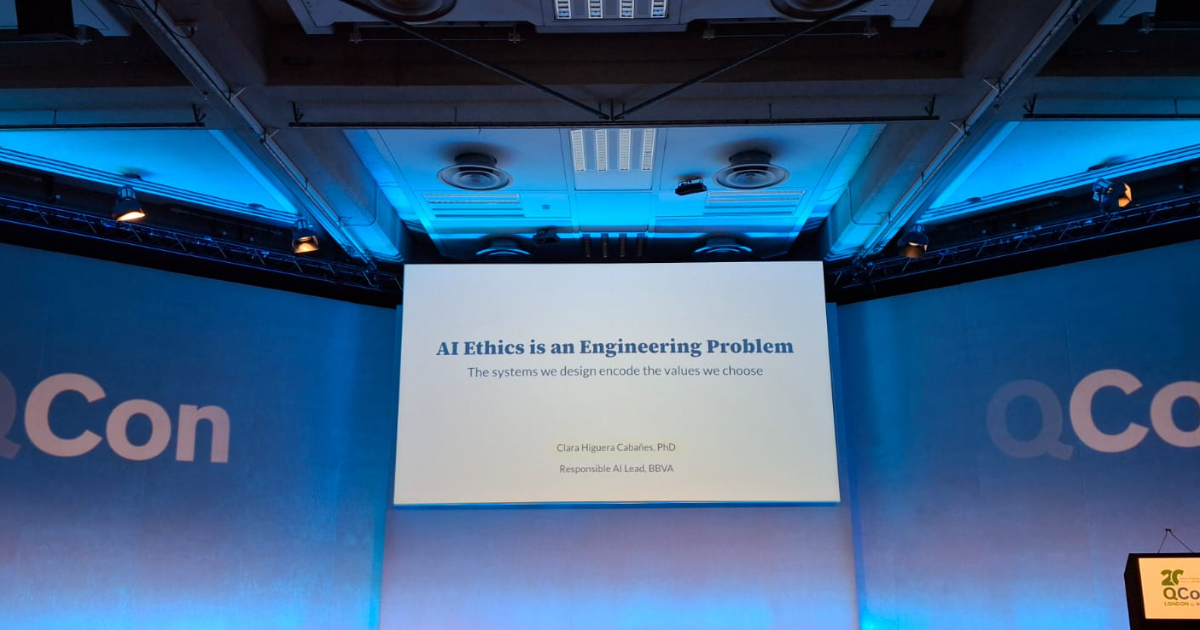
Clara Higuera's argument at QCon London 2026 cuts through a lot of noise: ethical AI is not primarily a policy problem, it is an engineering problem. That is the right diagnosis. For too long, organizations have treated responsible AI as an exercise in writing principles, forming ethics boards, and publishing transparency reports. Those efforts matter, but they mean little when the underlying systems are built without the rigor required to control what they actually do.
Higuera, as Responsible AI Program Lead at BBVA, framed the risks as fundamentally technical. Bias, explainability, robustness, and safety are not abstract governance questions. They are design and validation challenges that demand the same discipline we apply to performance, scalability, and security. If a model behaves unpredictably in production, no policy document will fix it. The fix comes from testing, monitoring, and engineering controls embedded directly into the development lifecycle. This shifts the conversation from aspiration to accountability.
What this means for teams building AI tools is straightforward. You cannot delegate ethics to a separate committee or a one-time review. The people writing the code, designing the data pipelines, and running the experiments are the ones who determine whether a system is trustworthy. That does not mean every engineer needs to become an ethicist. It means they need practical methods for detecting drift, auditing outputs, and measuring fairness, tools that fit into their existing workflows. When a model's decisions affect credit, hiring, or healthcare, the engineering team owns that outcome whether they acknowledge it or not.
The practical takeaway for our readers is this: treat responsible AI as a technical debt that compounds when ignored. Start with the same rigor you apply to latency or uptime. If your organization has a responsible AI policy but no corresponding engineering standards, the policy is a placeholder. Higuera's message is a direct challenge to that gap. The next step is not another framework. It is a pull request.