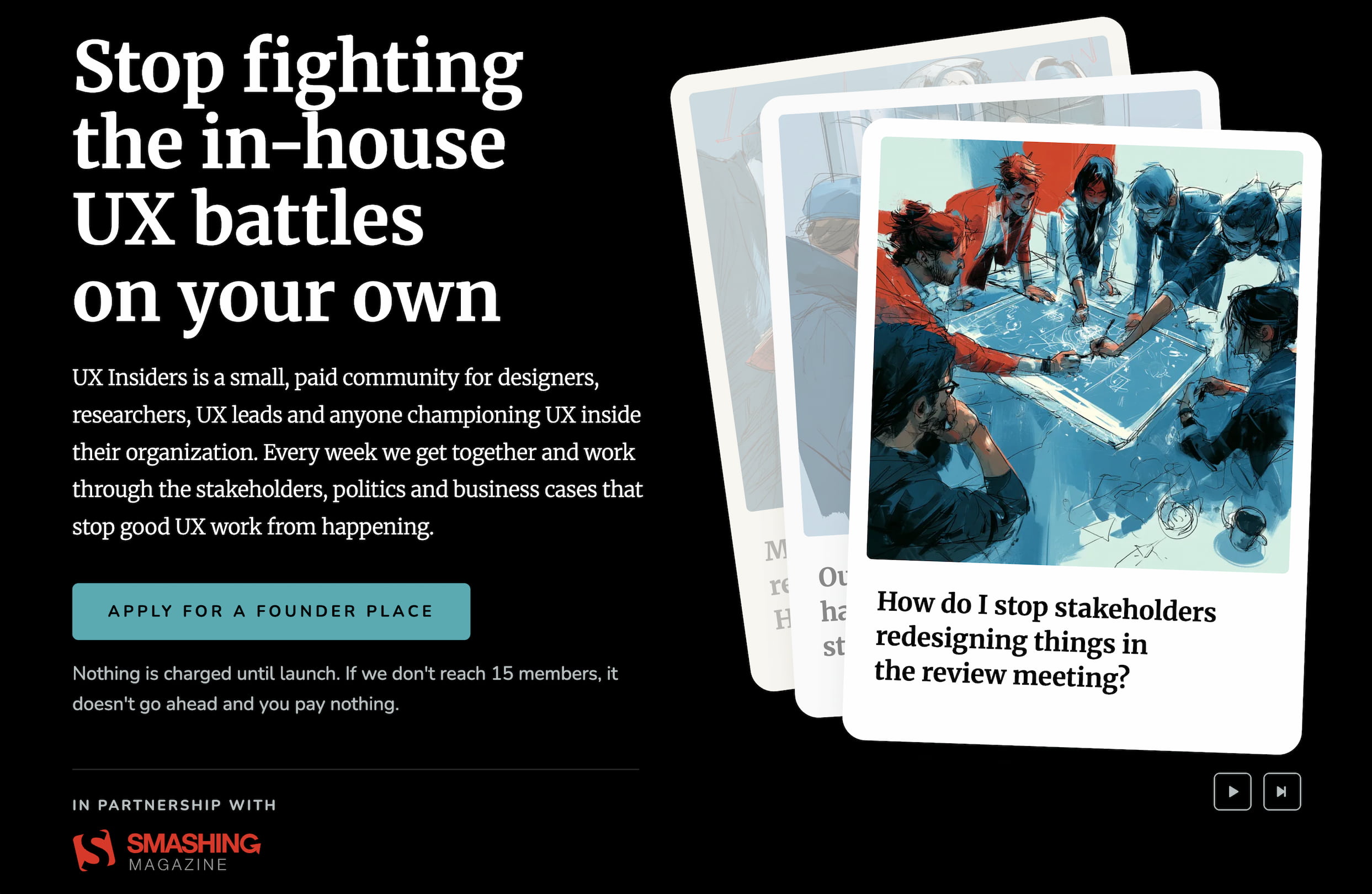
The UX profession has an isolation problem that no tool update or workflow hack can solve, and Paul Boag's new UX Insiders community is one of the smartest responses to it we've seen in years. As organizations lean harder into AI and squeeze budgets, the people advocating for user experience inside companies are often fighting alone, without a peer who has navigated the same political maze. That practical, human-centered gap is exactly what this community targets, and it matters far more than any feature release.
The raw truth Boag surfaces is that the hardest part of UX work inside an organization rarely involves pixels or prototypes. It is the business case that stalls, the stakeholder who overrides decisions, the sudden directive that AI can replace research. These are not design problems; they are political and strategic ones, and they require outside perspective to solve. A shared library of templates and research plans that have actually worked, not generic best practices, but real artifacts from people in similar roles, provides a kind of institutional memory that most in-house teams lack. And the weekly call format, run by someone who has been writing about digital work for years, keeps the advice grounded in experience rather than theory. This contrasts sharply with the recent news that Microsoft Retires Two Developer Tools, Redirects Teams to Manual Workflows, where a company simply ends a service and leaves teams to figure out replacements alone. UX Insiders does the opposite: it builds a support system before the problems compound.
What makes this worth watching is the deliberate, constrained structure. The community is for in-house people only, with a simple application gate that keeps out vendors and consultants. That honesty about who belongs in the room builds the trust necessary for candid conversations about organizational dysfunction. It is not a network for everyone; it is a network for people who share a specific context. The founder pricing for the first 25 members, £49 per month billed annually, locked in for as long as you stay, also signals a long-term bet rather than a quick launch. And the go/no-go threshold of 15 members by December 11 is refreshingly transparent: if the demand is not there, nobody pays. Compare that to the friction of Explore simpler ways to open CSVs without endless extra steps, where even a routine data task becomes a series of workarounds. Boag has removed the workarounds from joining: apply, get approved, start talking.
The concrete takeaway is this: if you are a UX professional inside an organization and you have ever wished you could ask someone outside your company "how did you handle that stakeholder?" or "can I see your actual research plan?", this is the structure that makes that possible on a recurring basis. The value is not in the platform, it is in the guarantee that someone else in the Slack channel has faced the same problem and can tell you what worked. Watch whether the first few weekly calls surface specific, reusable artifacts, because that library will determine whether the community becomes indispensable or just another calendar invite.