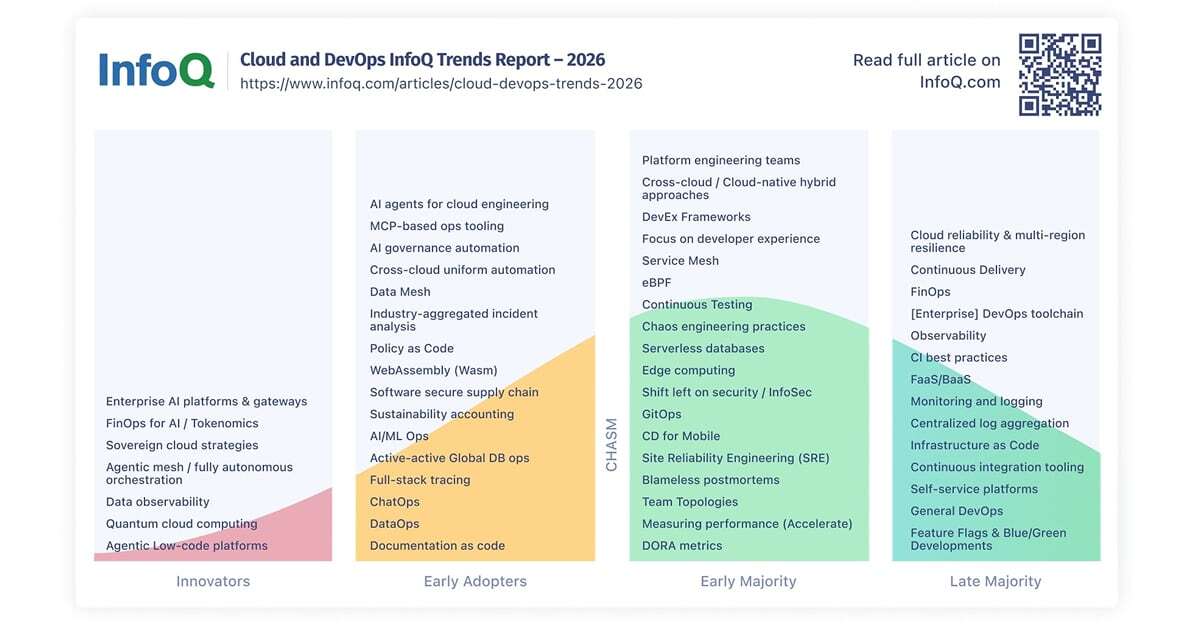
The InfoQ Cloud and DevOps trends report for 2026 is not a list of predictions. It is a mirror held up to the teams who are quietly drowning in their own infrastructure. When the editorial staff sits down to discuss what is emerging, they are not chasing novelty for its own sake. They are tracking the slow, grinding shift from managing systems to negotiating with them. For anyone who has spent a late night debugging a pipeline, the report's value is not in the headline topics. It is in the permission it gives you to stop treating operational firefighting as a permanent state of being.
Our take is straightforward: the conversation has moved past the tools themselves and into the economics of attention. The report's authors are pointing at a real tension that most engineering leaders feel but rarely articulate. The cloud was supposed to remove undifferentiated heavy lifting. Instead, it created a new kind of cognitive load. Every service, every config, every dependency asks a small piece of your brain to hold it in context. The trends report is essentially documenting how the best teams are responding to that load by building systems that require less human babysitting. They are not looking for a better YAML editor. They are looking for a way to make the platform itself explain what it needs.
For our readers, the practical consequence is immediate. If you are still evaluating your infrastructure strategy based on feature checklists, you are already behind. The teams that will thrive in 2026 are the ones who treat their cloud environment as a product with internal users, not as a collection of resources to be provisioned. The report's discussion of platform engineering trends is not a vendor pitch. It is a survival mechanism. We would tell any engineer or CTO who asks us directly: stop asking what tool to adopt next. Start asking what your team is trying to unlearn. The friction you feel today is often the result of processes that made sense for a smaller scale but are now actively hostile to progress.
The specific detail to watch is how the report frames the relationship between AI assistance and operational ownership. The editorial staff are not naive enough to claim that AI will replace the need for skilled operators. But the trajectory is clear. The next generation of cloud tools will not just automate tasks. They will change what questions you are capable of asking. That is the real transformation. If you are waiting for a single killer feature to justify your migration, you are missing the point. The point is that the baseline for what counts as an acceptable developer experience is rising. Our advice is to read the report not as a forecast, but as a checklist of operational debt you have been ignoring. The teams that take that seriously will not just survive the next twelve months. They will define what the rest of the industry copies two years later.