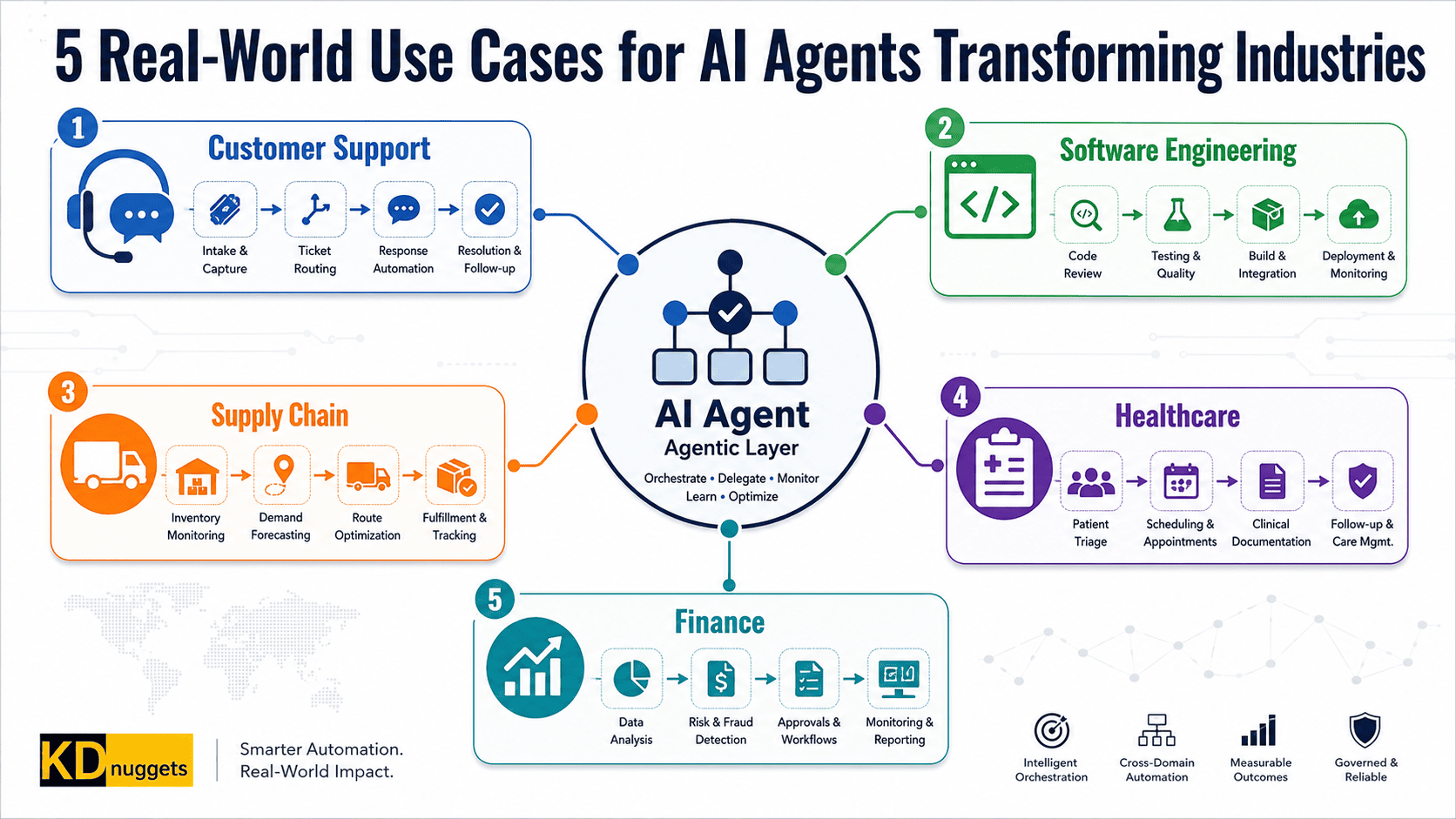
The shift we are watching across industries is not about spreadsheets getting faster or dashboards getting prettier. It is about work changing shape. The five use cases for AI agents, spanning support, coding, supply chains, healthcare, and fraud detection, are not isolated experiments. They are the first drafts of a new operational reality. If you have spent years wrestling with static rows and manual updates, you already understand the appeal. The promise here is not automation for its own sake. It is the removal of friction that has quietly capped what a single team can accomplish. This is why we keep returning to the idea of exploration over replacement. You are not being asked to abandon your tools. You are being asked to consider what happens when the tools start meeting you halfway.
What stands out in these real-world deployments is how unglamorous the wins actually are. An agent handling tier-one support tickets is not writing poetry. A system flagging fraudulent transactions is not dreaming in numbers. But these are the tasks that eat hours and morale. The practical consequence for our readers is simple: the barrier to entry is lower than the hype suggests. You do not need a data science team to start. You need a clear-eyed look at which repetitive, rule-based decisions are draining your calendar. The related work on bridging retrieval and action reinforces this point, showing that the gap between finding information and acting on it is where most of the value lives. Similarly, the practical guidance in unlocking ChatGPT for work suggests that the path forward is less about exotic architecture and more about disciplined prompts and clear boundaries.
Our honest take is that the industries highlighted are not the story. The story is the shift in accountability. When an AI agent autonomously manages a supply chain exception, who owns the outcome? The answer is still a human, but a human with different responsibilities than before. This is uncomfortable, and it should be. It is also inevitable. The teams that treat these agents as junior colleagues, with clear instructions and defined limits, will outperform those waiting for perfect reliability. We would tell a reader who asks, "Where do I begin?" to pick one process that is painful, measurable, and low-risk, then map the exceptions before letting an agent near it. The future we are moving toward is not one where you are replaced. It is one where your judgment becomes the bottleneck, which is a much better problem to have. As we look at how AI designs its own hardware, the trajectory is clear: the agent is not the destination, the judgment is. Watch for the moment your own tools start suggesting the next step. That is not a glitch. That is the signal.