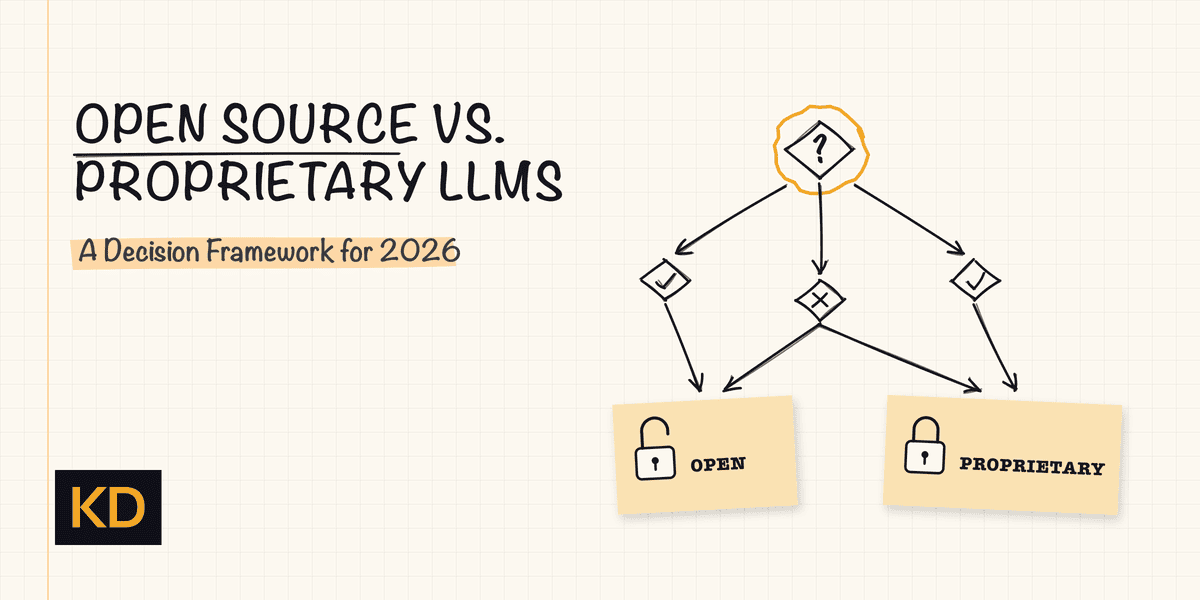
The four-question framework for choosing between open-weight and commercial LLMs is exactly the kind of practical thinking that has been missing from most AI infrastructure conversations. Rather than asking which model has the highest benchmark score or the largest context window, the guide forces a more useful line of inquiry: What does your actual workflow require, and under what constraints do you operate? This matters because the gap between a model that looks great on paper and one that performs reliably in production is where most data teams waste time and budget.
We have seen this pattern before in the evolution of data infrastructure. The discussion around model selection mirrors the debates playing out in storage and compute layers. For instance, Apache Iceberg V4 Redesigns Metadata to Handle More Frequent Writes represents a similar reckoning: metadata architecture must align with actual write patterns, not idealized workloads. The same principle applies to LLMs. An open-weight model may give you full control over fine-tuning and data residency, but if your use case demands low-latency inference at scale, a commercial API might serve you better without the operational overhead. The four questions cut through the noise by tying the decision directly to your data pipeline's real behavior.
The timing of this guide is no accident. As Nvidia affirms open source AI path and Hugging Face plans after CEO shift, the ecosystem is signaling that both open and closed approaches will persist. That makes the selection framework more valuable, not less. The risk is that teams treat the choice as ideological rather than operational. The guide sidesteps that trap by asking about latency tolerance, integration complexity, and the cost of model drift. Those are the variables that actually break projects.
The concrete takeaway is this: ignore model hype and start with the question of how frequently your data changes and how quickly you need answers. If your data is relatively static and your inference volume is predictable, an open-weight model you can self-host may win on cost and control. If your queries are ad hoc and your latency requirements are tight, a commercial model with a well-managed API will likely outperform. The four questions give you a repeatable process, not a one-time answer. Watch how your answers shift as your data volume grows, because the right choice in 2026 may not be the right choice in 2027.