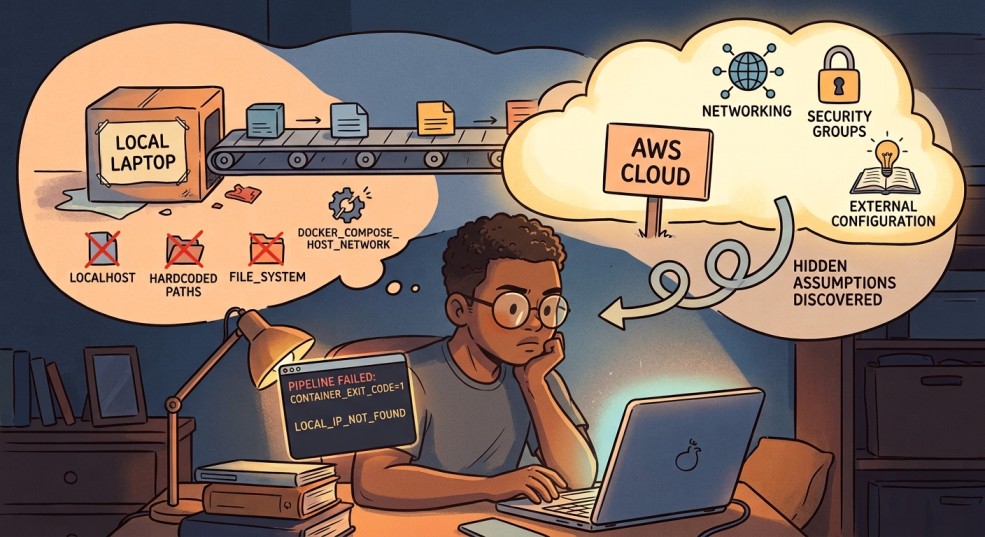
There's a quiet comedy in the moment your code stops being your problem and becomes the infrastructure's problem. Moving a Dockerized data pipeline to AWS captures that exact friction. On a laptop, everything works because you've unconsciously memorized the environment. The container hides the app, but not the assumptions. You assume networking is a given, storage is local, and environment variables are just there. Then you deploy, and the first thing that breaks is the thing you never thought to check. That's not a failure of the tool. That's the discipline of deployment finally introducing itself.
The honest take here is that "it works on my machine" isn't a punchline anymore. It's a design flaw in your mental model. When you move to AWS, you're not just changing where the code runs. You're changing the contract between your code and the world. Local paths become meaningless. DNS names replace container names. IAM permissions gate what you used to get for free. The real lesson is that Docker gives you portability of the application, but not of the environment. You still have to think about the network, the volumes, and the execution context. For anyone building data pipelines, this is the difference between a demo and a system. A demo runs on your laptop. A system runs despite your absence.
What we would tell a reader asking about this is simple: treat your local environment as a liar. Not because it's malicious, but because it's too kind. It fills in every gap you forgot to specify. So before you deploy, audit your assumptions. Check for hardcoded paths. Verify that your container doesn't rely on the host's DNS. Understand how your cloud provider's VPC handles outbound traffic. And for the love of reproducible builds, write down the networking rules you think are obvious. Because they aren't. The moment you're debugging a connection timeout that works locally, you'll wish you had.
The practical takeaway, the one worth quoting, is this: containers don't solve environment drift, they just make it easier to see where you cut corners. This isn't a warning against cloud deployment. It's an argument for treating deployment as a first-class citizen in your development process. So when you move your pipeline, expect the breakage. Plan for it. And remember that the difference between a smooth migration and a painful one is rarely the code. It's the assumptions you didn't know you were making. The open question we're left with is not whether you'll hit these issues, but whether you'll bother to document the fix for the next person. That documentation is the only thing that separates a one-time headache from a recurring one.