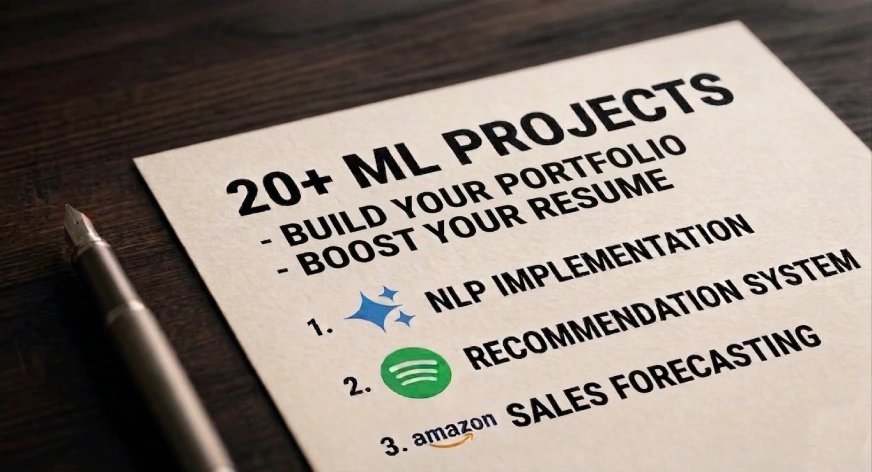
Theory gives you the foundation, but projects prove you can build. That is the core truth behind the collection of solved ML projects recently published by Analytics Vidhya, and it is a truth every aspiring data professional should take seriously. Recruiters do not ask to see your course completion certificates; they ask to see what you have made work. A portfolio of real, diverse projects is the single most direct signal of your ability to solve the problems they will pay you to solve.
This guide compiles more than twenty solved projects spanning regression, forecasting, natural language processing, and computer vision. That range matters. It tells a recruiter that you are not a one-trick specialist who memorized a single algorithm, you are someone who can adapt your approach to the data in front of you. Each solved project is a finished artifact, not a half-finished tutorial. That distinction is everything. A tutorial shows you followed instructions. A solved project shows you understood the problem, made decisions, and delivered a result. The guide gives you the latter, and it gives you the context to explain why each solution works.
What this means for you is straightforward: stop waiting until you feel ready. Start building. Pick a project in a domain that interests you, maybe the forecasting one if you work with time-series data, or the computer vision project if you want to explore image classification. Work through it until you understand every step. Then change one variable. Try a different dataset. Break it and fix it. That is where the learning accelerates, and that is what turns a solved project into a personal portfolio piece. The twenty-plus examples are a starting point, not a finish line.
Your resume will not get stronger by reading another chapter on gradient descent. It will get stronger when you can point to a project and say, "I built this, it works, and here is why." Go build.