Getting Started with the Claude API in Python
Our take
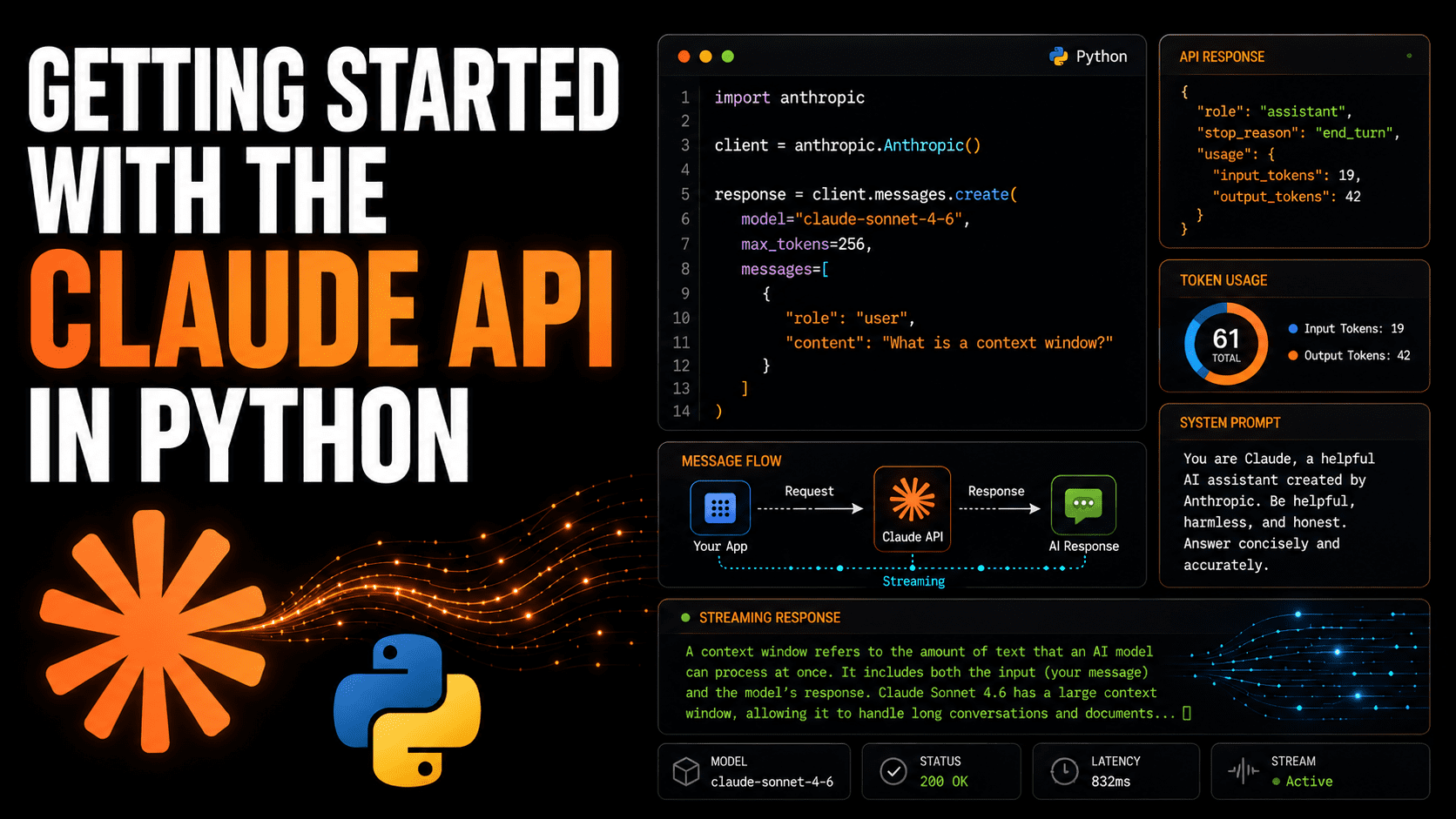
The emergence of accessible APIs for powerful language models like Claude marks a significant shift in the landscape of AI-driven data management. While generative AI has captured considerable attention, its practical application often felt locked behind complex infrastructure and specialized expertise. The release of the Claude API, particularly with readily available Python SDKs, democratizes access to this transformative technology. It’s a move that aligns perfectly with our vision of empowering users to harness the potential of AI without being overwhelmed by technical hurdles. For those already exploring the world of AI agents, the Claude API offers a compelling new tool. Consider the possibilities offered by [Getting Started with Hugging Face ML Intern: Your First ML Agent], where the model handles both code generation and training; integrating Claude’s reasoning capabilities could significantly enhance the agent’s problem-solving abilities. The ease of integration, as demonstrated in this new article, lowers the barrier to entry considerably, allowing developers and data professionals alike to begin experimenting and building real-world applications.
The significance extends beyond simply accessing a powerful language model. It's about opening up new avenues for automating complex workflows, extracting insights from unstructured data, and building more intelligent applications. Think of the predictive analysis challenges explored in [Predictive analysis of rotating equipment], where Claude could be leveraged to interpret sensor data, identify anomalies, and refine Remaining Useful Life (RUL) predictions with greater accuracy. The ability to seamlessly integrate Claude into existing Python environments – a language already extensively used in data science and development – further accelerates adoption. While style transfer applications, as discussed in [Improving machine-translated novels via style transfer — looking for advice on the faithfulness/fluency tradeoff [P]], may seem niche, they highlight the broader potential for Claude to refine and improve existing processes. The API’s flexibility allows developers to tailor the model's output to specific needs, mitigating potential issues like faithfulness versus fluency in translation, or accuracy versus explainability in predictive models.
The article’s focus on the fundamentals—making the first request and handling responses—is crucial. It highlights a deliberate strategy to provide a gentle onramp for users. This is a far more productive approach than overwhelming newcomers with advanced features. By focusing on the core functionality, the article enables users to quickly grasp the basics and begin building upon them. We’ve consistently emphasized the importance of accessibility in our approach to AI-native spreadsheet technology, and this aligns perfectly with that philosophy. It’s not about showcasing the complexity of the underlying algorithms; it’s about empowering users to achieve tangible results. The official SDK’s availability is also a testament to the commitment to developer experience, providing a stable and well-documented interface for interacting with the API.
Ultimately, the Claude API’s accessibility represents a critical step toward a future where AI is not a specialized tool, but an integral part of everyday workflows. The ease of integration, combined with Claude’s impressive capabilities, creates a potent combination for innovation. The focus on Python integration is particularly noteworthy given the prevalence of Python in data science and machine learning. As more developers and data professionals gain experience with the API, we anticipate a surge in creative applications across a variety of industries. The question now becomes: how will businesses leverage this newfound accessibility to transform their data management strategies and unlock previously unattainable levels of productivity and insight—and what new, unforeseen use cases will emerge as the technology matures?
Read on the original site
Open the publisher's page for the full experience