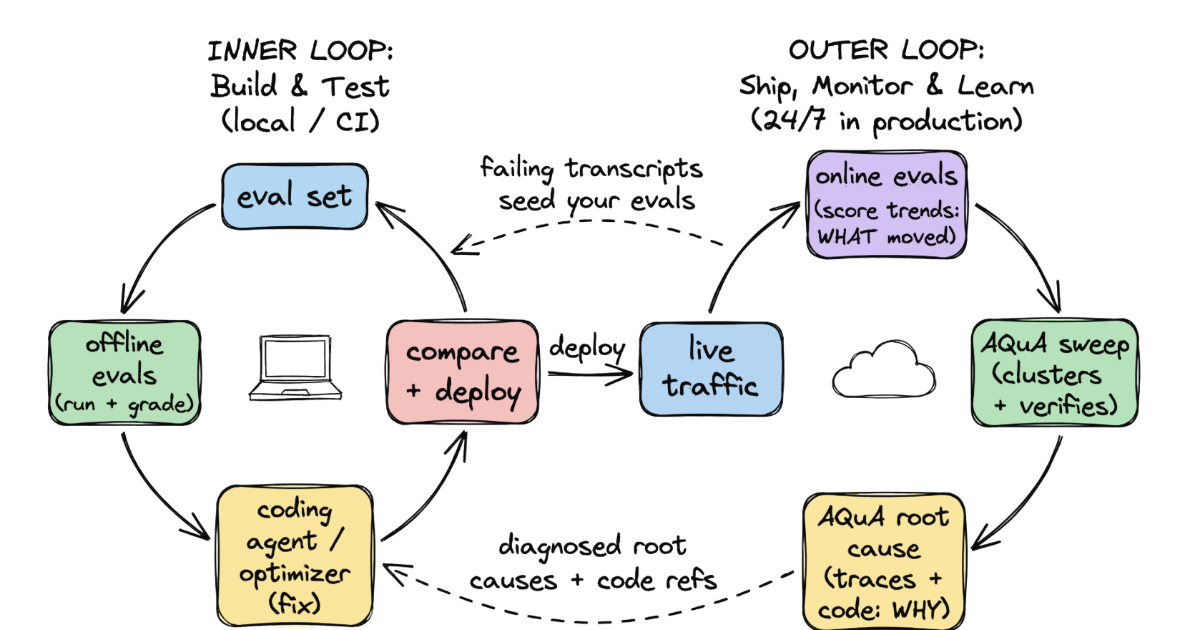
Google's decision to open-source AQuA is a practical and welcome step toward making AI agents actually reliable in production. For too long, the conversation around agentic AI has focused on what these systems can do in demos, not on how they fail when real users interact with them. AQuA changes that by giving developers a concrete tool to analyze production sessions, identify recurring failure patterns, and trace those failures back to specific deployed source code. That is the kind of transparency that builds trust, not hype.
The results from Google's 32-session replay are telling. After prompt changes guided by AQuA's analysis, seat selection bypasses dropped from 15 sessions to two, and dietary preference omissions went from seven to zero. Those are not hypothetical gains, they represent real user friction eliminated. This matters because the gap between what an agent does in a controlled test and what it does in the wild can be enormous. Our own reporting on software reliability reinforces that point: Testing Reveals 41% of Faults Go Undetected in Newer Python Libraries found that nearly half of planted faults slipped past detection in popular libraries. If standard testing misses that much, agent behavior in production is an even harder problem. AQuA offers a way to close that gap by rooting analysis in actual user sessions rather than synthetic scenarios.
What makes this tool particularly useful is its focus on root cause investigation against deployed source snapshots. Many debugging approaches treat agent failures as black-box events, you see the wrong output, but you cannot easily tell whether the prompt, the model, the tool call, or some interaction between them caused it. AQuA links failure patterns directly to the code that was running when they occurred. That shifts debugging from guesswork to forensic analysis. For teams building AI agents into customer-facing workflows, this is the difference between chasing symptoms and fixing causes.
The open-source nature of the release is also worth noting. Google is not selling a proprietary debugger or locking this capability into a closed platform. By making AQuA a reference implementation anyone can inspect, modify, and run, the company is acknowledging that agent reliability is a shared infrastructure problem, not a competitive advantage. That aligns with a broader trend we have observed: Nvidia's open source AI future faces new questions after Huang's exit raised concerns about how commitment to open-source AI can shift with leadership changes. Google's move with AQuA suggests a different approach, one where the tool itself is open, regardless of corporate priorities.
The specific takeaway is this: if you are deploying AI agents in production today, you should treat AQuA as a baseline, not a luxury. The 32-session replay reduced real user errors by an order of magnitude. That is not a marginal improvement; it is the difference between an agent that frustrates users and one that earns their trust. The open question is how quickly the broader ecosystem will adopt this kind of production-first debugging, and whether the tooling will evolve to handle the scale and complexity of multi-agent systems. For now, Google has given developers a clear starting point. What they do with it will determine whether the next generation of AI agents actually works when it matters.