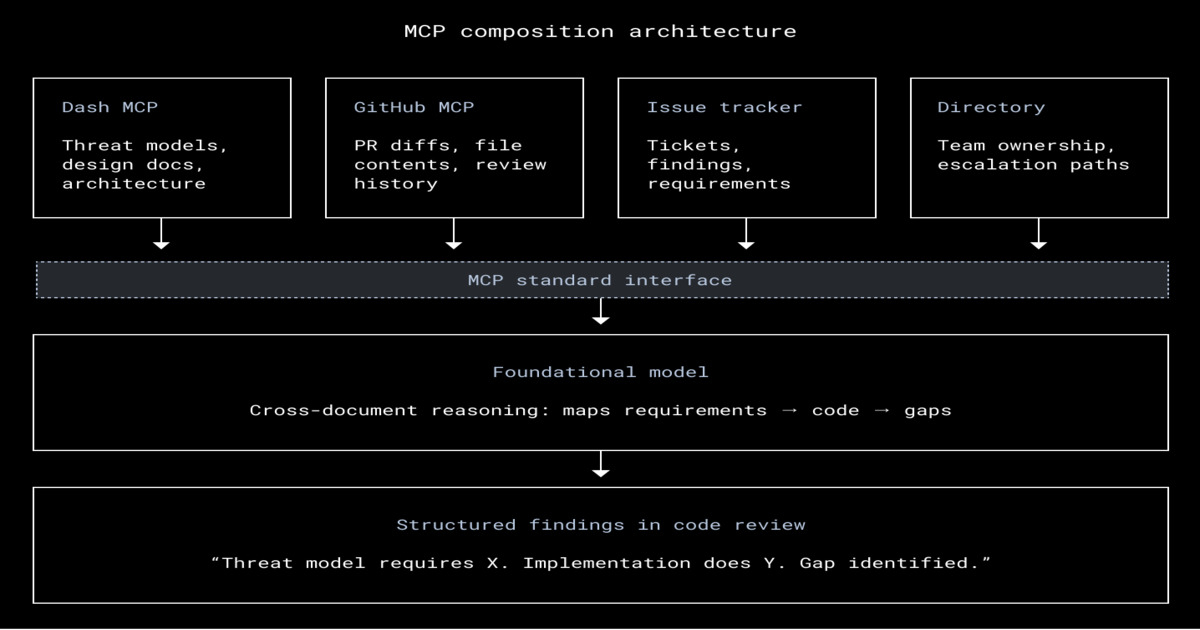
Dropbox's decision to wire Model Context Protocol into its internal knowledge platform, Dash, is a quiet admission that the hardest part of security reviews isn't reading code. It's remembering why the code exists in the first place. By surfacing threat models and security requirements directly inside pull requests, the company has turned a chronic pain point into a design constraint: context should travel to the reviewer, not the other way around. That sounds simple, but anyone who has watched a developer juggle a spec doc, a ticket, and a diff across three monitors knows how rare that simplicity is in practice.
The real insight here isn't the integration itself, but what it signals about the future of code review. We've spent years building linters and static analysis tools that catch known bad patterns. Those tools are necessary, but they're also backward-looking. MCP-driven retrieval is a step toward closing the loop between intent and implementation. When a reviewer opens a pull request, they're not just checking for bugs; they're validating that the design's security promises were kept. Dropbox's approach makes that validation tangible by pulling the threat model into the same interface where the code is being questioned. That's not a feature add. It's a workflow shift.
For teams considering a similar path, the takeaway is direct: start with your knowledge graph, not your model. Dropbox's advantage wasn't a smarter AI. It was Dash, a platform that already organized security design documents into a queryable structure. MCP is the messenger; Dash is the memory. If your organization doesn't have that foundation, bolting on context retrieval will just give you faster access to scattered information. The lesson is to invest in structuring your security knowledge first, then add the protocol layer. Otherwise, you're building a faster car with no road.
The open question worth watching is how this scales beyond threat models. If MCP can surface security design for pull requests, the same pattern applies to compliance checks, architectural decision records, or even API deprecation rationales. Dropbox has effectively demonstrated that the gap between design and review is an information problem, not a discipline problem. The concrete thing to track next is whether they publish their evaluation methodology for retrieval quality. Any team can demo a demo. Knowing how they measure whether the right context reached the right reviewer at the right time would give the rest of us a benchmark to hold our own systems against. That's the detail that turns an interesting integration into a repeatable practice.