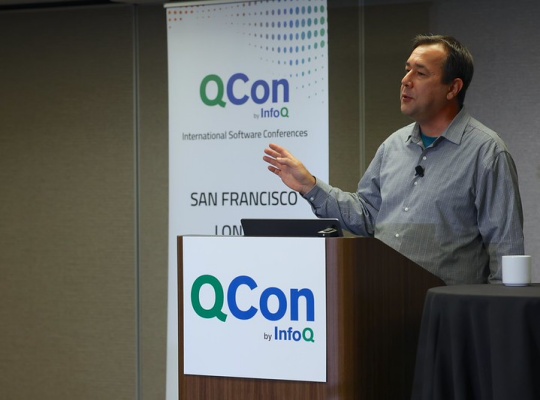
The economics of the cloud have a way of exposing assumptions we stopped questioning. For years, we treated the database as a monolithic appliance: compute and storage fused together, scaled as a unit, and paid for as a unit. Murat Demirbas's presentation on disaggregated systems argues that this coupling is no longer a technical necessity but a financial choice, and one that increasingly does not make sense. By decoupling compute from storage, you gain elastic scaling and fault isolation, but you also start paying only for what you actually use. That is not a tweak. It is a different way of thinking about infrastructure, and it aligns with the pressures many teams feel today as workloads grow more variable and budgets more scrutinized.
What makes Demirbas's take compelling is his historical framing. He points out that classical Paxos roles already foreshadowed this separation, with leaders and acceptors operating as distinct logical functions. The idea of splitting responsibilities is not new; what changed is that cloud economics finally make it practical at scale. This resonates with adjacent conversations in our coverage. For instance, as teams architect AI-Powered Mobile UIs: Speed, Delight, and Scalability, they face the same tension between responsiveness and infrastructure cost. And when Dropbox Evolves Riviera Content Processing Platform to Support AI Workloads, they are effectively building a disaggregated pipeline where storage and processing are optimized independently. The pattern is everywhere: the most practical systems are the ones that stop pretending every component must live in the same box.
Our honest take is that disaggregation is not a silver bullet, and Demirbas does not pretend it is. Network tradeoffs are real. Moving data between compute and storage introduces latency that shared-memory designs avoid, and not every workload justifies that cost. But the evolution of shared-memory systems suggests we are getting better at masking those penalties, and self-assembling database designs point toward a future where the system adapts to the workload rather than the other way around. If you are running a data-heavy application today, the question is not whether disaggregation is fashionable. The question is whether your current architecture is charging you for idle compute or forcing you to over-provision storage to get the performance you need.
The practical takeaway for readers is straightforward: start auditing where your costs actually accumulate. If you are paying for storage you rarely touch or compute that sits idle during off-peak hours, disaggregation deserves a serious look. This is especially relevant given the memory pressure described in The KV Cache Tax: Why Inference Servers Run Out of Memory Before Compute, where the bottleneck is not raw processing power but how resources are allocated. Demirbas's presentation gives you a vocabulary for that problem, and a historical reason to trust that the separation is viable. Watch how network latency improvements continue to close the gap. That is the detail that will decide whether disaggregation moves from clever architecture to default choice.