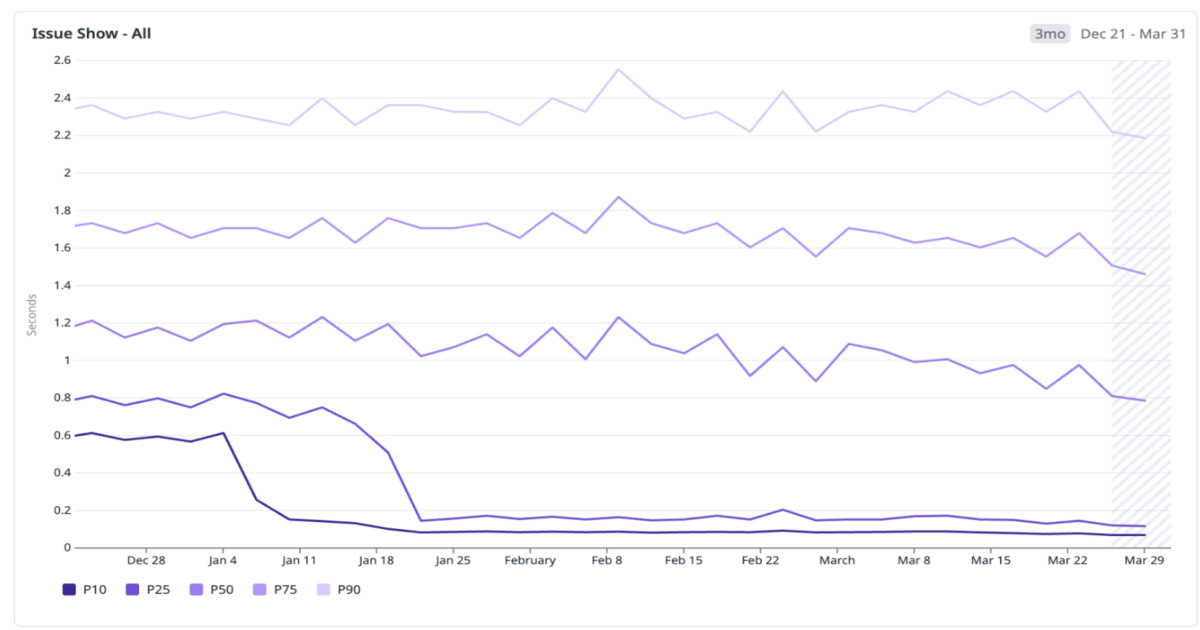
GitHub's recent work on Issues navigation is a quiet masterclass in making the web feel instant. By rethinking client-side architecture with a combination of caching, predictive prefetching, and service workers, the team lifted instant navigation from 4% to 22%. That jump is not just a metric; it is a signal that the biggest performance wins are no longer found in faster servers, but in how intelligently we treat the browser as a partner. For anyone who has watched a spinner spin while waiting for a page reload, this is the kind of engineering that turns a daily frustration into a non-event.
The practical takeaway here is that perceived latency is a product feature, not a backend problem. GitHub's use of IndexedDB and in-memory caching means that data is served from where the user is, not from where the server happens to be. This is especially relevant for teams building data-heavy tools, where the gap between a click and a response often defines whether a workflow feels fluid or clunky. Instead of waiting for a network round-trip, the system predicts what you will need next and has it ready. That is the difference between a user pausing to wonder if the app broke and a user staying in flow. For product managers and developers alike, this is a reminder that the best interactions are the ones you do not notice.
What we would tell a reader asking about this is straightforward: do not wait for your platform to solve this for you. The architecture GitHub describes is not magic, but it does require intentionality. Predictive prefetching and background synchronization are not one-size-fits-all features; they demand a clear understanding of user journeys and the data that matters most at each step. Start small, measure the impact on perceived speed, and iterate. The 4% to 22% improvement did not come from a single fix but from a layered approach, and that is the real lesson. It is also worth noting that this focus on client-side intelligence will only grow as more applications move toward real-time collaboration and offline-first experiences.
The open question we are watching is how far this pattern scales. GitHub's Issues are a structured, bounded dataset, but most organizations are not working with that kind of clarity. As this approach spreads to more complex, sprawling data models, the challenge will be deciding what to prefetch and what to leave behind. For now, the concrete point to take away is this: instant navigation is not about doing less work, but about doing the right work before the user asks. If you are building a tool that relies on navigation, ask yourself what your version of 4% to 22% looks like, and whether you are ready to invest in the architecture that makes it possible.