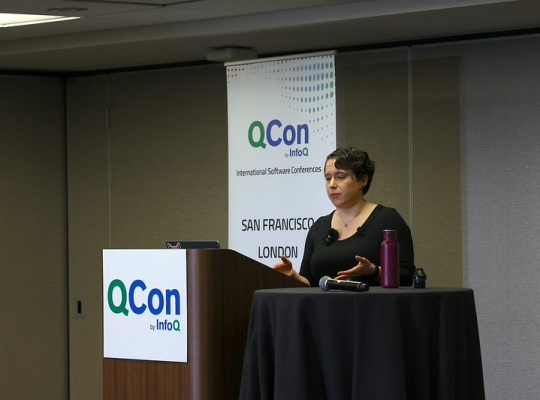
Most engineering teams treat a rewrite as a risk to be managed, not an opportunity to question their assumptions. So when Ruth Linehan shares how migrating high-performance caching services from Kotlin to Rust "shattered internal preconceptions," we should all pay attention. Her talk is not a cheerleading session for a language. It is a grounded account of what happens when you let the borrow checker do its job: the feedback loop shortens, the compiler becomes a collaborator, and delivery velocity actually improves. That last point deserves emphasis, because the usual suspicion is that Rust's safety guarantees cost you speed in development. Linehan's experience suggests the opposite, and her profile of tools like Criterion and flamegraphs shows a team that didn't just adopt a new language, but a new way of reasoning about concurrency.
This story lands in a broader context that our readers already know well. We recently covered how Perplexity Transforms Search with CobbleDB, Achieving 5x Faster Queries, where a migration from a managed database to an internal key-value store produced dramatic gains. Both cases share a through line: sometimes the biggest wins come from re-examining the default tool. Similarly, our look at Jev vs LLMs: Evaluating AI for Practical Decision-Making shows that even AI systems benefit from a skeptical, benchmark-driven approach. And when we consider how Scale Sandboxes Instantly: A New Approach to Concurrent AI Workloads required rethinking infrastructure, the pattern is clear: progress rarely comes from polishing what exists. It comes from questioning the boundaries of what you think your stack can do.
Our honest take is that Linehan's talk is a practical blueprint for teams that have written off Rust as too strict or too slow to adopt. The borrow checker is not a hurdle; it is a design tool that surfaces ownership issues before they become runtime bugs. That is not a philosophical point. It means fewer hours spent debugging data races and more time shipping features. For teams currently feeling constrained by their language's ergonomics, the takeaway is direct: if a team can migrate a high-performance caching service and come out the other side with better velocity, the barrier to entry is lower than the industry narrative suggests. The open question is whether your team is willing to trade a few weeks of learning curve for months of fewer production incidents. Given the results Linehan describes, we would tell any engineer on the fence to explore that trade, because the compiler is not your adversary. It is the best reviewer you have not hired yet.