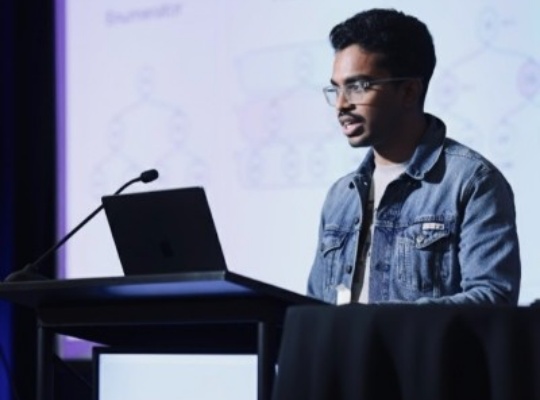
Uber's approach to managing 65,000 monthly code changes without breaking the build is not just impressive, it's a practical blueprint for any organization drowning in monorepo complexity. Dhruva Juloori's focus on SubmitQueue, with its binary speculation trees and conflict analysis, shows that the real innovation isn't in adding more CI resources but in using intelligence to avoid unnecessary work. For teams still wrestling with brittle merge processes, this is a clear signal that the future of development operations lies in prediction, not brute force.
The core insight here is that Uber slashed CI resource usage by 53% while accelerating pull request landing times by 37%, not by throwing hardware at the problem, but by bypassing large diffs that would have triggered wasteful builds. This aligns with a broader theme we've explored: the idea that Master the Code by Slowing Down in the Age of AI applies equally to infrastructure. Just as individual engineers benefit from deliberate practice, engineering systems benefit from deliberate execution. SubmitQueue's machine learning models predict build success and execution times, effectively deciding which changes are safe to land without full validation. This is a smarter, more human-centered approach: it acknowledges that not all code changes are equal, and that treating them as such wastes time and energy.
What makes this story resonate is that Uber isn't claiming a revolution, it's solving a concrete, painful problem. Any engineer who has watched a CI pipeline queue for hours only to fail on a trivial conflict will recognize the value of speculative trees that test multiple merge orders simultaneously. This is not about replacing developers with AI; it's about giving them a system that respects their time. The results speak for themselves: faster landing times, less resource waste, and a greener mainline. For teams considering similar investments, the takeaway is direct: focus on the bottlenecks that cause the most friction. In Uber's case, that meant prioritizing large diffs, which are disproportionately expensive to test. This is a lesson that scales, whether you're managing a monorepo with thousands of contributors or a smaller codebase with a handful.
The open question that remains is how broadly these techniques can be adopted. SubmitQueue's reliance on binary speculation trees and conflict analysis is sophisticated, but the underlying principle, predict before you build, is universal. We've seen how The Hidden Architecture of Language Models Gets a Definitive Survey reveals that even fundamental concepts like tokenization are often overlooked; similarly, the mechanics of merge queues are frequently treated as an afterthought. Uber's work suggests that treating merge orchestration as a first-class engineering problem, not a CI checkbox, can yield outsized returns. The detail to watch is whether other large-scale systems can replicate the 37% acceleration without the specific ML models Uber built. If they can, we may be looking at a new standard for how teams think about code integration, one that values intelligence over volume.