InfoQ Opens AI Security & Privacy Engineering Cohort for Regulated Industries
Our take
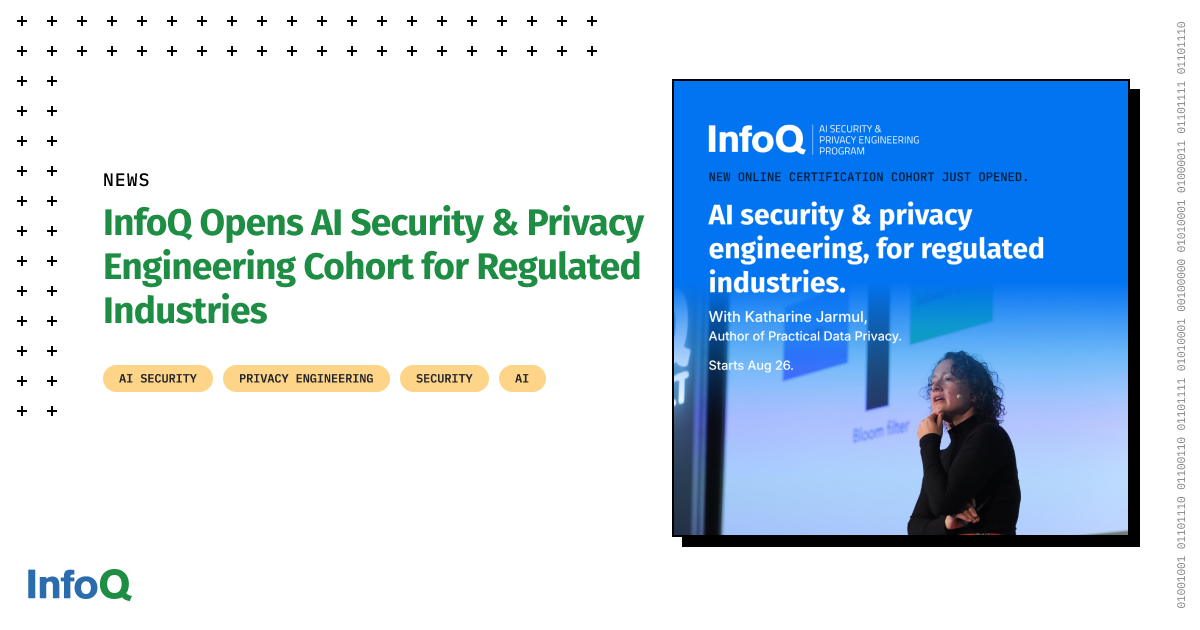
The emergence of dedicated AI Security & Privacy Engineering cohorts, like the one launched by InfoQ, signals a crucial maturing of the AI landscape. For too long, the focus has been overwhelmingly on model development and performance, often with security and privacy considerations treated as afterthoughts. This is particularly acute within regulated industries – finance, healthcare, government – where the stakes are exceptionally high. InfoQ’s initiative, targeting senior engineers and architects, indicates a recognition that robust AI governance isn’t a bolt-on feature, but a foundational requirement. It’s encouraging to see training programs specifically addressing the complexities of applying established security and privacy practices to the unique challenges posed by production AI systems. The need for this kind of specialized training is amplified by the rapid evolution of AI models and architectures, as highlighted in recent discussions around Large Action Models (LAMs) vs Agentic LLMs: What’s the Real Difference?. Understanding the subtle yet critical distinctions between these approaches is essential for building secure and reliable AI solutions.
The curriculum’s emphasis on threat modeling, observability, and governance is particularly noteworthy. Traditional security approaches often fall short when applied to AI, demanding a shift in mindset and methodology. AI models are inherently complex and unpredictable, making standard vulnerability assessments inadequate. Observability – the ability to monitor and understand the internal workings of an AI system – is vital for detecting anomalies and identifying potential security breaches. Furthermore, governance frameworks are needed to ensure that AI systems are aligned with ethical principles and regulatory requirements. The ongoing exploration of techniques like dynamic partition splitting, demonstrated by Netflix’s efforts in improving Cassandra performance Netflix Cuts Cassandra Read Latency from Seconds to Milliseconds with Dynamic Partition Splitting, showcases the kind of pragmatic engineering that will be necessary to operationalize AI securely and efficiently. Tackling these challenges requires a deep understanding of both the AI technology itself and the underlying infrastructure supporting it.
The fact that InfoQ is addressing this need highlights a broader trend: a growing awareness of the potential risks associated with unchecked AI deployment. Early enthusiasm for AI’s capabilities has given way to a more nuanced understanding of its limitations and vulnerabilities. Concerns around data privacy, algorithmic bias, and the potential for malicious use are driving demand for more robust security and governance practices. This isn’t about stifling innovation; it’s about building AI systems that are trustworthy, reliable, and aligned with human values. The training cohort's focus on regulated industries suggests that compliance requirements will play an increasingly significant role in shaping the future of AI development. It’s also a clear indication that the skills gap in AI security and privacy is widening, and requires focused attention. The possibilities for AI applications in areas like object detection and pose estimation continue to expand – as demonstrated by the accessibility of tools like YOLO26 YOLO26 Tutorial: Object Detection, Pose Estimation & More – but these advancements come with corresponding responsibilities.
Ultimately, this development points to a shift from a purely performance-driven AI landscape to one that prioritizes responsible innovation. The demand for skilled AI Security & Privacy Engineers is only going to increase, and initiatives like this cohort are a vital step in bridging that gap. As AI becomes increasingly integrated into critical infrastructure and decision-making processes, the ability to secure and govern these systems will become paramount. The question now is: how quickly can we scale up the talent pool to meet the rapidly growing demand for AI security and privacy expertise, and will organizations be prepared to invest in the necessary training and resources to build truly secure and ethical AI systems?
InfoQ has opened enrollment for a five-week AI Security & Privacy Engineering cohort for senior engineers and architects in regulated industries, focused on applying security, privacy, threat modeling, observability, and governance practices to production AI systems.
By Artenisa ChatziouRead on the original site
Open the publisher's page for the full experience