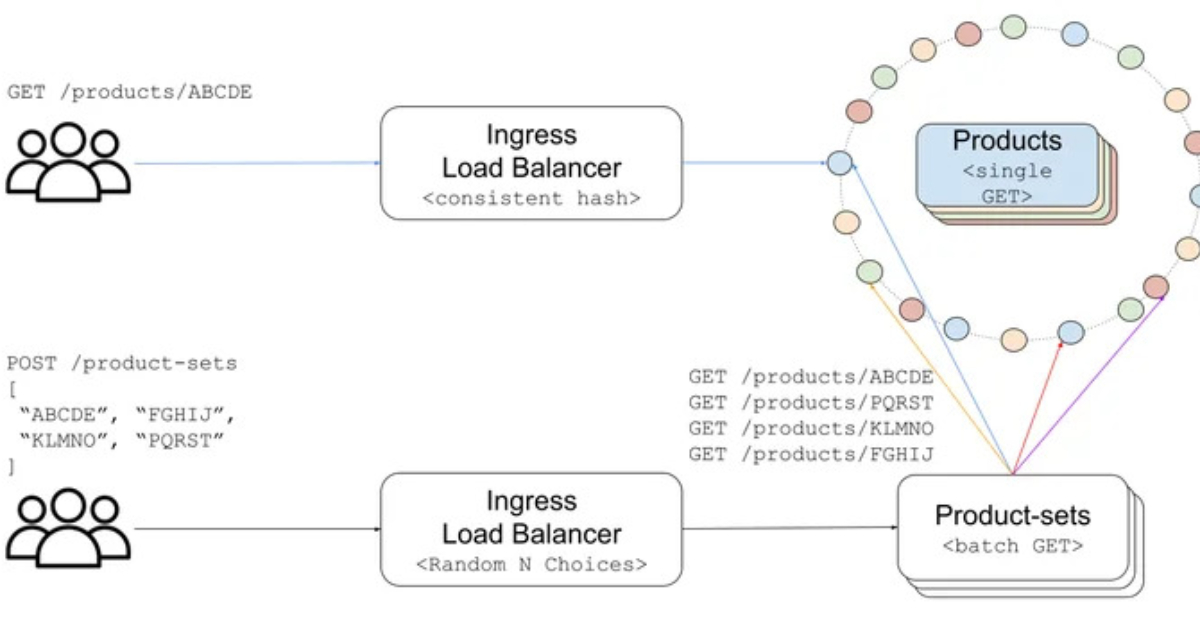
Zalando's engineering team just published a detailed account of building an in-process, client-side load balancer for an API handling roughly one million requests per second. The results were predictably better latency, reduced infrastructure spend, and clearer visibility into where failures actually originate. For anyone who has wrestled with the operational reality of running high-throughput systems, this is not just another architecture blog post. It is a concrete argument that the load balancer you run as a separate, network-level appliance might be the very thing adding friction you no longer need to accept.
The practical insight here is that client-side balancing is not a new idea, but Zalando's execution shows how far the approach can go when it is embedded directly into the process. Instead of routing every request through a fixed intermediary, the client itself becomes the balancer, which means fewer hops, less operational overhead, and a tighter feedback loop when something goes wrong. For teams drowning in the complexity of managing multiple services, this is a reminder that sometimes the most effective optimization is removing a layer rather than adding another one. If you are tired of chasing latency spikes that seem to come from nowhere, explore how latency measurement works in practice or consider what client-side resilience really demands. The related work on observability in distributed systems reinforces why Zalando's focus on failure origin matters so much.
What stands out is the discipline behind the design. Zalando did not just move the load balancer into the client and call it a day. They built for predictability, not peak throughput. That distinction is worth sitting with. A system that handles one million requests per second is impressive, but a system that does it with consistent, predictable latency under changing conditions is something else entirely. For our readers, the takeaway is direct: you do not need to be operating at Zalando's scale to benefit from this thinking. If your traffic patterns are uneven, if your infrastructure costs are creeping upward, or if your debugging sessions always end with "it was the network," then the problem might not be your code. It might be that your load balancing strategy is working against you.
This is not a story about a magic bullet. Client-side load balancing introduces its own challenges around discovery, retries, and failure handling. But Zalando's experience suggests those challenges are manageable, and the payoff is a system that feels simpler to operate, not more complex. If a reader asked us whether this approach is worth exploring, our answer would be measured but clear: start small, instrument everything, and measure the difference. The specific detail to watch is how they handled failure detection and retries, because that is where most implementations quietly fall apart. For now, the honest take is that Zalando has given the broader engineering community a useful case study in questioning default assumptions. The next time you are staring at a diagram with a load balancer sitting between your clients and your services, ask yourself if that box is earning its place. Sometimes the best architecture is the one that removes a component you assumed was essential.