Instacart Builds Blueberry, an AI-Powered Assistant to Help On-Call Engineers Investigate Incidents
Our take
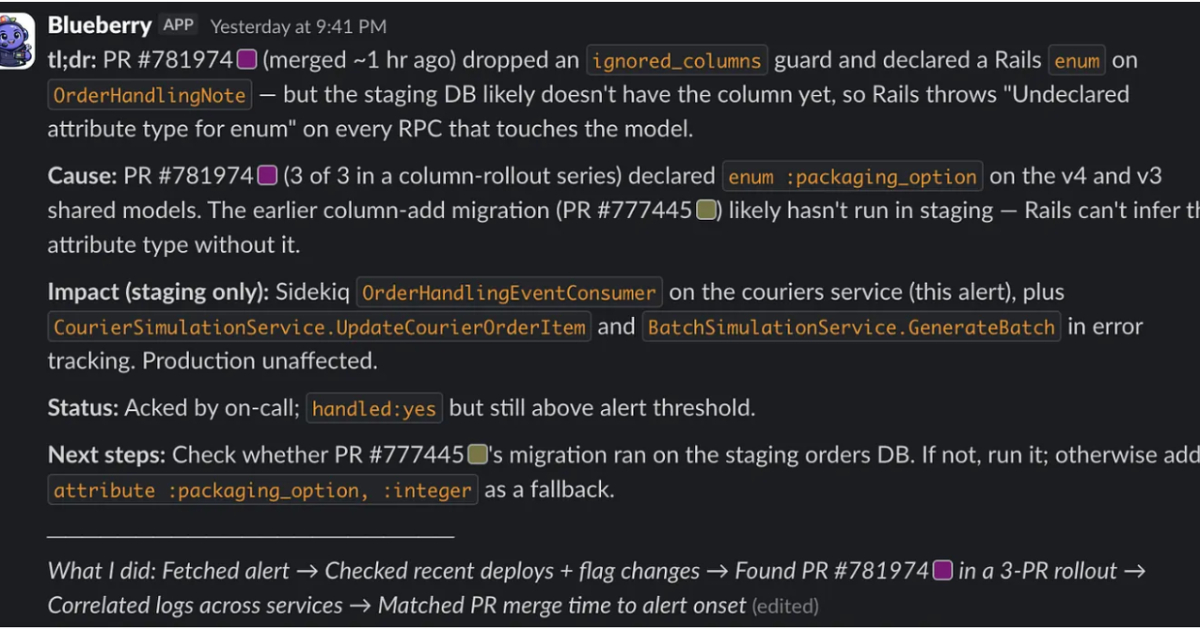
Instacart’s introduction of Blueberry, an AI-powered incident response assistant, signals a significant shift in how engineering teams manage on-call responsibilities. The relentless pressure on SREs to rapidly diagnose and resolve production issues has long been a source of stress and inefficiency. Blueberry’s approach – leveraging AI agents to synthesize operational data, historical incidents, and ultimately generate root cause hypotheses directly within Slack – offers a compelling solution. It’s a move that aligns with broader trends in AI-assisted workflows, much like Naïve’s recent funding round to automate company setup [Naïve raises $28.5M to automate the grunt work of setting up and running a company], demonstrating a desire to offload repetitive tasks and empower engineers to focus on more strategic work. The focus on keeping engineers “in control” is key; it’s not about replacing human expertise but augmenting it with intelligent automation. This echoes the growing understanding of AI's role as a collaborative tool, as highlighted in recent discussions surrounding best practices for AI coding assistants like Claude Code [Claude Code Best Practices: 3 Lessons from 400,000 Sessions].
The innovation of Blueberry isn't just about applying AI; it’s about *how* it’s applied. The use of parallel subagents suggests a sophisticated architecture designed to accelerate the investigation process, intelligently distributing tasks and consolidating findings. Integrating with MCPs (presumably monitoring and control planes) allows for real-time data access, while leveraging incident history provides valuable context and pattern recognition. This layered approach avoids the pitfalls of many early AI implementations that simply throw data at a model and hope for the best. The grounding of hypotheses in existing data is particularly important; it mitigates the risk of AI hallucinations and ensures that engineers are presented with actionable insights, not speculative guesses. While the scale of Tesla and SpaceX's Terafab chip factory [Tesla and SpaceX will invest $16.8B to start building ‘Terafab’ chip factory in Texas] is a different order of magnitude, both initiatives showcase the power of focused investment in advanced technology to address critical operational challenges.
Beyond Instacart, Blueberry’s success hinges on its ability to seamlessly integrate into existing workflows and provide tangible value to on-call engineers. The Slack integration is a smart choice, as it leverages a platform already deeply embedded in many engineering teams' communication habits. The system's effectiveness will also depend on the quality and completeness of the historical incident data it’s trained on. Garbage in, garbage out remains a critical consideration for any AI-driven solution. However, if Instacart can demonstrate a significant reduction in mean time to resolution (MTTR) and a decrease in on-call fatigue, Blueberry could become a blueprint for incident response systems across a wide range of industries. The emphasis on user control is a crucial differentiator, acknowledging that AI should be a tool to assist, not replace, human judgment.
The emergence of tools like Blueberry points towards a future where AI plays an increasingly integral role in operational resilience. We’re moving beyond simple monitoring and alerting to systems that actively participate in the troubleshooting process, proactively identifying potential issues and suggesting remediation strategies. The challenge now lies in developing robust validation mechanisms and ensuring that these AI assistants are continuously learning and adapting to evolving system complexities. One key question to watch is how companies will adapt their incident response training programs to incorporate these new AI-powered tools, ensuring that engineers can effectively leverage their capabilities and maintain a deep understanding of the underlying systems.
Instacart introduced Blueberry, an AI-assisted incident response system that helps on-call engineers investigate production issues faster. It combines AI agents, operational data, and historical incident knowledge to generate grounded root cause hypotheses in Slack. It uses parallel subagents, MCP integrations, and incident history to reduce investigation time while keeping engineers in control.
By Leela KumiliRead on the original site
Open the publisher's page for the full experience