Kaggle + Google’s Free 5-Day Agentic AI Course
Our take
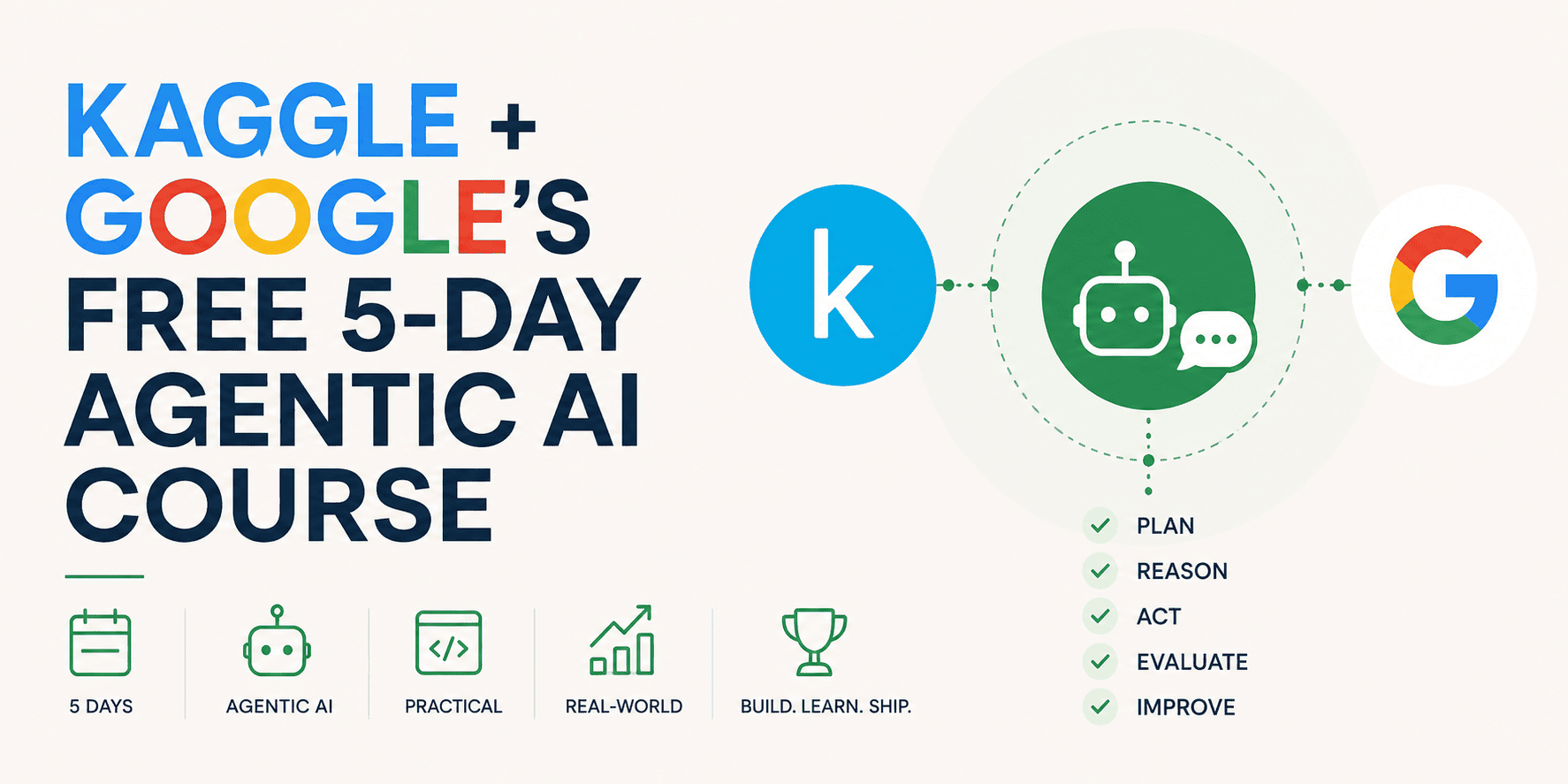
The availability of Google and Kaggle's 5-Day AI Agents course signifies a noteworthy shift toward democratizing access to increasingly sophisticated AI technologies. It’s not just about offering free education; it’s about lowering the barrier to entry for individuals and organizations seeking to leverage agentic AI—a field rapidly moving beyond simple chatbot interactions. As we’ve explored in [The AI Slop Problem Nobody's Talking About | Substack CEO Interview], the sheer volume of emerging AI tools can be overwhelming, and a solid foundation in agent design and implementation is crucial to avoid a chaotic proliferation of poorly designed systems. This course addresses that need directly, providing a structured learning pathway that equips users with practical skills. The free accessibility is particularly important as many advanced AI resources remain locked behind paywalls, further widening the gap between those who can easily experiment and those who can't.
The power of this offering lies in the combined strengths of Google and Kaggle. Google, of course, brings its deep expertise in AI research and development, while Kaggle provides a vibrant community and a proven platform for hands-on learning. This pairing fosters both theoretical understanding and practical application, a critical combination for mastering agentic AI. Jake Mannix’s presentation, [Presentation: From Copy-Paste to Composition: Building Agents Like Real Software], highlights the importance of moving beyond ad-hoc solutions and developing robust, architected agents—a core tenet of the kind of structured learning this course promises. The course's focus on agentic AI – systems capable of autonomous planning and action – is particularly relevant, as we see the limitations of traditional, reactive AI models becoming increasingly apparent. We’ve also seen, as Anthropic detailed in [Anthropic Details How It Contains Claude Across Web, Code, and Cowork], the emphasis on safety and containment within AI systems, and a better understanding of agent architecture will inevitably lead to safer and more reliable deployments.
The potential impact of widespread agentic AI literacy is substantial. Imagine data analysts building custom agents to automate complex data exploration tasks, or marketers creating agents that personalize customer experiences at scale. This isn’t about replacing human workers; it’s about empowering them with tools that amplify their capabilities and free them from repetitive, time-consuming tasks. The shift towards agentic AI fundamentally changes how we interact with data and software. Instead of painstakingly crafting complex formulas or writing extensive code, users can define goals and delegate execution to intelligent agents. This paradigm shift will unlock new levels of productivity and innovation across various industries, and the availability of accessible educational resources like this course is a vital catalyst for that transformation. It’s a move away from the traditional, often rigid, spreadsheet paradigm and towards a more fluid, dynamic data management experience.
Ultimately, the success of this initiative will be measured not just by the number of enrollments, but by the tangible impact it has on the broader AI landscape. Will it lead to a generation of users who can confidently design, build, and deploy effective agentic AI solutions? Will it accelerate the adoption of AI across diverse industries and skillsets? The focus on practical skills and real-world applications suggests a promising trajectory, but the ongoing challenge will be to ensure that this increased accessibility doesn't come at the expense of responsible AI development and deployment. It will be fascinating to watch how the skills and insights gained from this course translate into innovative applications and, crucially, how users address the ethical considerations inherent in increasingly autonomous systems.
Read on the original site
Open the publisher's page for the full experience