Large Action Models (LAMs) vs Agentic LLMs: What’s the Real Difference?
Our take
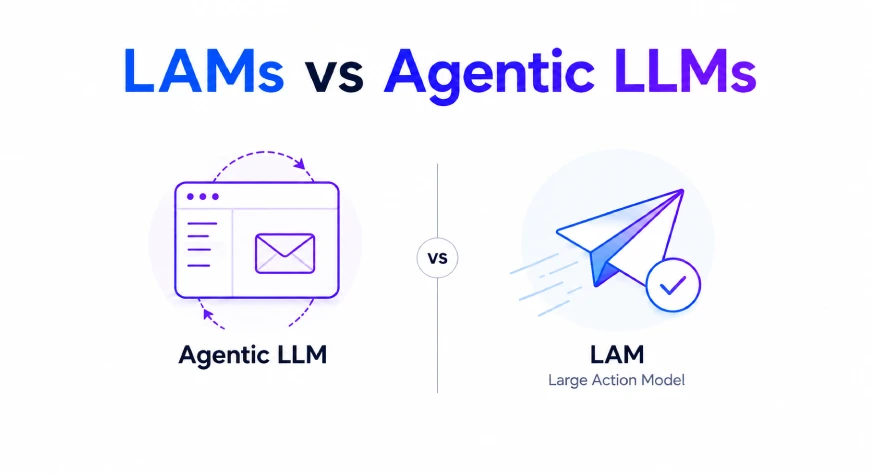
The recent exploration of Large Action Models (LAMs) versus agentic LLMs, as detailed in Large Action Models (LAMs) vs Agentic LLMs: What’s the Real Difference?, highlights a critical, yet often overlooked, distinction in the rapidly evolving landscape of AI. The simple example—instructing an AI to “Polish my email and send it”—demonstrates the starkly different potential outcomes depending on the underlying architecture. While both approaches leverage the power of large language models, their execution pathways diverge significantly, impacting everything from reliability to workflow integration. This isn't just a theoretical debate; it’s a practical consideration for anyone looking to embed AI into their daily operations, and underscores why understanding these nuances is increasingly vital. Related explorations, like the practical application of object detection and pose estimation showcased in YOLO26 Tutorial: Object Detection, Pose Estimation & More, demonstrate the expanding capabilities of AI models across diverse tasks, further emphasizing the need for precise control and predictable outcomes.
The core difference, as the Analytics Vidhya piece clarifies, lies in the autonomy granted to the AI. Agentic LLMs operate with a degree of independent decision-making, breaking down tasks into smaller steps, utilizing tools, and iterating toward a solution. This can be powerful for complex, open-ended goals, but also introduces potential for unexpected or undesirable actions. LAMs, conversely, are designed to execute instructions more directly, offering greater predictability and control. Think of it as the difference between delegating a project to a highly capable but somewhat unpredictable assistant versus providing a very detailed and specific set of instructions to a reliable executor. The rise of Vision Language Models, and how models like GPT-4o, Gemini, and Claude Vision work, as explained in Modern VLMs Explained: How GPT-4o, Gemini, Claude Vision, and Qwen-VL Work, underscores this need for precision; incorporating visual understanding into AI workflows demands a heightened focus on reliable execution.
The implications for data management are profound. As AI becomes increasingly integrated into spreadsheet workflows – automating tasks, generating insights, and even directly manipulating data – the choice between LAMs and agentic LLMs will be a key factor in determining the safety, accuracy, and usability of these systems. We’ve traditionally relied on the structured nature of spreadsheets to provide a level of control and auditability. Introducing AI agents that operate with significant autonomy threatens that stability. However, dismissing agentic approaches entirely would be a mistake. Their ability to adapt and solve complex problems presents a significant opportunity to unlock new levels of productivity and insight. The key lies in finding the right balance – leveraging the power of agentic AI where appropriate, while maintaining the predictable execution and control offered by LAMs for critical tasks.
Ultimately, the distinction between LAMs and agentic LLMs represents a crucial step towards responsible AI adoption. It forces us to move beyond the hype and focus on the practical realities of deploying these powerful tools. As the capabilities of both approaches continue to evolve, the question will no longer be *if* we should use AI, but *how* we should use it—carefully considering the trade-offs between autonomy and control, and prioritizing user outcomes over purely technological advancements. What safeguards and architectural patterns will emerge to ensure that AI agents, regardless of their type, remain aligned with human intentions and contribute positively to our data-driven workflows?
You tell your AI “Polish my email and send it.” Same sentence, three outcomes. The gap between Large Action Models (LAMs) and agentic LLMs is one of the most practically important distinctions in AI today, and also one of the least clearly explained. In this article, we cut through the confusion through a simple breakdown […]
The post Large Action Models (LAMs) vs Agentic LLMs: What’s the Real Difference? appeared first on Analytics Vidhya.
Read on the original site
Open the publisher's page for the full experience