Loop Engineering for AI Agents: How /loop is Changing AI Workflows
Our take
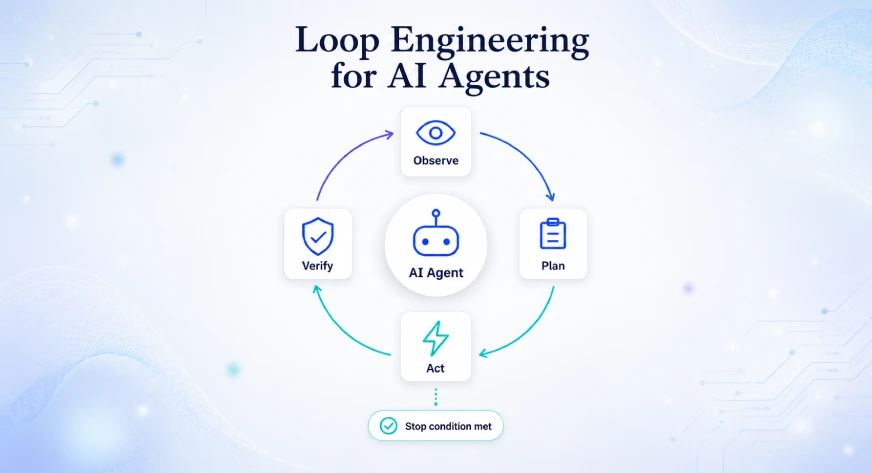
The shift towards AI agents capable of persistent, autonomous operation marks a significant evolution beyond the initial wave of LLM-powered assistants. The /loop framework, as detailed in How Open Source Enables Collaboration in Creating a Platform, presents a compelling solution to the challenges of managing these increasingly complex workflows. Previously, leveraging LLMs often involved a series of discrete prompts, demanding constant human oversight to guide the model’s next steps. This cycle was inherently limiting, especially when dealing with tasks requiring continuous monitoring, iterative refinement, or automated responses to changing conditions. The move to “loop engineering” fundamentally changes this dynamic, enabling teams to define goals and stop conditions, allowing the AI agent to operate independently until those criteria are met, much like the scalable architecture described in AWS Details How One Customer Scaled to One Million Lambda Functions. This represents a crucial step towards the realization of genuinely autonomous AI systems.
The beauty of the /loop approach lies in its potential to unlock a new level of productivity and efficiency. Instead of dedicating human resources to micromanaging AI interactions, teams can focus on higher-level strategic objectives, trusting the agent to handle the repetitive, detail-oriented tasks. Consider, for instance, an agent tasked with monitoring a stream of data for anomalies and automatically adjusting parameters within a system—a task that would previously require constant human attention. With /loop, this process can be automated entirely, freeing up valuable time and resources. This also aligns with the emerging trend of building systems that operate in real-time, as highlighted in Article: Beat-Aligned Mobile Audio Streaming with Virtual Chunks and Native Playback, where responsiveness and continuous operation are paramount, demonstrating the growing need for persistent AI agents.
The implications extend beyond simple task automation. Loop engineering paves the way for more sophisticated AI applications in areas like dynamic pricing, personalized recommendations, and automated research. Imagine an agent continuously analyzing market trends and adjusting pricing strategies in real-time, or an agent automatically synthesizing information from multiple sources to generate comprehensive reports. The ability to define a clear goal and then allow an AI agent to autonomously pursue it opens up a vast range of possibilities. Furthermore, this framework addresses a key challenge in the broader AI landscape: the need for more robust and reliable systems. By encapsulating logic within defined loops, teams can more easily debug, monitor, and control the behavior of their AI agents, leading to increased trust and adoption.
Ultimately, the emergence of /loop and similar frameworks signals a maturing of the AI agent paradigm. We are moving beyond the era of simple chatbots and towards a future where AI agents are integral components of our workflows, acting as reliable and autonomous partners. The focus is shifting from prompting to orchestration, and from one-off interactions to persistent, goal-oriented operation. The critical question now becomes: how will organizations adapt their processes and skillsets to effectively leverage these increasingly powerful AI agents, and what new governance models will be needed to ensure responsible and ethical deployment at scale?
AI agents are moving from one-time assistants to persistent workers that can repeat tasks, monitor changes, run checks, update workflows, and return with results. Instead of prompting an LLM once and deciding every next step manually, teams can now use AI agents that keep working (on a Loop) until a goal or stop condition is […]
The post Loop Engineering for AI Agents: How /loop is Changing AI Workflows appeared first on Analytics Vidhya.
Read on the original site
Open the publisher's page for the full experience