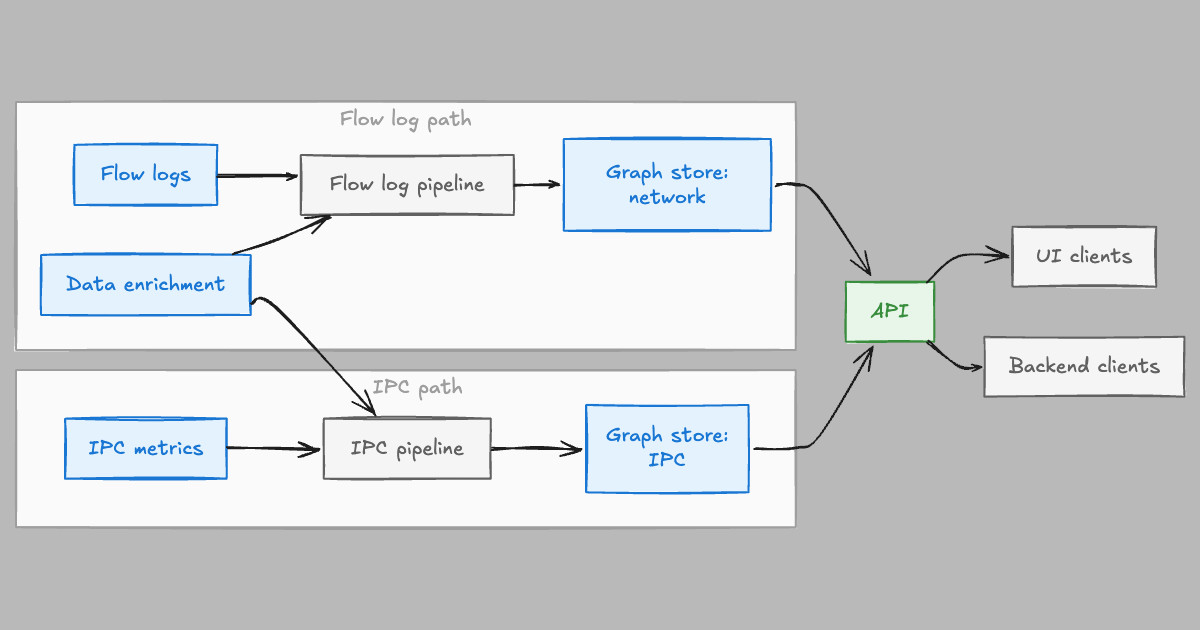
Netflix's description of how it rebuilt the pipeline behind Service Topology is a quiet masterclass in engineering discipline. The system now separates intermediary resolution from enrichment and persistence across three distinct stages, which sounds like standard modularity until you consider the pressure that a real-time dependency map puts on every layer. The team didn't invent a new paradigm or lean on hype. They made deliberate, practical choices about where complexity should live and where it should be pushed back. That is the kind of work that rarely makes a keynote but defines whether a platform survives its own growth.
The most telling decision is the propagation of backpressure all the way to Kafka rather than dropping records. In most streaming architectures, backpressure is treated as a failure mode, something to smooth over with buffers or quietly shed. Netflix's approach says the opposite: the system should hold its producers accountable, not hide behind data loss. For anyone running data-heavy operations, this is the difference between a system that degrades gracefully and one that lies to you until it breaks. Similarly, choosing server-sent events over gRPC for high-volume internal transfers is a pragmatic call. gRPC is excellent for request-reply patterns, but when you are pushing continuous state to a visualization layer, the simpler transport often wins on operational sanity. This is not flashy technology. It is the unglamorous work of making sure the tool you built for yourself can survive contact with production.
What this means for our readers is straightforward: the hard problems in real-time systems are rarely about the first mile of data ingestion or the last mile of user interface. They live in the middle, where enrichment, persistence, and delivery need to coexist without strangling each other. If you are building a service map, a dashboard, or any internal observability tool, the takeaway is not to copy Netflix's architecture. It is to copy their instinct for separating concerns and their willingness to let a bottleneck propagate rather than paper over it. Ask yourself where you are dropping data because it is easier than slowing down the pipeline. Ask yourself whether your transport choice is serving the traffic pattern or just the habit of using the same tool for every job.
The open question is how far this design scales beyond Netflix's own infrastructure. Backpressure to Kafka works when your producers can tolerate the constraint, but not every organization has that luxury. The detail to watch is how they handle the inevitable spikes in dependency churn, when a service fails and the topology graph suddenly needs to reflect a cascade of changes without melting the pipeline. That is the moment when the three-stage separation earns its keep, or reveals its limits. For now, the lesson is clear: build for the pressure you expect, and let the system tell you when you are wrong. That is the kind of advice that ages well, because it is less about the specific stack and more about the mindset. And in a world where real-time maps are becoming table stakes, that mindset is the real competitive edge.