OKF: Redefining Knowledge Bases for AI Agents
Our take
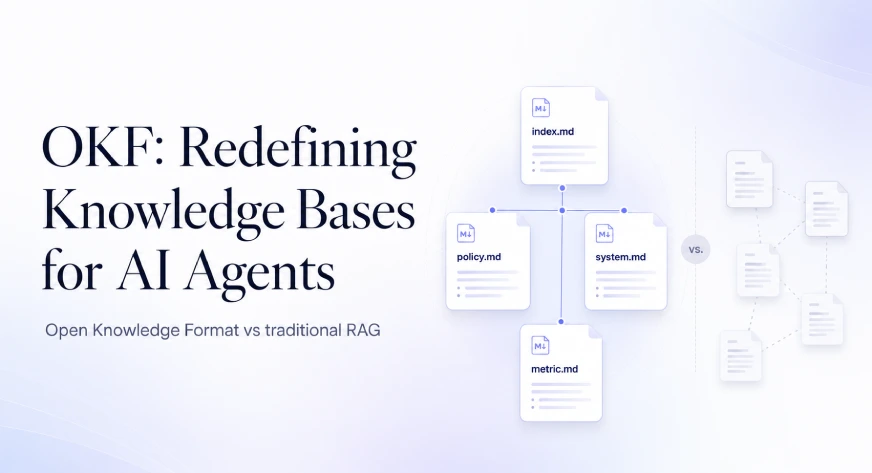
The introduction of Google’s Open Knowledge Format (OKF) in 2026 represents a potentially significant shift in how we approach knowledge bases for AI agents. The core concept – a bundle of plain Markdown files, lightweight YAML metadata, and conceptual links – feels refreshingly simple compared to the current trend of embedding everything into vector databases. It challenges the assumption that complex, computationally intensive infrastructure is *always* necessary for AI to access and utilize information. This move echoes concerns around the escalating costs and resource demands of large language models (LLMs) and their associated data pipelines, a topic explored in detail in "Netflix invented binge-watching. Now it may have outgrown it," which highlights how even established models can struggle with sustained engagement and evolving user needs – a parallel that suggests a need for more adaptable and efficient knowledge structures. The beauty of OKF lies in its accessibility; it leverages existing, widely understood file formats, lowering the barrier to entry for developers and promoting interoperability across different AI systems.
The implications of OKF extend beyond simply reducing computational overhead. By decoupling knowledge representation from vector embeddings, it allows for more human-readable and editable knowledge bases. This opens the door for improved knowledge governance, easier debugging of AI systems, and a greater degree of transparency in how AI agents are reasoning. Consider the challenges faced by data scientists when troubleshooting model outputs; often, the underlying knowledge representation is opaque and difficult to modify. This contrasts starkly with the familiar process of editing a Markdown document. Moreover, the focus on explicit links between concepts is a welcome departure from the implicit relationships captured in embeddings, potentially leading to more structured and explainable AI behavior. It’s also worth noting how this aligns with ongoing discussions about the importance of data encoding strategies, as illustrated by the challenges of encoding both target and feature variables for multiclass classification, a quandary detailed in "How should I encode both target and feature variable for a multiclass classification? [D]". The ability to clearly define relationships within a knowledge base could prove invaluable in complex classification tasks.
While vector databases undoubtedly offer advantages for certain applications, particularly those requiring semantic similarity search, OKF’s approach offers a compelling alternative for scenarios where structured knowledge and explainability are paramount. It's less about replacing existing technologies and more about providing a complementary option that caters to different needs and priorities. The lightness of the format also lends itself well to integration with smaller, more specialized AI agents, allowing for the creation of highly focused and efficient knowledge systems. We’re seeing a broader trend towards customization and personalization in AI, as evidenced by Apple’s efforts to allow users to customize Siri’s personality, as described in "You can now customize Siri’s pace and expressivity in the latest iOS 27 beta," and OKF seems poised to enable similar levels of tailored knowledge representation for AI applications.
Looking ahead, the success of OKF will depend on its adoption by the broader AI community and the development of tooling to facilitate its creation, maintenance, and integration with various AI frameworks. The potential for a more accessible, transparent, and manageable approach to AI knowledge is undeniable. One critical question remains: will OKF spark a broader re-evaluation of the reliance on embedding-heavy approaches, prompting a more nuanced understanding of the trade-offs between computational efficiency, knowledge representation, and AI explainability? The simplicity of the format suggests a powerful challenge to the prevailing paradigm, and the industry will be watching closely to see if it gains traction.
In June 2026, Google introduced the Open Knowledge Format (OKF), an open specification for how AI agents organise and exchange knowledge. An OKF bundle is just Markdown files, lightweight YAML metadata, and links between concepts, yet it challenges the assumption that every AI application needs embeddings and vector databases. Because the knowledge base is plain […]
The post OKF: Redefining Knowledge Bases for AI Agents appeared first on Analytics Vidhya.
Read on the original site
Open the publisher's page for the full experience