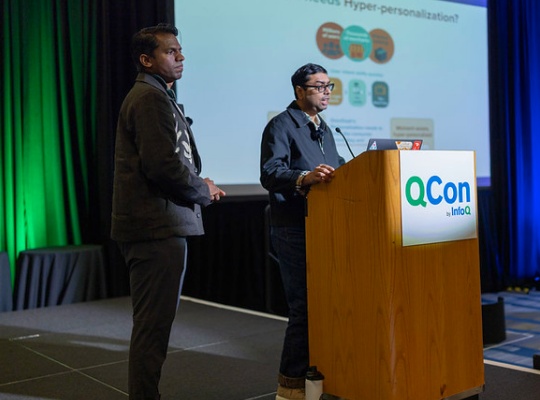
The most interesting idea in Sudeep Das and Pradeep Muthukrishnan's talk isn't that DoorDash uses AI. It's that they've stopped trying to make one AI do everything. The team pairs LLMs with traditional deep learning in a way that respects what each does best. That's a pragmatic decision, and it's one more companies should borrow from.
The core problem is that user intent is fleeting. A customer might want something warm and savory at 6 PM, then a cold drink an hour later. Static merchandising can't keep up. DoorDash's approach uses LLMs to generate natural-language consumer profiles and content blueprints, which is a fancy way of saying the system can describe what you want in human terms. Then, the last-mile ranking still relies on conventional deep learning models. The LLM handles the big picture, and the traditional model handles the split-second decision of which item to show first.
For practitioners, this is a relief. It means you don't have to force a large language model to do everything, which is expensive, slow, and often unreliable at the final step. Instead, you let it do what it's good at: understanding context and generating flexible descriptions of intent. The older models remain better at the narrow task of ranking thousands of items in milliseconds. This hybrid architecture is more than a technical detail. It's a realistic blueprint for anyone who has been told to "just use AI" but has hit the wall of latency and cost.
What stands out is the emphasis on short-lived intent. DoorDash isn't just tracking that you like sushi. It's trying to understand that you want sushi right now, and maybe only because it's Friday night. That's a different problem than building a permanent profile. The LLM-generated profiles are dynamic, which means they can change as your mood changes. That's the kind of personalization users actually feel. It's not about showing you the same recommendation you ignored last week. It's about adapting to the present moment.
The takeaway for anyone building recommendation systems is to stop treating personalization as a single model problem. Use the LLM to understand intent and generate content, then let the faster, more mature models handle the final ranking. That division of labor is what makes scale possible without sacrificing speed. DoorDash's approach is a strong argument that the future of personalization isn't about choosing between old and new AI. It's about getting them to work together.