Python Data Classes Beyond the Boilerplate
Our take
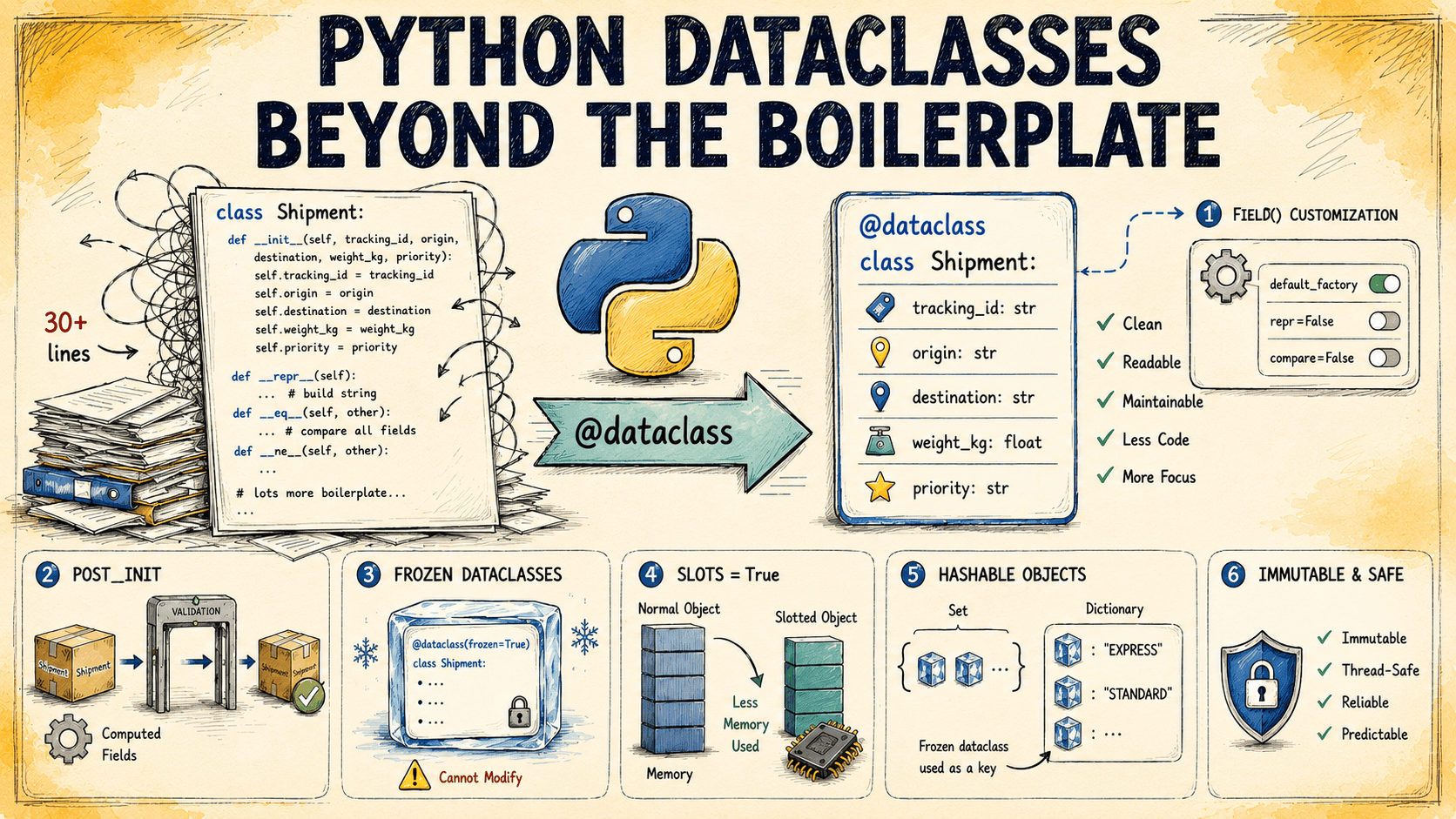
Python's dataclasses have steadily gained traction as a powerful tool for simplifying data modeling, and the recent exploration of techniques extending beyond boilerplate reduction is particularly significant. Initially lauded for automating repetitive tasks like `__init__`, `__repr__`, `__eq__`, and more, dataclasses are now proving their mettle as a foundation for robust and performant data structures. We've seen similar interest in streamlining complex statistical analyses, as highlighted in [Survival Analysis and the Cox Proportional Hazards Model: A Beginner-Friendly Guide], which demonstrates the practical value of clean, well-structured data in achieving meaningful results. The ability to define custom fields, implement validation logic, and leverage computed attributes within dataclasses moves them beyond simple convenience and into the realm of serious data engineering. Furthermore, the considerations around immutability and memory optimization are crucial for applications dealing with large datasets or performance-sensitive workloads. Developers are increasingly recognizing the need for efficient data handling, and dataclasses offer a compelling pathway toward that goal, especially when compared to the sometimes verbose nature of traditional class definitions.
The evolution of dataclasses underscores a broader trend in Python development – a move towards more declarative and concise code. This aligns with the growing emphasis on developer productivity and maintainability, particularly within teams. While the initial appeal was the reduction of repetitive code, the advanced features now available reveal a deeper understanding of how data is handled and processed. It's interesting to note the parallel conversation around coding practices in general, as discussed in [What coding practices are you adopting for development today? [D]], where developers consistently seek ways to improve code quality and efficiency. Dataclasses contribute directly to this effort by providing a standardized and expressive way to define data structures, reducing the cognitive load on developers and allowing them to focus on the core logic of their applications. The ability to easily enforce data integrity through validation is a particularly valuable addition, preventing common errors and improving the overall reliability of systems.
The implications of these advancements extend beyond individual projects. As AI and machine learning continue to permeate various industries, the need for efficient and reliable data structures becomes ever more critical. The memory optimization techniques offered by dataclasses can be particularly impactful in resource-constrained environments or when dealing with massive datasets common in AI workflows. Consider the career pathways being explored by those entering the field, as outlined in [How to Build a Career in AI: 3 Distinct Pathways]; a strong grasp of data structures and efficient data handling is a foundational skill regardless of the chosen specialization. Dataclasses offer a readily accessible and powerful tool for building a solid foundation in this area. The ability to quickly prototype and iterate on data models using dataclasses can significantly accelerate the development cycle for AI-driven applications.
Looking ahead, it will be fascinating to observe how the Python community continues to evolve the dataclasses ecosystem. The integration with other libraries, such as Pandas and NumPy, is likely to deepen, further expanding their utility. We can also anticipate more sophisticated validation and transformation capabilities being added, allowing developers to build even more robust and adaptable data structures. The question becomes: will dataclasses eventually become the default choice for defining data models in Python, effectively replacing traditional classes in many scenarios, or will they continue to serve as a valuable, specialized tool within a broader landscape of data modeling techniques? The answers will undoubtedly shape the future of Python development and its role in the broader data science and AI landscape.
Read on the original site
Open the publisher's page for the full experience