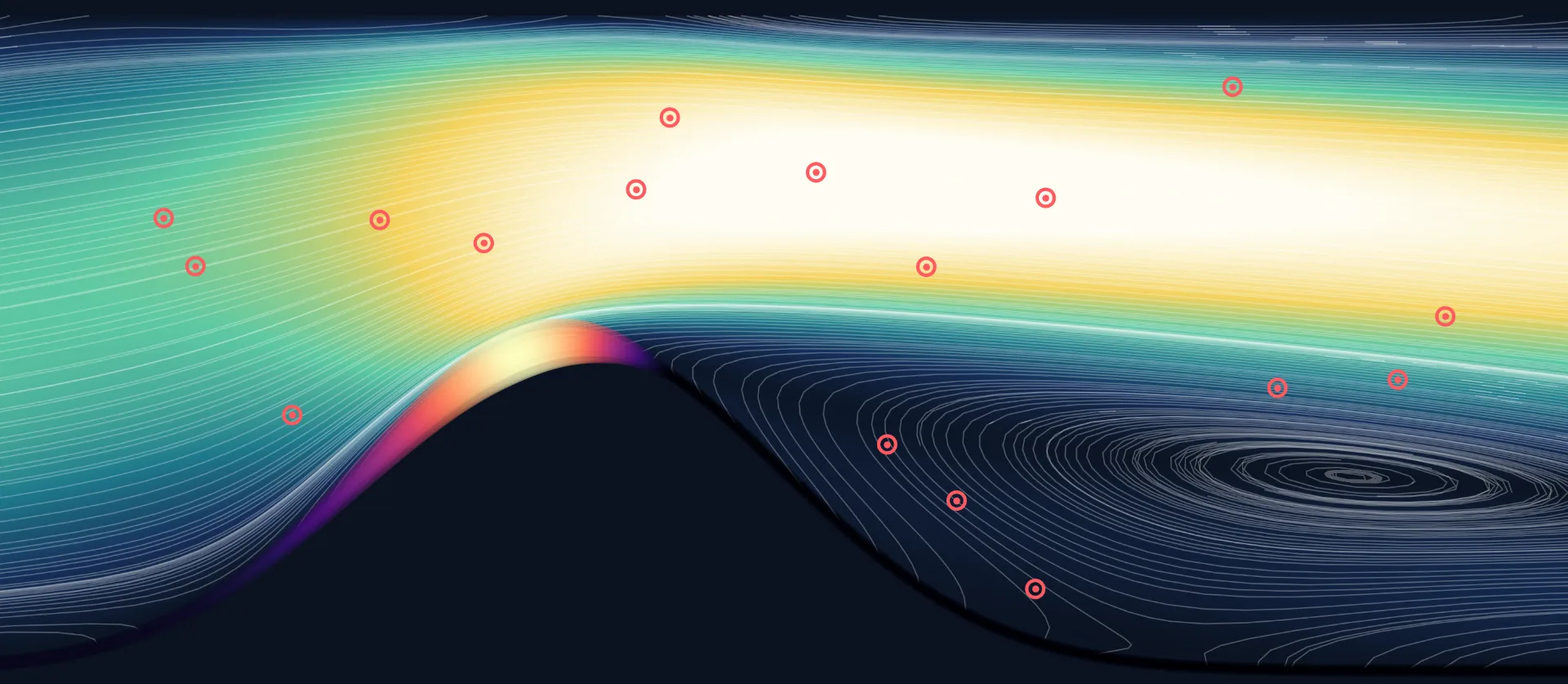
Forty noisy readings from a narrowed artery, and from that sparse data, a physics-informed neural network recovers blood flow, viscosity, and wall shear stress with meaningful accuracy. That is not a lab curiosity; it is a direct challenge to how we think about data scarcity in technical workflows. The PyTorch implementation of a Physics-Informed Neural Network (PINN) for the Navier-Stokes inverse problem shows that when you embed physical laws directly into the training process, you can extract reliable signals from remarkably little input. The practical implication for anyone working with real-world data is immediate: you no longer need thousands of clean measurements to get answers that matter.
This matters because the old assumption, that more data always produces better results, is quietly being retired. The same principle is reshaping how we build tools for everyday work. Consider what happens when you can Describe Your Data in Plain Words and Let AI Feed Your Spreadsheet Continuously. The spreadsheet, once a static container for manually entered numbers, becomes a living system that pulls in fresh data without human intervention. The PINN approach takes that logic deeper: it does not just collect data; it reconstructs hidden physics from a handful of noisy points. For engineers, clinicians, and analysts who deal with measurements that are expensive, invasive, or simply hard to collect, that capability transforms what is possible.
Our opinion is straightforward: the inverse problem solved here is a template, not a one-off trick. If you can recover blood flow dynamics from forty readings, you can apply the same thinking to thermal systems, structural loads, or any domain governed by known equations. This is where the conversation around AI shifts from "how much data do we need" to "what minimal data, combined with domain knowledge, is sufficient." The Build for the AI era: Your guide to Disrupt 2026 framing around building enduring companies applies here too: the companies that will thrive are the ones that stop treating AI as a black box that consumes terabytes and start treating it as a reasoning layer that works with what you already understand about your problem.
The specific takeaway is this: if your organization collects sparse or noisy sensor data, whether from medical devices, manufacturing equipment, or environmental monitors, a PINN approach deserves a serious evaluation. The implementation is from scratch in PyTorch, which means it is reproducible, auditable, and adaptable. The open question is how quickly this moves from research demonstrations into production pipelines. The blood flow example is clean because the Navier-Stokes equations are well understood. The real test will come when practitioners apply the same method to systems where the governing physics is only partially known, or where the noise is not random but structured. That is the edge case worth watching, because it will determine whether this technique stays in academic papers or becomes a standard tool in the engineer's kit.