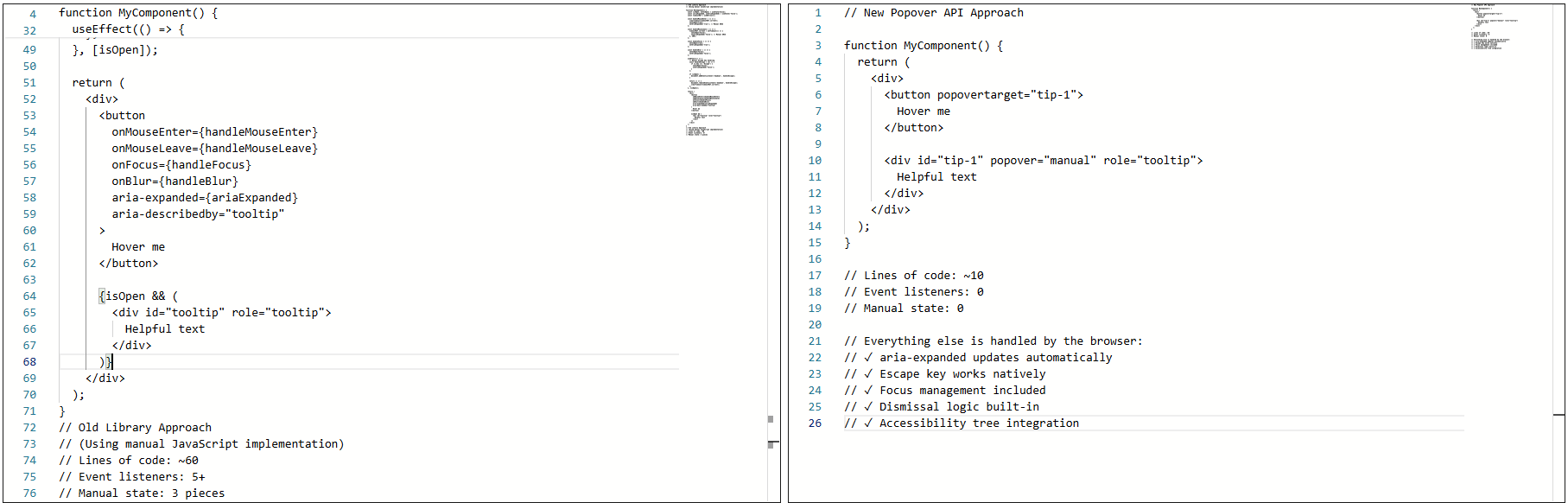
For anyone who has ever built a UI component from scratch, the tooltip is a deceptively hard problem. Calling out the traditional advice to reach for a library is right because that advice was, until recently, the only honest answer. But the browser itself has quietly closed a gap we had accepted as permanent. The Popover API turns tooltips from something we simulate into something the platform actually understands. That is not a minor convenience. It represents a shift in where responsibility for user experience lives: away from our fragile JavaScript and toward the browser's own rendering and accessibility logic.
Consider what the author discovered when they rebuilt a single tooltip without a library. Opening and closing, keyboard interaction, Escape handling, and much of the accessibility now come from the platform itself. That means the code you write shrinks, but more importantly, the surface area for bugs shrinks with it. When a user tabs into a trigger, the tooltip appears. When they press Escape, it dismisses. These behaviors are no longer promises you keep with event listeners and state variables; they are guarantees the browser provides. For teams shipping products, this is a direct reduction in maintenance debt. For users, it means fewer moments where a tooltip simply does not appear, or appears in the wrong place, or traps focus.
The practical takeaway here is straightforward: the next time you reach for a library to solve a UI problem, pause and ask whether the browser has already solved it. The Popover API is not the only example. Native form validation, dialog elements, and CSS container queries have all followed a similar trajectory. Each one removes a layer of custom code that, in hindsight, was only there because the platform was incomplete. The experience of building a tooltip without a library confirms that the trade-off between using a library and writing native code has shifted. The library is no longer the safer bet for something as fundamental as a tooltip.
What this means for your own work is a matter of habit more than technology. Start with the platform. Test what the browser offers before you install a dependency. This tooltip works, it is accessible, and it required no third-party code. That is not a headline, it is a practical standard to aim for.