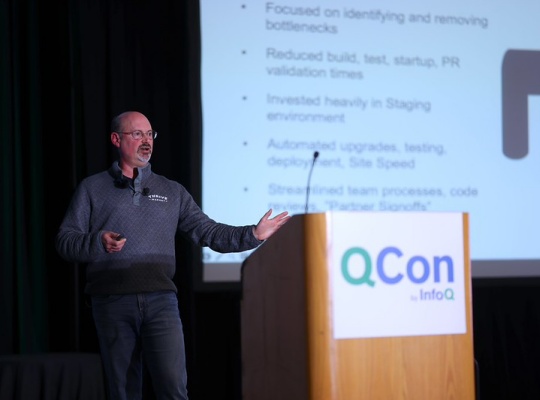
There is a lesson buried in eBay's Velocity Initiative that has nothing to do with service counts or DORA metrics, and Randy Shoup tells it with refreshing clarity: you can have the best engineering playbook in the world, but if your organization is built on fear and waterfall thinking, the code will not save you. Doubling productivity and modernizing how 4,500 services are delivered is an impressive technical feat, but Shoup's real point is that the hardest problems were never technical. They were cultural.
For anyone leading a data team or building tools for non-experts, this is the part worth sitting with. Shoup is not saying that strong engineering execution is irrelevant. He is saying it is insufficient. The teams that got faster did so because they were given permission to move differently, not because they discovered a better microservice pattern. The "pathological" culture of fear he describes is not an abstraction; it is the friction that makes every tool rollout slower, every adoption curve flatter, and every spreadsheet migration feel like a negotiation. If you are building an AI-native platform and expecting it to succeed on its own merits, this story is a warning: the sharpest technology will be dulled by an environment that punishes experimentation.
What this means for you is practical. When you introduce a tool that promises to simplify complex data work, the resistance you meet is rarely about the tool. It is about trust, about whether people feel safe trying something new, and about whether the planning cycle allows for the kind of iterative learning that real adoption requires. Shoup's experience suggests that you should spend as much time auditing your team's decision-making culture as you do reviewing your architecture. If risk aversion is rewarded, no amount of intuitive design will get your users to explore. If planning is rigid, your rollout will be dead on arrival regardless of how elegant the underlying technology is.
The takeaway is not that you should abandon technical rigor. It is that you should stop treating culture as a soft skill and start treating it as a constraint, like latency or cost. Shoup's story gives you a concrete lens for diagnosing why a transformation might stall even when the engineering looks strong. So before you celebrate the next metric improvement, ask yourself what your team's default response to failure is. That answer will tell you more about your future than any dashboard will.