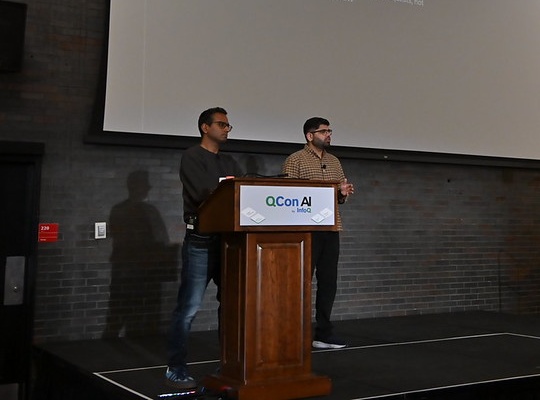
The leap from a working prototype to a production system is where most AI projects stall. Deepak Mohanakumar Chandramouli and Bhumik Vinodkumar Thakkar tackle this head-on, sharing how to move AI agents from a local FastAPI setup to a resilient Kubernetes environment using Ray. Their focus on RayCluster topology, stateful memory, and auto-scaling under dynamic traffic is exactly the kind of operational thinking that separates demo-day demos from tools that actually ship. This matters because the industry is flooded with agent frameworks that work beautifully in isolation but collapse under real-world load. If you are building agents today, you need a control plane that handles state without breaking, and guardrails that prevent runaway costs or hallucinated outputs. Their emphasis on LLM-as-a-judge evaluation pipelines is particularly sharp, it is one thing to build an agent that answers questions, and another to build one that knows when it is wrong.
This operational rigor connects directly to broader concerns about agent reliability. As we noted in our coverage of Why your next insider threat might come from an AI agent, Microsoft is urging enterprises to watch the agents employees use with systems not controlled by AI labs. The speakers' multi-region setup and guardrail design offer a practical answer to that warning: if you cannot trust the agent's environment, you cannot trust its output. Similarly, the work on stress-testing agents in simulation, as explored in See how AI stress-tests robots and self-driving cars before they roll out, reinforces the value of evaluation pipelines that catch failures before they reach users. Chandramouli and Thakkar are not just solving scaling; they are building the infrastructure for accountability.
The practical takeaway is clear: your agent's architecture must treat memory and traffic as first-class infrastructure concerns, not afterthoughts. Stateful memory handling is the difference between an agent that remembers your context across sessions and one that starts fresh every time, a distinction that kills user trust. Auto-scaling on dynamic traffic is what keeps response times stable when a viral post suddenly spikes demand. And a robust control plane with guardrails is what prevents a single misbehaving agent from burning through your API budget or serving garbage to customers. These are not abstract best practices; they are the concrete decisions that determine whether your prototype becomes a product or a cautionary tale.
One detail worth watching is how they handle the LLM-as-a-judge pipeline. Using one model to evaluate another is a powerful technique, but it introduces its own failure modes, what happens when the judge model is biased or hallucinates? The speakers do not shy away from this complexity, and that honesty is refreshing. The next frontier for agent operations will be building evaluation loops that are themselves resilient to the flaws of the models they monitor.