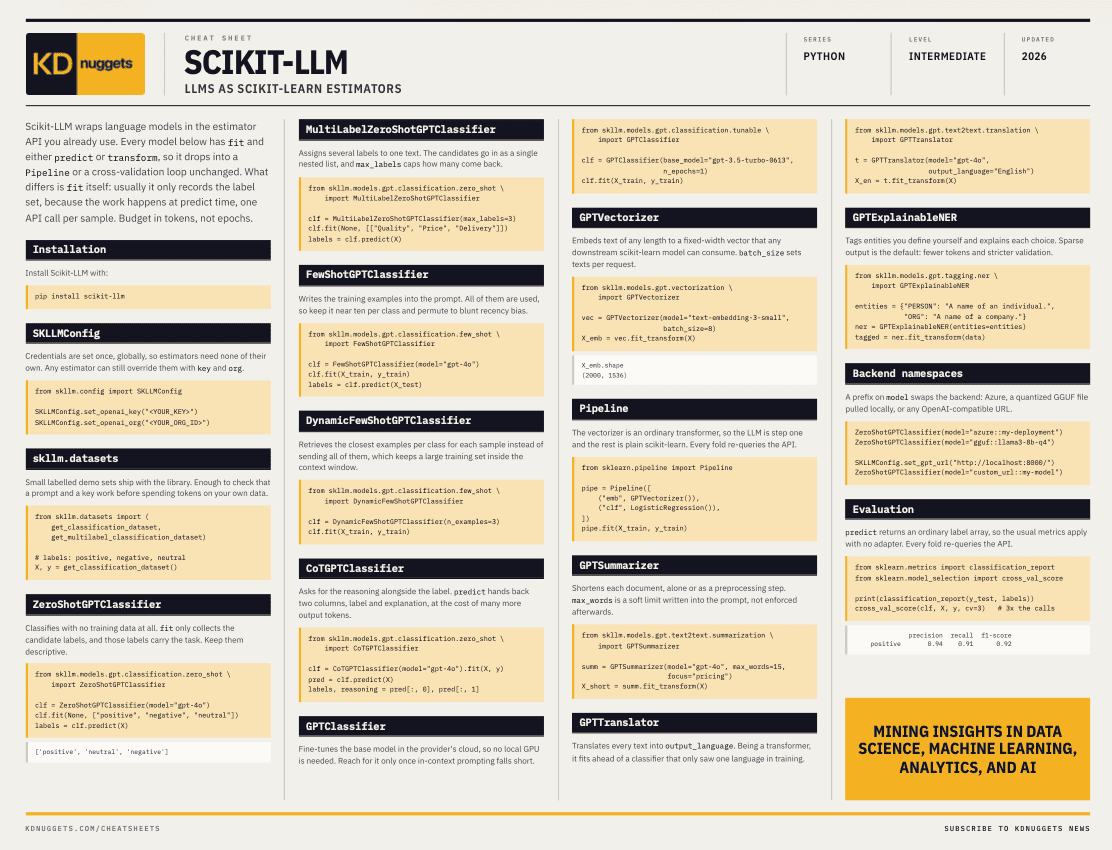
If you have spent any time with machine learning tooling, you know the quiet anxiety of fitting a round peg into a square hole. The scikit-learn API is the industry's default workbench, yet most natural language workflows still live outside it. You build a text-processing step, then you hand it off to a model, then you write a custom wrapper just to make everything play nice with a `GridSearchCV`. It is not broken, exactly, but it is certainly not elegant. That is why the arrival of Scikit-LLM feels less like a novelty and more like a relief. By wrapping language models inside the familiar estimator API, this library does something deceptively simple: it lets your LLM sit in a `Pipeline` or a cross-validation loop as if it were just another regressor. No awkward shims, no bespoke glue code. Just a native fit.
For our readers, the practical implication is immediate and tangible. If you have already invested in scikit-learn's ecosystem, you do not need to learn a new paradigm or abandon your existing workflows. You can explore how a large language model behaves inside a stacking ensemble, or discover what happens when you tune its hyperparameters across a validation grid. This is not about replacing your toolbox; it is about expanding what you can do without switching toolboxes. The barrier to entry drops because the mental model stays the same. You already know how to call `.fit()` and `.predict()`. The only difference is that now the underlying model happens to be a transformer with a billion parameters. That is a subtle shift, but it is the kind of shift that turns a curious experiment into a daily habit.
Here is where we want to push back on the hype that often surrounds AI integrations. The value here is not that Scikit-LLM makes language models more powerful. It is not a magic wand. The value is that it makes them more *testable*. When your LLM is a first-class citizen in a cross-validation loop, you can finally measure its behavior against a baseline. You can ask hard questions about variance, overfitting, and generalization. You can compare a fine-tuned model against a prompted one with the same statistical rigor you would apply to a random forest. That is a profound shift for practitioners who have been treating LLM outputs as mysterious oracles. Suddenly, the oracle is just another estimator, subject to the same evaluation discipline as everything else.
What we would tell a reader who asks about this library is straightforward: do not wait for a perfect use case. Take a small classification task you already have, swap in an LLM-based estimator, and run a quick grid search. See what happens when you change the prompt template inside the pipeline. Watch how cross-validation scores fluctuate. The specific numbers you get matter less than the muscle memory you build. And here is the concrete detail to watch: how the library handles token limits and batch size during `fit()` versus `predict()`. That is where the abstraction can hide inefficiencies. Pay attention to whether the API encourages lazy evaluation or eager computation, because that will determine whether your experiments stay interactive or start feeling sluggish. The potential is not in the wrapper itself. It is in what you can now measure. Go measure something.